What is the Strait of Hormuz? Oil route explained
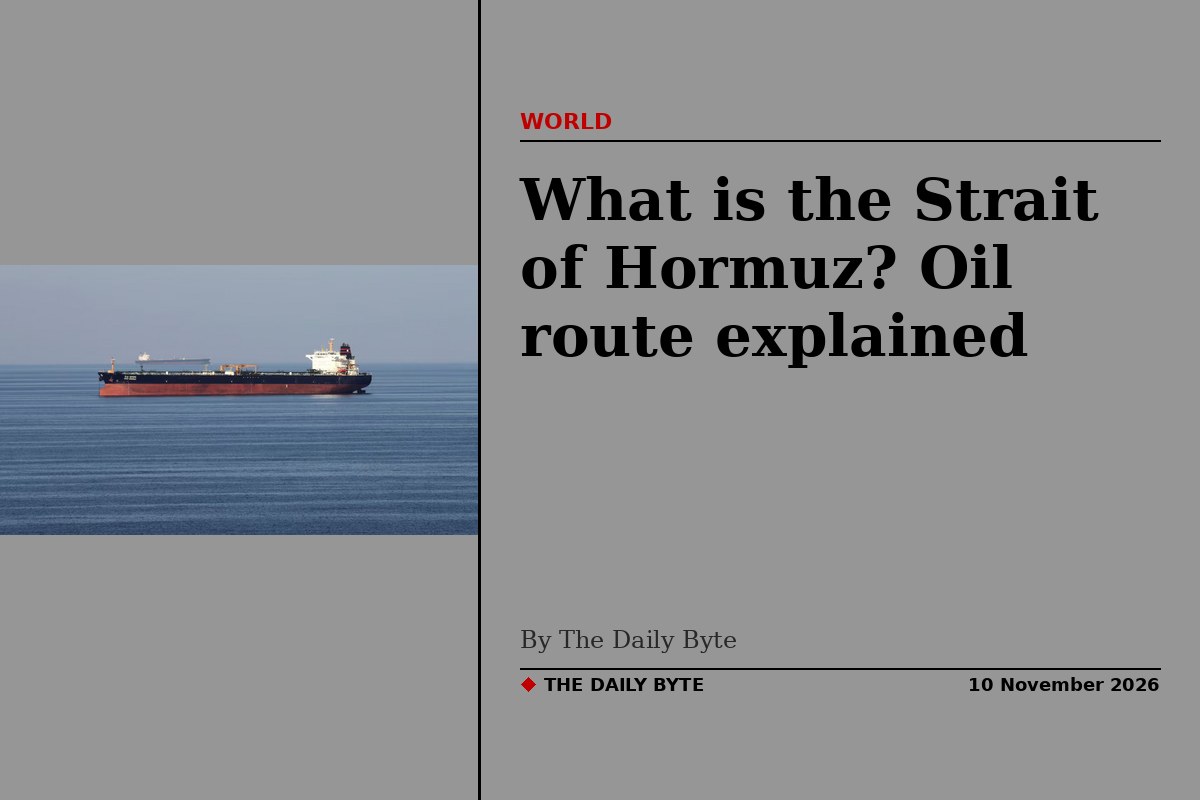
The Strait of Hormuz is a narrow stretch of water between Iran and the Arabian Peninsula, and it is the most important oil passage in the world. About a fifth of the world's oil used to pass through it every day before the war in the region in 2026, and about a fifth of the world's liquefied natural gas still depends on it. That is why every threat to the strait, every diplomatic breakthrough, and every fall in tanker traffic moves oil prices — and why it is in the news again on Tuesday 10 November 2026, as the United States and Iran talk about a possible deal and oil prices fall. In short, Hormuz is a bottleneck: a huge share of the world's energy has to squeeze through a channel only a few miles wide, with almost no alternative route.
This explainer sets out where the strait is, how much energy passes through it, who depends on it, what has happened to traffic in 2026, and what a closure — or a deal — would actually mean. The figures come from the US Energy Information Administration and the International Energy Agency, the two sources most widely used for this route. Where the 2026 figures are uncertain, that uncertainty is stated, because the tracking data behind them became unreliable after military action began in February.
What is the Strait of Hormuz, in simple terms?
The Strait of Hormuz connects the Persian Gulf to the Gulf of Oman, and from there to the Arabian Sea and the Indian Ocean. It separates Iran, on its northern shore, from Oman and the United Arab Emirates on its southern shore. It is the only sea exit from the Persian Gulf, which means oil and gas produced in Saudi Arabia, Iraq, Kuwait, Qatar, the UAE, Bahrain and Iran itself has to pass through it to reach buyers by sea.
The strait is about 104 miles long. At its narrowest point it is 29 nautical miles wide, about 54 kilometres, according to the International Energy Agency's factsheet of February 2026. That sounds wide, but the part ships can actually use is much narrower: the navigable channels are about two miles wide in each direction, separated by a two-mile buffer zone. The US Energy Information Administration notes that the strait is still deep and wide enough for the world's largest crude oil tankers, which is why so much trade can pass through such a small space.
That geography is the whole story. A small naval force, a minefield, or a decision to stop and search ships can threaten a very large flow of trade, because there is nowhere else for the ships to go. It is also why the strait has been a flashpoint in every serious crisis in the Gulf for decades, and why it returned to the centre of world news in 2026.
How much oil and gas normally passes through it?
Before the disruption of 2026, the figures were remarkably stable. The EIA put total oil flows through the strait at 20.9 million barrels a day in the first half of 2025 — about 20 per cent of global petroleum liquids consumption, and about a quarter of all the oil traded by sea. Of that total, about 15 million barrels a day was crude oil and condensate, and the rest was refined petroleum products such as petrol, diesel and jet fuel. The IEA reached a similar picture for the full year 2025, counting almost 20 million barrels a day.
Gas matters just as much. The EIA estimated that 11.4 billion cubic feet a day of liquefied natural gas, or LNG, moved through the strait in the first half of 2025 — more than 20 per cent of global LNG trade, mostly from Qatar. The IEA put the full-year share at 19 per cent, and said that 93 per cent of Qatar's LNG exports and 96 per cent of the UAE's LNG exports leave through the strait. Unlike oil, LNG has no pipeline alternative at all: if the strait closed, that gas would have nowhere to go.
To put 20 million barrels a day in perspective, it is roughly the equivalent of a fifth of everything the world burns in a day, and it is more than the entire daily oil consumption of the United States and China combined in some measures. It is also why the strait is routinely described by the EIA as the world's most important oil transit chokepoint. No other sea passage carries as much energy in as small a space.
Who depends on it most?
Seven Gulf states ship oil through Hormuz: Saudi Arabia, the UAE, Kuwait, Qatar, Iraq, Bahrain and Iran itself. Saudi Arabia is the largest user: its crude oil and condensate made up 38 per cent of Hormuz crude flows in 2024, according to EIA tanker-tracking data. Iraq, Kuwait and the UAE are also major users, and Qatar's dependence is almost total for its gas exports.
On the buying side, Asia dominates. The EIA estimated that 89 per cent of the crude oil and condensate that moved through the strait in the first half of 2025 went to Asian markets. China, India, Japan and South Korea together took 69 per cent of the crude and condensate, according to the IEA. That is why a disruption in Hormuz hits Asian economies first, and why China, India, Japan and South Korea watch the strait more closely than almost any other waterway.
Europe and the United States are less directly exposed, but they are not insulated. Oil is priced globally, so a shortage in Asia pushes up the price everywhere, including for petrol and diesel in Britain. LNG is the same: a disruption to Qatari gas would tighten the global gas market and push up prices in Europe, even though most of the cargoes are bound for Asia.
Why is there no easy alternative route?
Only two countries have working crude pipelines that avoid the strait: Saudi Arabia and the UAE. Saudi Arabia's East-West pipeline carries oil to the Red Sea port of Yanbu, and the UAE has a pipeline to Fujairah on the Gulf of Oman, outside the strait. The IEA estimates their combined spare capacity at 3.5 to 5.5 million barrels a day — a large number on its own, but far below the roughly 20 million barrels a day that normally passes through the strait.
Other Gulf producers have no bypass at all. Iraq, Kuwait, Qatar and Bahrain would have to keep their oil in the ground, or store it, if the strait closed for any length of time. Even Saudi Arabia and the UAE could not replace the full flow, and their pipelines were not built to carry the refined products and condensate that also use the strait.
For gas, there is no bypass. Qatar's LNG plants are on the Gulf coast, and their only sea route is through Hormuz. That is why analysts describe LNG as the most exposed part of the trade, and why a long disruption would fall hardest on Asian gas buyers and on Qatar and the UAE as exporters.
What has happened to traffic in 2026?
Traffic through the strait has fallen sharply in 2026, after military action began on 28 February. The EIA's Global Energy Security Data, released on 12 August 2026, put total oil flows at 14.9 million barrels a day in the first quarter of 2026 and 4.9 million barrels a day in the second quarter, down from 21.6 million in the last quarter of 2025. That is a fall of more than three quarters on the headline figure.
That headline figure needs a warning, and the EIA itself gives it. The agency says the ship-tracking data behind the 2026 figures have become "especially unreliable" since late February 2026, and that the figures are being revised frequently. Tanker traffic is estimated from Automatic Identification System signals — the position broadcasts ships transmit — and in a war zone ships switch those signals off, spoof them, or take routes that tracking firms cannot see. The 4.9 million figure is therefore a measure of what tracking systems could see, not a precise measure of how much oil actually moved.
The wider evidence supports that caution. World oil supply fell by only about 4 per cent in the same period, according to analysis of the EIA data, which would be impossible if 16 million barrels a day of oil had simply stopped moving. Some oil was rerouted, some was stored, and some moved without being tracked. What is certain is that traffic fell, freight and insurance costs rose sharply — one measure of the cost of carrying oil from the Gulf to China reached a record in early October — and the strait became a central pressure point in the war between the United States, Israel and Iran.
By November, the picture was changing again. Hopes of progress in US-Iran diplomacy have sent oil prices lower, with Brent crude reported below 92 dollars a barrel on Tuesday 10 November, and President Donald Trump has said Iran is militarily effectively over and that there is positive momentum around negotiations to end the conflict. None of that means the strait is back to normal, and none of it means a deal is done. It means the market is pricing in a lower risk of a wider war than it was a few weeks ago.
Could the strait be closed, and what would that mean?
A closure has been threatened many times, and it has never happened for more than a brief period. Iran has the capability to harass shipping — with mines, fast attack boats, missiles and drones — and its parliament has at times voted to close the strait, but a full closure would also stop Iran's own oil exports, which depend on the same waterway. It would also invite a military response from the United States and its allies, who have kept warships in the region precisely to keep the strait open.
What is more likely, and what has happened in 2026, is disruption rather than closure: fewer ships, higher insurance, longer delays, and a risk premium on every barrel. That alone is enough to move oil prices, because traders price in the risk of a worse outcome, not just the outcome that has already happened. A full closure, if it ever happened, would be a different order of event: it would trap oil at the wellhead, cut Asian supplies, push Brent sharply higher, and force governments to release emergency oil stocks.
It is also worth being clear about what a closure would not do. It would not stop oil production in the Gulf, and it would not stop the world from using oil. It would stop that oil from reaching buyers by sea, which is why the effect would be felt first in prices, then in physical shortages in the countries most dependent on Gulf crude. That is the difference between a price shock and a supply shock, and Hormuz can deliver both.
Why does it move oil prices and petrol costs?
Oil is priced globally, so a risk in one place is priced everywhere. When traders worry that Hormuz might close, they bid up the price of Brent crude, the benchmark used to price most of the world's oil. That feeds through, with a lag, to wholesale petrol and diesel prices, and then to the price at the pump. It also feeds through to gas prices, because LNG cargoes are priced against oil in many contracts.
Freight and insurance are the other channel. When the risk of attack rises, insurers charge more to cover a tanker through the strait, and shipowners charge more to send a ship there. Those costs are added to the price of the cargo, and they rise even if no ship is actually attacked. In October 2026, the daily rate for carrying oil from the Gulf to China reached a record, according to data cited by Bloomberg — a sign of how expensive the risk had become, even before any closure.
That is why the strait matters to people who never think about shipping. A rise in Brent feeds into transport costs, food prices, and inflation, and it limits what central banks can do about interest rates. A fall in Brent, as on Tuesday, does the opposite: it eases inflation pressure and gives governments a little more room. The strait is a long way from a British petrol station, but the price at that station is set, in part, in those few miles of water.
What to watch next
The first thing to watch is the diplomacy. The United States and Iran are reported to be negotiating, and Iran's security chief has set out seven conditions for a deal, while the US has said the war is effectively over. If talks progress, tanker traffic should recover and the risk premium should fall further. If they break down, traffic could fall again and prices could rise just as quickly.
The second is the tanker data. The EIA's next update to its Global Energy Security Data will show whether the second-quarter fall was a tracking problem, a real fall, or something in between. Watch for the agency's own caveats about the reliability of the data, not just the headline number. A revised figure that is higher than 4.9 million would not mean the strait is safe; it would mean the tracking was worse than the first estimate suggested.
The third is Brent itself. A sustained fall below 90 dollars would suggest the market believes the risk has passed. A sharp rise would suggest the opposite. Neither, on its own, tells you what will happen next — but together, the diplomacy, the tanker data and the price give a clearer picture than any one of them alone.
Frequently asked questions
Where is the Strait of Hormuz? Between Iran to the north and Oman and the United Arab Emirates to the south. It connects the Persian Gulf to the Gulf of Oman and the Arabian Sea, and it is the only sea exit from the Gulf.
How much oil passes through it? About 20.9 million barrels a day in the first half of 2025, according to the EIA — about a fifth of world oil use and about a quarter of seaborne oil trade. Traffic fell sharply in 2026, but the exact 2026 figure is uncertain because ship-tracking data became unreliable after February.
Has the strait been closed? No. It has been threatened and disrupted, and traffic has fallen, but there has been no full closure. Ships are still passing through, at lower volumes and higher cost than before the war.
Why can't oil go another way? Only Saudi Arabia and the UAE have pipelines that bypass the strait, with spare capacity of 3.5 to 5.5 million barrels a day — far below the normal flow. LNG has no bypass at all.
Does it affect UK petrol prices? Yes, indirectly. Oil is priced globally, so a risk premium on Brent feeds through to wholesale fuel prices and then to the pump, even though most of the oil through Hormuz goes to Asia.


