What Is Supported Housing? Birmingham Probe Explained
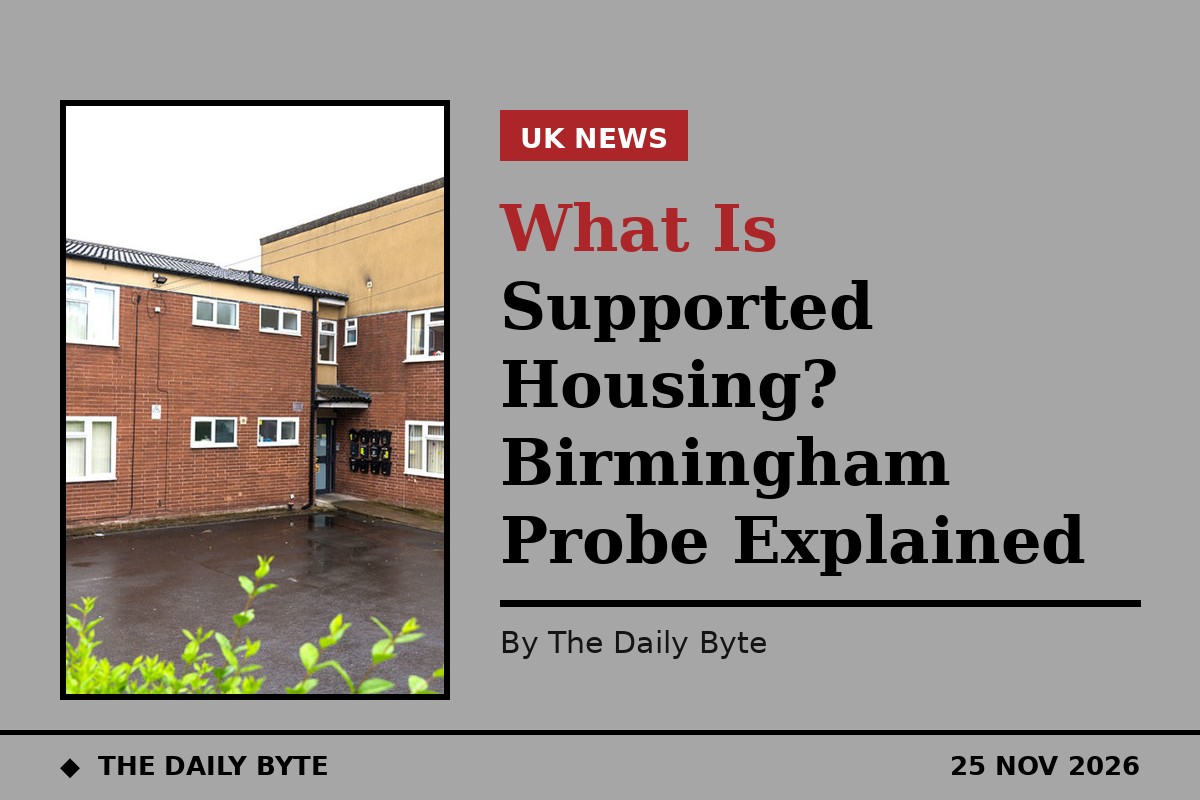
Supported housing is accommodation where residents need, and are provided with, care, support or supervision to help them live as independently as possible in the community. It is housing with help built in: a home, plus support from staff who are there to help residents manage their lives. It is for some of the most vulnerable people in society, including older people, people with mental health problems or learning disabilities, people recovering from drug or alcohol problems, women fleeing domestic abuse, people who have been homeless, young people leaving care, and refugees. On 24 November 2026 the government launched an urgent investigation into supported housing in Birmingham, where it says rogue landlords are exploiting the system at the expense of vulnerable people and the taxpayer.
What is supported housing?
The government's own definition is straightforward: supported housing is accommodation where residents require and are provided with care, support and supervision to help them live as independently as possible within the community. It is different from ordinary rented housing because the support is part of the package, not an optional extra. That support might mean help with cooking, cleaning and managing money, help with medication, or someone to call on in a crisis. The housing itself might be adapted — a ground-floor flat, a home with a warden, or a building designed for people with particular needs.
There are three broad types. Some supported housing is long-term, for people with enduring needs such as a long-term physical or mental health condition, a learning disability or autism. Some is short-term or transitional, for people who need support for a period before moving on — for example, someone leaving hospital, leaving care, or escaping domestic abuse. And sheltered housing for older people is a well-known form, where residents have their own homes with a warden or alarm system and communal facilities nearby. The government's policy statement on social housing rents lists the groups supported housing can cover: sheltered accommodation, extra care housing, domestic violence refuges, hostels for the homeless, support for people with drug or alcohol problems, mental health problems, learning disabilities or other disabilities, support for offenders and people at risk of offending, young people leaving care, teenage parents, and refugees.
What is supported exempt accommodation?
Supported exempt accommodation — usually shortened to SEA — is a particular category of supported housing, and it is the category at the centre of the Birmingham investigation. Under Housing Benefit rules, supported housing is called "specified accommodation", and there are four categories: exempt accommodation, managed properties, refuges, and local authority hostels. Exempt accommodation is supported housing where the landlord is a not-for-profit organisation and provides care, support or supervision to the resident.
The word "exempt" matters because it is about money. Since 1996, supported housing has had special rules in Housing Benefit. Providers of exempt accommodation can claim Housing Benefit at a higher rate than the normal local housing allowance, because providing care and support costs more than an ordinary letting. Housing Benefit recognises those higher costs, and claims for people in specified accommodation are also excluded from the benefit cap calculation. The idea is to protect specialist supported housing provided by not-for-profit organisations from rent restrictions. But the higher payments also create a temptation: if a provider can claim much more in Housing Benefit than an ordinary landlord, and nobody checks whether the support is actually being delivered, there is money to be made by cutting corners.
Who provides supported housing, and how is it paid for?
Supported housing is usually provided by housing associations, registered charities, voluntary organisations or local authorities — not-for-profit organisations. People usually come into supported housing through a referral, often from a council, a hospital, social services or a charity. The resident's rent and support costs are generally covered by Housing Benefit, which is administered by the local authority on behalf of the Department for Work and Pensions. To qualify, the resident must need, and receive, more than minimal care, support or supervision. That need is supposed to be assessed by someone suitably qualified before the person moves in.
The system depends on checks. The council that pays the Housing Benefit is expected to review claims and make sure the support is real, the accommodation is fit to live in, and the money is being spent as intended. When those checks fail, or when providers are not properly overseen, the system can be abused — and that is what the government says has happened in Birmingham.
What has gone wrong in Birmingham?
Birmingham has become the focus because of the sheer size of its sector. More than 34,000 Birmingham residents currently live in supported exempt accommodation, compared with about 22,000 in London, despite the capital having a far larger population. Supported housing expenditure has risen faster in Birmingham than the national average in recent years. Birmingham City Council paid out £404.4 million for supported exempt accommodation in the 2024 to 2025 financial year, with a further £211.8 million paid between April and July 2026.
The problems reported are stark. The government says there have been reports of inappropriate provision, such as homes with no heating or hot water, or without the necessary adaptations for the people living in them, as well as exploitative practices that prevent vulnerable people from getting the support they need and are entitled to. Reports have also found cases where so-called "ghost tenants" were used to falsely claim Housing Benefit, and providers not putting in place the support they had promised. A recent internal audit by the council found it could not show that a review had been completed for 72% of the claims tested. At the time the results were published, 12,700 live cases were waiting for review, of which around 7,100 had exceeded the six-month limit. The council said a plan was in place to reduce the backlog to zero by the end of the year. The announcement follows a BBC Panorama investigation last month, years of reporting by local media, and a letter to the prime minister from Conservative councillors Robert Alden and Ken Wood demanding urgent intervention.
What is the Birmingham investigation?
On 24 November 2026, the government announced an eight-week independent investigation into supported exempt accommodation in Birmingham. It will be led by Sir David Pearson, a social care expert who chairs the government's Supported Housing Advisory Panel, and it will report to ministers in January 2027. Sir David will report directly to the Housing Secretary, Angela Rayner, and the Work and Pensions Secretary, Pat McFadden, with findings shared with the First Secretary of State in parallel.
The investigation will examine the scale of the problems in Birmingham's supported exempt accommodation sector, including the quality of the accommodation and the support provided, the use of public money, and the effectiveness of oversight and regulation. It will also consider whether the issues it finds apply more widely across the country. In her letter appointing Sir David, the Housing Secretary said good-quality supported housing can turn lives around, but that there are increasing reports of the system being abused, with vulnerable people exploited at the expense of the taxpayer. She said the investigation should focus on Birmingham, given consistent reports that the area is at the epicentre of concerns about poor-quality supported accommodation.
Announcing the investigation, Angela Rayner said anyone who has seen the accusations about rogue landlords operating housing for vulnerable people will be appalled, and that the government is determined that individuals should be held to account. Pat McFadden said Housing Benefit is there to keep a roof over the heads of people who need it most, and that the investigation will identify where accountability and oversight have failed and recommend action to tackle poor practice, protect residents and ensure public money is spent appropriately. The government expects Birmingham City Council to cooperate fully, and will update the Best Value Commissioners on the development.
What happens next?
The investigation is only one part of a wider reform. It will complement the Supported Housing (Regulatory Oversight) Act 2023, which introduces a licensing regime for supported housing, backed by national standards and local strategies. The government is currently consulting on draft regulations for that licensing regime. The consultation opened on 15 October 2026 and closes in December 2026, with implementation expected in 2027. Once the licensing regime is in force, councils will have powers to remove unscrupulous providers.
Sir David's investigation will begin immediately, with initial findings and recommendations reported to ministers in the new year. The terms of reference ask him to identify vulnerabilities in the current system, including abuse of loopholes in the regulatory framework, and to map the barriers to enforcement, such as gaps in evidence, information sharing and agency responsibilities. Any suspected fraud or abuse found during the work is to be referred immediately to the relevant body.
How is supported housing different from a care home?
Supported housing is not the same as a care home or a hospital. In a care home, residents receive personal care around the clock and the home is registered and inspected as a care service. In supported housing, residents generally have their own tenancy and their own front door, and the support is there to help them live independently rather than to look after them full-time. The support can be as light as a weekly visit and a call system, or as intensive as staff on site through the day. Sheltered housing for older people is the most familiar form: residents live independently in their own flats, with a warden or alarm system for emergencies and communal facilities such as a lounge or laundry.
It is also different from ordinary social housing. In ordinary social housing, the landlord provides the home and the tenant lives independently without support attached. In supported housing, the support is part of the tenancy. That is why the rent is higher and why Housing Benefit pays more: the payment covers not just the bricks and mortar but the staff time, the supervision and the services that make it possible for the resident to live there.
Frequently asked questions
Who can live in supported housing? People who need care, support or supervision to live independently, including older people, people with mental health problems or learning disabilities, people recovering from addiction, women fleeing domestic abuse, people who have been homeless, young people leaving care, and refugees. A need for more than minimal support must be assessed before moving in.
Who pays for supported housing? Housing costs are usually covered by Housing Benefit, administered by the local council for the Department for Work and Pensions. Providers of exempt accommodation can claim at a higher rate because of the cost of providing support.
What is a ghost tenant? A "ghost tenant" is a person claimed as living in a property for Housing Benefit purposes when they do not actually live there. The government says cases of ghost tenants being used to falsely claim Housing Benefit have been found in Birmingham.
When will the Birmingham investigation report? The eight-week investigation began immediately after its announcement on 24 November 2026, and Sir David Pearson is expected to report initial findings and recommendations to ministers in January 2027.
What is the Supported Housing (Regulatory Oversight) Act 2023? It is the law that introduces a licensing regime for supported housing, with national standards and local strategies. The government is consulting on draft licensing regulations, with the consultation closing in December 2026 and implementation expected in 2027.