What Is Tear Gas and Is It Dangerous?
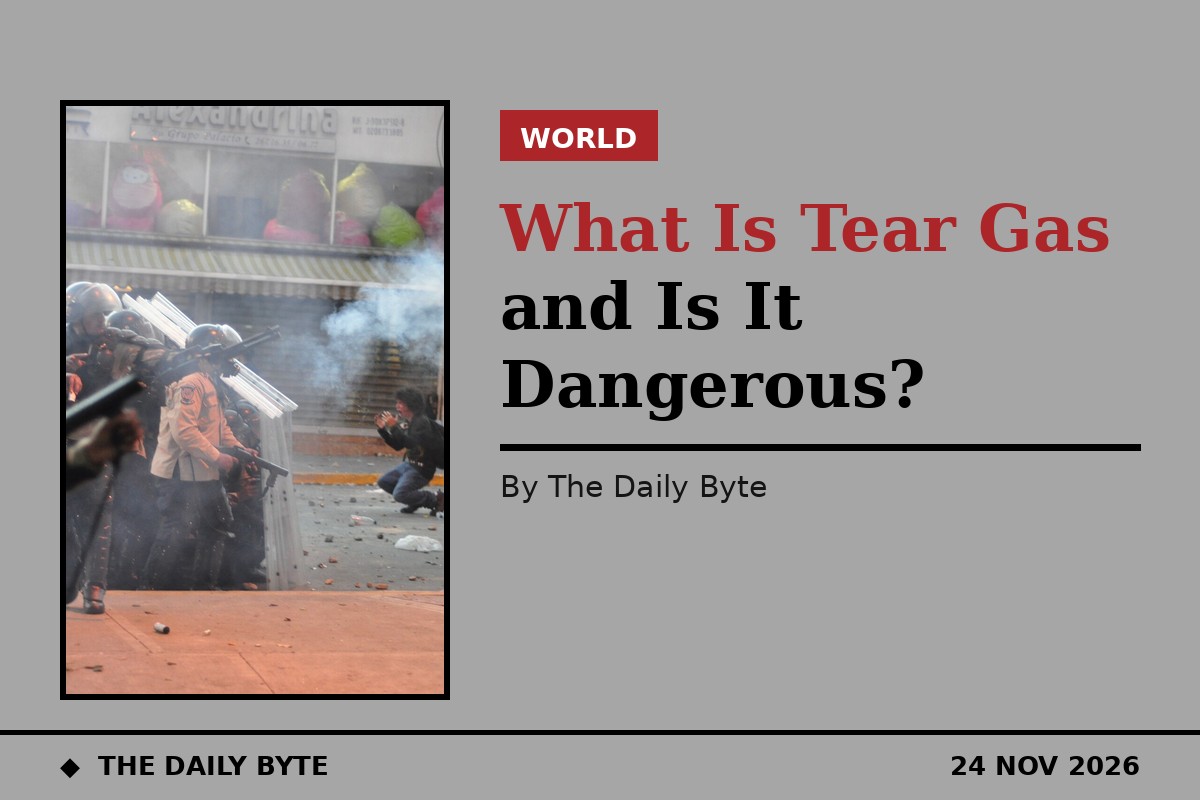
Tear gas is a chemical weapon used by police and security forces to disperse crowds, and the short answer to whether it is dangerous is yes, it can be, even though most people recover quickly. The name is misleading in two ways: it is not really a gas, and its effects go well beyond making people cry. The question is being asked again this week because, on 17 November 2026, an investigation carried out by Ukraine with the help of the Organisation for the Prohibition of Chemical Weapons, the global chemical weapons watchdog, concluded that Russian forces had used a drone to drop a canister of CS tear gas on Ukrainian troops, the first time the use of the agent in Ukraine has been linked to the Russian military. The report was circulated to the watchdog's 193 member states ahead of its annual meeting in The Hague, which runs from 23 to 27 November 2026. Here is what tear gas actually is, how it works, and when it turns from a temporary irritant into something that can kill.
What is tear gas?
Tear gas is a general term for a group of chemical agents, also called lachrymatory agents or riot-control agents, that irritate the eyes, skin and airways. Despite the name, tear gas is not actually a gas. It is usually a solid powder that is heated and mixed with a solvent, then released as an aerosol, a fine cloud of solid or liquid particles suspended in the air. The two most common compounds are CS gas, whose active chemical is 2-chlorobenzalmalononitrile, and CN gas, or chloroacetophenone. Other agents in the same family include CR gas and pepper spray, which is made from oleoresin capsicum, the oil from chilli peppers, and its synthetic form, PAVA. CS gas is the most widely used of all of them, while CN has the most recorded toxicity. The term mace is sometimes used loosely for these agents, after an early commercial self-defence spray, but mace is a brand name rather than a chemical.
Tear gas is usually delivered in one of three ways. The most familiar is the grenade or canister, which is fired or thrown and produces a cloud of chemicals, usually within 60 seconds. Sprays fire a stream of the agent over a distance of about 2.4 to 3.6 metres in bursts of one or two seconds, putting a higher dose directly onto the people targeted. The agents can also be dissolved in water and fired from water cannon, or packed as a powder inside a thin-coated projectile similar to a paintball. Whichever way it is delivered, the cloud is indiscriminate: it spreads beyond the people it was aimed at, and bystanders, including children, older people and people with health conditions, can be caught in it.
How does tear gas work on the body?
Tear gas works by irritating the mucous membranes in the eyes, nose, mouth and lungs. Its chemicals activate pain receptors, known as TRPV1 receptors, which sense burning and severe pain, and that is what forces people to flee an area or leaves them unable to move. The effects come on fast. With CS gas, symptoms of irritation typically appear within 20 to 60 seconds of exposure. The eyes stream with tears, the eyelids spasm shut, and vision can blur or be lost temporarily. The nose runs, the mouth and throat burn, and people cough, choke, drool and struggle to swallow. Breathing becomes difficult as the airways become inflamed and the smooth muscle around them contracts, narrowing the passages that carry air. The skin burns, turns red and itches, and in some people the exposure triggers an allergic reaction. Nausea and vomiting are common, and the pain, panic and disorientation that follow can leave people unable to find their way out of the cloud, which is part of what makes the agent effective as a crowd-control weapon.
For most healthy adults who can get into fresh air quickly, the worst effects pass. Symptoms commonly settle within 30 minutes of leaving the area, and most people feel the effects for about 15 to 30 minutes if they can remove the chemical from their skin and take off clothing that has been contaminated. But that quick recovery depends on being able to escape, and on the dose being low. People who are exposed for a long time, who are exposed to high concentrations, or who are trapped in an enclosed space face a very different outcome, and the long-term effects are not well studied. The published medical literature on tear gas is of lower quality and does not firmly establish cause and effect for many of the lasting harms that have been reported.
Is tear gas dangerous?
Yes, and the danger is greater than the label less-lethal suggests. Physicians for Human Rights, which carried out a systematic review of the medical literature together with the International Network of Civil Liberties Organizations, found troubling levels of illness and even instances of death caused by these weapons. The eyes are among the most vulnerable parts of the body: irritation of the conjunctiva and cornea can lead to corneal burns, abrasions and cuts, and in the worst cases to permanent blindness. The respiratory system is the other main site of serious harm. Exposure can bring on attacks of respiratory distress, a lack of oxygen in the blood, respiratory arrest and death, and people with pre-existing breathing conditions such as asthma are particularly at risk. They are likely to need medical attention and may sometimes need hospital treatment or even support from a ventilator. The skin can suffer chemical burns, blistering and allergic dermatitis that lasts for days. The heart and blood vessels are affected too: tear gas raises the heart rate and blood pressure, and in people with existing heart conditions the combination of a racing heart, higher blood pressure and a lack of oxygen can lead to a heart attack.
The physical injuries are not only chemical. The canisters and grenades themselves are dangerous projectiles. Manufacturer warnings on tear gas cartridges state that they should not be fired directly at people because severe injury or death may result, yet direct hits have caused severe bruising, loss of eyesight and skull fractures. Physicians for Human Rights notes that direct impact by canisters and grenades carrying tear gas can cause significant blunt trauma and death. A case of serious vascular injury from tear gas shells in Iran was associated with nerve injury in 44 per cent of cases and amputation in 17 per cent. In the 2019-20 protests in Chile, people suffered complete and permanent loss of vision in one or both eyes after being hit by tear gas grenades. A study of protesters exposed to tear gas during the 2020 protests in Portland, Oregon, found that 2,116 of them, or 93.8 per cent, reported physical or psychological health problems immediately after exposure or in the days that followed, and more than half received or planned to seek medical care for their injuries.
There are other, less visible harms. The disorientation and agitation caused by the physical symptoms often lead to fear, anxiety and panic, and symptoms of post-traumatic stress disorder have been documented in people exposed repeatedly or for long periods during protests. There are case reports suggesting harm to pregnancy and the foetus, and animal studies indicate that miscarriages and foetal abnormalities can occur after exposure, although there is not enough population data to prove a causal link in humans. The quality of the agent matters as well. The Venezuelan chemist Monica Krauter studied thousands of tear gas canisters fired by Venezuelan authorities from 2014 onwards and concluded that most of them used CS gas as the main component and that 72 per cent of the tear gas used was expired. She warned that expired tear gas breaks down into cyanide oxide, phosgenes and nitrogen compounds that are extremely dangerous. The canisters themselves are also a hazard: because the gas needs heat to turn into an aerosol, the cans are extremely hot to touch and can cause burns, and they can detonate while someone is holding them.
Who is most at risk?
The people most at risk are those who cannot escape the cloud, those who breathe in a large dose, and those whose health is already fragile. People with asthma or other long-term breathing conditions can suffer severe attacks at even low concentrations. People with heart disease face the combined strain of a faster heartbeat, higher blood pressure and reduced oxygen. Children, older people and pregnant women are more vulnerable, and anyone trapped in a confined space, such as a room, a tunnel or a street with no way out, faces a far higher dose than someone in the open air. The risk also rises when several canisters are fired into the same spot, when firing is repeated, or when different chemical agents are mixed together, all practices that Physicians for Human Rights says should be avoided. Bystanders are at risk precisely because the weapon is indiscriminate: the cloud does not distinguish between a protester, a journalist, a passer-by or a child, and the guidance is clear that the deployment of such weapons must minimise the risk to people who are not involved.
Is tear gas legal?
The law draws a sharp line between war and policing. The use of tear gas in warfare was prohibited by the Geneva Protocol of 1925, and the Chemical Weapons Convention of 1993, which bans the military use of riot-control agents, allows them to be used by police for law enforcement. That is the distinction at the centre of the November 2026 investigation in Ukraine: while police use of tear gas is allowed under the convention, it is forbidden for armed forces to use it in war. Russia has signed the Chemical Weapons Convention, which bans the military use of tear gas. The investigation, reported by the Associated Press on 17 November 2026, focused on a single incident in September 2024, when Russian forces attacked a Ukrainian military post in central Ukraine. Investigators found a video posted to a pro-Russian Telegram channel that they say shows a grenade filled with tear gas being dropped from a drone onto Ukrainian troops. The Organisation for the Prohibition of Chemical Weapons had already confirmed in 2024 that CS gas had been found at several locations in Ukraine, but the new investigation is the first to connect that use to the Russian military. Ukraine says there have been about 14,000 similar incidents during the war, with troops needing medical attention in 3,000 of them. Russian authorities did not immediately comment on the findings, but they have denied using chemical weapons in the past and have alleged that Ukraine has used the banned substances.
Even where tear gas is legal, international guidance sets strict limits. United Nations guidance states that tear gas should be used only as a last resort, after a warning and an opportunity to disperse, and should not be used in confined spaces. International human rights principles require that any use of force is minimised, targeted and proportionate, that less-lethal weapons are carefully controlled, and that medical aid is given to anyone injured at the earliest possible moment. Physicians for Human Rights and the International Network of Civil Liberties Organizations go further: because chemical irritants are indiscriminate by nature, they argue that the legality of their use is questionable, and they call for bans on firing canisters directly at crowds or individuals, firing into closed spaces or places with no safe way out, and mixing agents together.
What should you do if you are exposed to tear gas?
The first step is to get out of the cloud and into fresh air as quickly as possible, moving upwind if you can and avoiding rubbing your eyes, which spreads the chemical further. Next, remove any clothing that has been exposed to the chemicals, cutting it off rather than pulling it up over your face and head, and put the contaminated clothing in a plastic bag to be discarded. Shower to wash the chemical from your skin, take out contact lenses and throw them away, and take off glasses and clean them thoroughly. The effects usually fade within 15 to 30 minutes once you are in clean air and the chemical is off your skin, but anyone with severe reactions, breathing difficulty, chest pain, a serious eye injury or burns should seek medical treatment, as doctors can treat burns and give medicine for asthma symptoms. In 2026, the World Health Organization published interim clinical guidance to help health-care workers assess and manage exposure to riot-control agents, a sign that the medical consequences of these weapons are now being treated as a clinical problem rather than a passing discomfort. The canisters themselves should never be picked up: they are extremely hot and can explode. The safest advice remains the simplest. Tear gas is designed to make an area impossible to stay in, and the best protection is not to be in it at all.


