What Is the Aqaba-Amman Water Project?
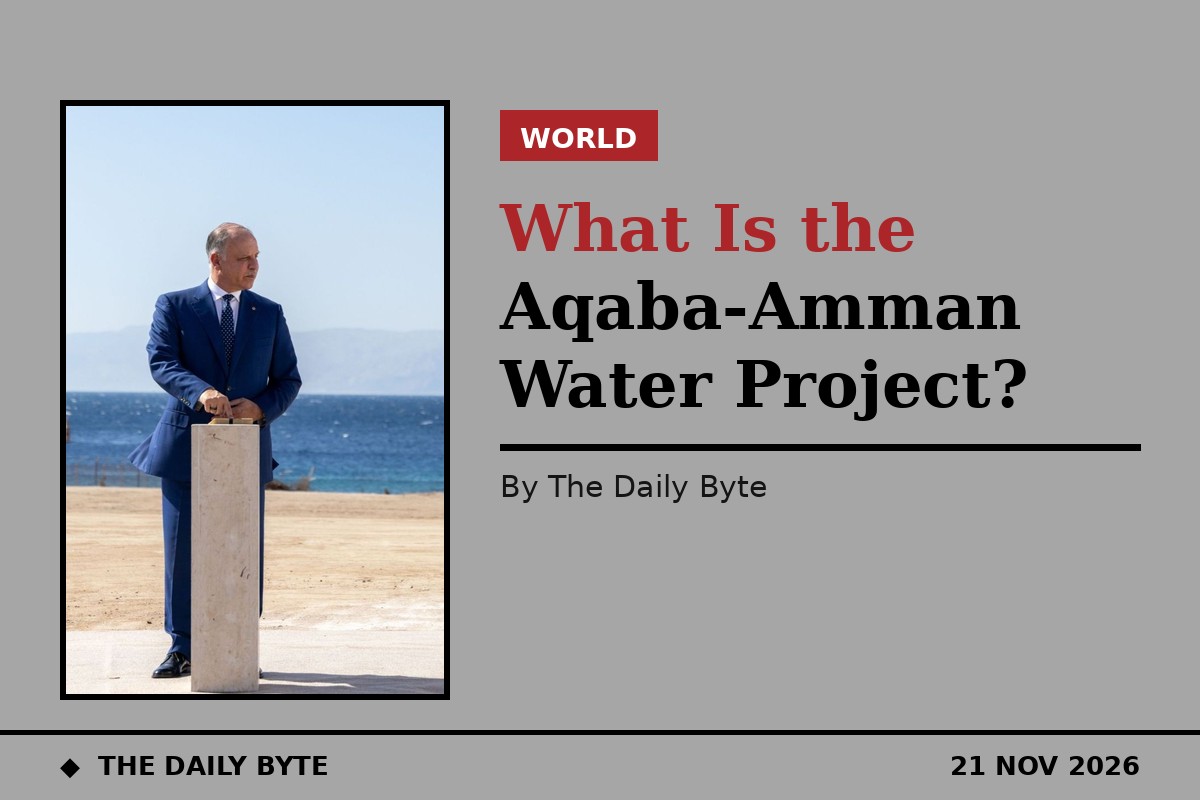
The Aqaba-Amman Water Project is Jordan's National Water Carrier, a scheme to desalinate seawater from the Gulf of Aqaba and pipe it about 417 kilometres north to Amman. It will supply 300 million cubic metres of desalinated drinking water a year, meeting about 40 percent of Jordan's drinking water needs and delivering water to more than five million people. It was officially launched in Aqaba on 18 November 2026 and is one of the largest desalination and water conveyance projects in the world.
The launch was presided over by Prince Faisal bin Al Hussein, deputising for King Abdullah II, with Prime Minister Jafar Hassan in attendance. The project is valued at 4.68 billion Jordanian dinars, about 6.6 billion US dollars, and the Green Climate Fund puts total financing at 6.664 billion dollars. It is the largest strategic investment in Jordan's history in terms of construction scale and capital cost.
Jordan is among the most water-scarce countries in the world. The Green Climate Fund says the country has only 61 cubic metres of available water per person per year, far below the absolute scarcity threshold of 500 cubic metres, and describes Jordan as the second most water-scarce country in the world. Climate change and population growth are placing further pressure on already limited supplies. The project is designed to change that by adding a large, reliable source of drinking water that does not depend on rainfall or on aquifers that are being depleted.
How will the project work?
The project has three main components: a desalination plant, a conveyance pipeline with pumping stations, and solar power generation. Seawater will be drawn from the Gulf of Aqaba, Jordan's only coastline, and treated at a desalination plant in Aqaba's industrial zone. The plant will produce about 300 million cubic metres of fresh drinking water a year, or roughly 851,000 cubic metres a day, and will withdraw about 600 million cubic metres of seawater annually, with about half returned to the Gulf of Aqaba under internationally recognised environmental requirements and standards.
The fresh water will then travel through a pipeline stretching approximately 417 kilometres from Aqaba to Amman, with pumping systems lifting it to elevations of up to 1,100 metres above sea level. That climb is one of the project's defining engineering challenges: Amman sits on a plateau far above the coast, so the water must be pumped uphill over most of its journey, which is why energy is such a large part of the design.
To help power that pumping, the project includes about 300 megawatts of solar power capacity, which is expected to meet about 30 percent of its electricity needs. The Green Climate Fund says the completed project will provide 100 litres of water per person per day to those it serves, and will create more than 35,000 jobs directly and indirectly during construction and operation.
Who is building it and who is paying?
The project is being developed by the National Carrier Project Company, known as NCPC, which is owned by Meridiam, Suez International and the Jordanian Social Security Investment Fund. A consortium comprising Meridiam as lead developer and sponsor and SUEZ as technical and operating partner is developing the project under a build-operate-transfer model, and full ownership will pass to the Jordanian government 26 years after operations begin. Other partners named in project reporting include VINCI Construction Grands Projets and Orascom Construction.
The Green Climate Fund is providing 295 million dollars in concessional loans and grants, its largest commitment for a single country. Its finance is channelled through the International Finance Corporation, the fund's accredited entity for the project, and played a central role in mobilising private capital alongside more than 20 development finance institutions, commercial banks and impact funds. The fund says its concessional terms will help keep water affordable for Jordanian households, in a sector where private investment has historically been limited.
On 19 November 2026, the day after the launch, Jordan signed a 6.6 billion dollar agreement with lead developer Meridiam to launch executive works on the project, during the Jordan-EU Investment Conference at the Dead Sea. Former planning minister Wissam Rabadi described the project as among Jordan's largest strategic undertakings, backed by the government and the Social Security Investment Fund, and said the cornerstone-laying ceremony marked a long-awaited milestone given its direct impact on citizens.
When will the water arrive?
Water delivery is expected to begin by the end of 2030. Construction is planned as a single phase over about four years, with the desalination plant, pipeline and pumping stations built together. The project aims to nearly double per capita water availability by 2030, and to increase the frequency of water supply to households across all of Jordan's governorates.
That timetable matters because Jordan's water shortages are not a distant problem. Many households already receive piped water only on certain days of the week, and the country hosts a large refugee population alongside its own growing demand. The project is intended to ease pressure on existing resources, diversify supplies and improve delivery efficiency, rather than simply adding volume to the existing network.
Why does Jordan need desalinated water?
Jordan has almost no surface water of its own and relies heavily on groundwater, which is being pumped faster than it is replenished, and on shared rivers whose flows are contested and shrinking. Rainfall is low and variable, and climate change is expected to make dry years drier. Desalination offers a supply that is independent of rain, but it has always been expensive, largely because of the energy needed to remove salt from seawater and to pump the water uphill to Amman.
Two features of this project are designed to answer that cost problem. The first is scale: at 300 million cubic metres a year, it is one of the largest desalination plants in the world, and large plants produce water more cheaply per cubic metre than small ones. The second is the solar capacity, which is expected to cover about 30 percent of the project's electricity needs and shield part of its operating cost from energy prices.
Affordability remains the central question. The Green Climate Fund's executive director, Mafalda Duarte, said its concessional finance would help maintain affordability for five million Jordanians on terms that other financiers are not in a position to take. Whether the water stays affordable for the poorest households once the plant is running will be one of the main tests of the project, alongside whether it is delivered on time.
What are the risks and criticisms?
The environmental questions centre on the brine: the concentrated salt water left over after desalination. The project will return about half of the seawater it withdraws to the Gulf of Aqaba, and the discharge must be managed so that it does not damage the coral reefs and marine life of the gulf, which is a narrow, enclosed sea shared by Jordan, Israel, Egypt and Saudi Arabia. Project reporting says the return will follow internationally recognised environmental requirements and standards, but the gulf's ecology will be watched closely as the plant comes into operation.
There are also construction and financing risks. A project of this size, built in a single four-year phase across desert and mountain terrain, leaves little room for delay, and the build-operate-transfer model means the private consortium carries the construction risk but also controls the asset for 26 years before ownership passes to the government. Supporters argue that is the only way to finance a project of this scale; critics of such models generally argue that the long concession period and the price of the water need close public scrutiny.
The head of the Green Climate Fund told Reuters that talks were under way to launch similar projects in Syria and Yemen, which shows how closely other water-stressed countries in the region are watching Jordan's experience. If the Aqaba-Amman carrier works as planned, it could become a template for large-scale desalination elsewhere in the Middle East. If it runs late or proves too expensive, it will be a cautionary tale instead.
Frequently asked questions
What is the Aqaba-Amman Water Project? Jordan's National Water Carrier: a desalination plant at Aqaba and a 417-kilometre pipeline carrying the treated water to Amman, supplying about 300 million cubic metres of drinking water a year.
How much will it cost? About 6.6 billion US dollars, or 4.68 billion Jordanian dinars. The Green Climate Fund puts total financing at 6.664 billion dollars, including its own 295 million dollars in concessional loans and grants.
When will it be finished? Water delivery is expected to begin by the end of 2030, after a single construction phase of about four years.
How much of Jordan's water will it supply? About 40 percent of the country's drinking water needs, serving more than five million people with about 100 litres per person per day.
Who owns it? The National Carrier Project Company, owned by Meridiam, Suez International and Jordan's Social Security Investment Fund, will build, operate and maintain it under a build-operate-transfer model. Full ownership passes to the Jordanian government 26 years after operations begin.


