What Is the Caribbean Court of Justice? Explained
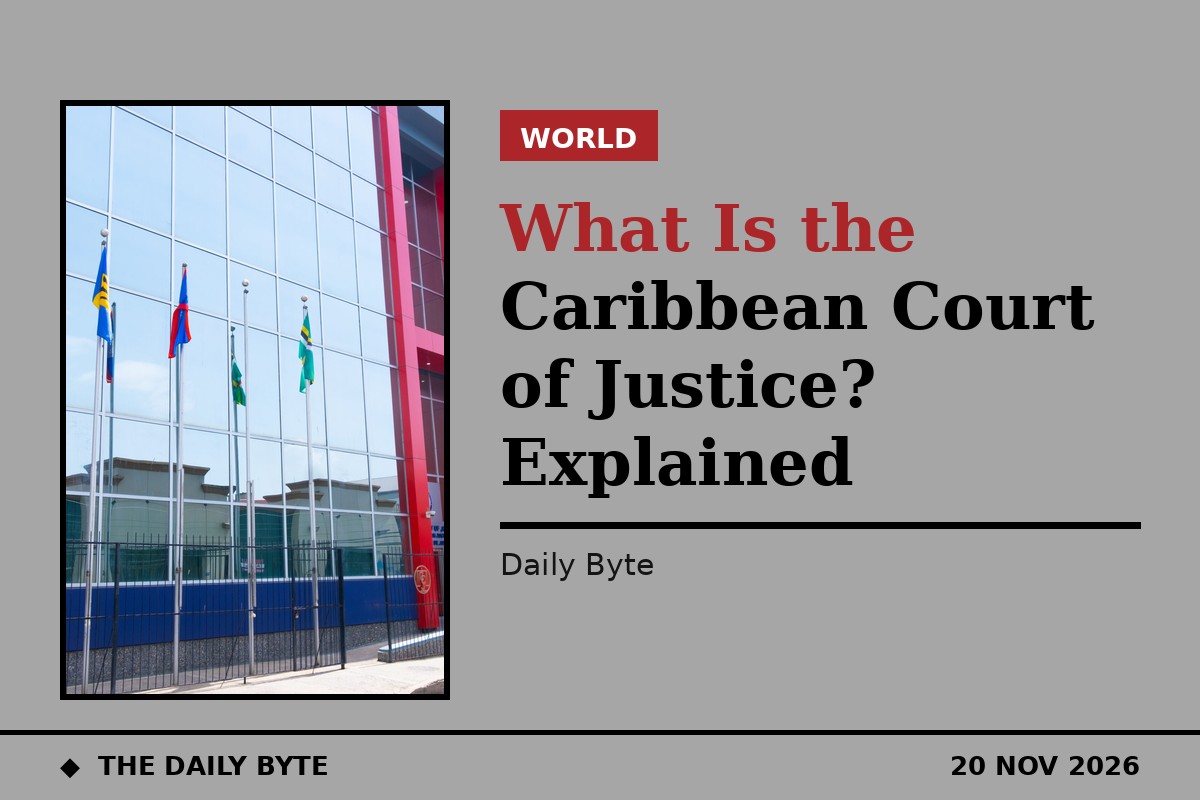
Guyana's President Irfaan Ali has urged more Caribbean countries to make the Caribbean Court of Justice (CCJ) their final court, calling the regional court "a credit to our region" and asking why, amid the push for reparations and talk of freedom from colonial rule, the region cannot agree to use its own court. His remarks, made on Thursday 20 November 2026 at a judicial conference in Georgetown, put a long-running Caribbean question back in the spotlight: what exactly is the CCJ, and why do most Caribbean countries still send their final appeals to London?
The short answer is that the CCJ is two courts in one. It is both an international court that interprets the treaty behind the Caribbean Community (CARICOM) and the final court of appeal for the Caribbean countries that have chosen it. Only five countries have made that second choice so far. The rest still appeal to the Judicial Committee of the Privy Council in London, a legacy of British colonial rule that the CCJ was created to replace.
What is the Caribbean Court of Justice?
The Caribbean Court of Justice is the regional judicial tribunal of the Caribbean. The agreement establishing it was signed on 14 February 2001 in Barbados by CARICOM leaders, and the Court was inaugurated on 16 April 2005 in Port of Spain, Trinidad and Tobago, which is its seat. Twelve states signed the agreement: Antigua and Barbuda, Barbados, Belize, Dominica, Grenada, Guyana, Jamaica, St Kitts and Nevis, St Lucia, St Vincent and the Grenadines, Suriname, and Trinidad and Tobago.
The Court describes itself as a hybrid institution. In one role it is a municipal court of last resort, the highest court in the land for the states that have joined its appellate jurisdiction. In the other it is an international court, applying rules of international law to interpret and apply the Revised Treaty of Chaguaramas, the treaty that established CARICOM and its single market and economy. The Court itself says it functions in that second role much like the European Court of Justice and the International Court of Justice. There is no appeal from a CCJ decision to any other court in the world: it is a final court in both of its jurisdictions.
Its stated mission is advancing Caribbean jurisprudence by providing accessible, efficient and substantive justice for the people and states of the Caribbean Community. Its published judgments now number more than 370: 328 in its appellate jurisdiction and 43 in its original jurisdiction, according to the Court's own judgments list.
The original jurisdiction: the treaty court
In its original jurisdiction, the CCJ is an international court, and it is the only court that has the authority to interpret the Revised Treaty of Chaguaramas when there are disagreements about it. That matters because the treaty governs the CARICOM Single Market and Economy (CSME): the free movement of people, goods, services, capital and labour, and the right of establishment across member states. If a CARICOM national believes a member state has broken the treaty's rules on free movement, for example, the CCJ is the court that decides the question.
All twelve signatory states take part in the original jurisdiction. That is the important distinction at the heart of the current debate: every CARICOM state already accepts the CCJ as the interpreter of the regional treaty, but only five have gone further and made it their final court of appeal. In its original jurisdiction the Court decides disputes under the treaty, including cases brought by states and, in defined circumstances, by private persons and companies whose treaty rights are affected. Its judgments in this jurisdiction are delivered as a single judgment of the court, with no separate concurring or dissenting opinions.
The appellate jurisdiction: the final court of appeal
In its appellate jurisdiction, the CCJ hears appeals from lower courts in civil and criminal matters from the states that have replaced the Privy Council with the CCJ. It is, for those states, the highest municipal court in the region. The five states that have acceded to the appellate jurisdiction are Barbados, Belize, Dominica, Guyana and Saint Lucia.
A case reaches the CCJ on appeal from a country's Court of Appeal. Under the agreement establishing the Court, appeals lie as of right in defined cases, including final decisions in civil proceedings where the matter in dispute is worth at least EC$25,000, and final decisions in proceedings for the dissolution or nullity of marriage. Other appeals need the leave of the Court of Appeal, and the CCJ itself can grant special leave to appeal in any civil or criminal matter. In practice, that means the Court hears the most serious criminal appeals, major civil disputes and constitutional cases from its five appellate states, and its word on them is final.
For the other CARICOM states, the final appeal still goes to London. A litigant in Jamaica, Trinidad and Tobago, the Bahamas or the Eastern Caribbean states that have not joined must take a case to the Judicial Committee of the Privy Council, a body of mostly British judges sitting in London, even though the case itself is entirely Caribbean. That is the arrangement President Ali was challenging in Georgetown.
Who runs the Court, and how is it paid for?
The Court currently has seven judges, including its President. The agreement establishing it allows for a total of nine judges excluding the President. Judges are not appointed by politicians. Each judge is appointed after an interview by the Regional Judicial and Legal Services Commission (RJLSC), an eleven-person body that the Court says includes no politically appointed members: it brings together the Court President, bar association and judicial service nominees, civil society representatives, distinguished jurists and representatives of the legal profession. The President is appointed by the Heads of Government of the signatory states on the recommendation of the Commission, and if the Heads do not appoint the Commission's nominee they must ask for another one: they cannot propose a candidate of their own.
The Court is funded through a trust fund of US$100 million, administered by a Board of Trustees drawn from regional bodies including CARICOM, the University of the West Indies, the Caribbean Association of Industry and Commerce and the Caribbean Congress of Labour. The fund was designed to keep the Court financially independent of the governments whose laws it judges, so that its running costs do not depend on annual political decisions.
Why have only five countries joined as a final court?
There is no single reason, and the answer is different in each country. One practical obstacle is constitutional: in several states, replacing the Privy Council as the final court means amending the constitution, and in some states that requires a referendum. Grenada put the question to voters in a referendum and they said no. Antigua and Barbuda has debated holding a public vote. In other states the change needs a special parliamentary majority that governments have not been able to assemble, or the issue has simply never reached the top of the political agenda.
There is also a question of confidence, which is the point President Ali was making. Some political leaders and lawyers argue that the Privy Council, with centuries of accumulated case law and judges drawn from the top of the British legal system, offers a known and trusted standard, and that a young regional court needs time to build the same depth of precedent. Supporters of the CCJ answer that the Court has now been operating for more than twenty years, that its judges are drawn from across the Commonwealth and not only the Caribbean, and that it has shaped jurisprudence on constitutional rights, democratic governance, the rule of law and regional integration. They also argue that it is wrong in principle for independent Caribbean states to have their most important cases decided in London, and that a court sitting in Port of Spain is more accessible to ordinary Caribbean litigants than one sitting thousands of miles away.
Cost plays a part in the argument too. Appealing to London is expensive, and critics of the Privy Council route say that in practice only wealthy litigants and governments can afford a final appeal. The CCJ's defenders say a regional final court brings final justice within reach of more people. Opponents reply that the CCJ's own costs, and the cost of changing constitutions to join it, are also real.
Why is it in the news now?
President Ali raised the issue while opening the 9th Biennial Conference of the Caribbean Association of Judicial Officers (CAJO) at the Marriott Hotel in Georgetown, Guyana, on Thursday 20 November 2026. The three-day conference, held under the theme "Changing Fundamentals of Judging", brought together 194 delegates, including chief justices, judges, magistrates, registrars and court administrators from across the Caribbean and beyond.
Ali told the conference that public trust helps safeguard judicial independence, and that courts must adapt to rapid technological and social change while continuing to provide timely and accessible justice. He said scrutiny of the courts on social media is legitimate, but criticism must be distinguished from intimidation, and that a court cannot decide a case by "counting the number of likes, shares, or comments". He also proposed a mechanism to brief judges on regional security threats, including intelligence on criminal networks and terrorism, arguing that the separation of powers should not mean separating information.
On the CCJ itself, his message was direct. "We should also take immense pride in the Caribbean Court of Justice. The CCJ remains a credit to our region, an institution that demonstrates our capacity to build and sustain institutions of the highest judicial standing," he said. "And on this note, I find it sometimes difficult to understand and explain why, in all our push, for example, for reparations, we cannot all agree that the CCJ is our final court. That we speak so loftily about freedom and independence and being away from colonial rule, and we cannot be brave enough. We cannot trust ourselves enough to make the CCJ our final court."
What happens next?
Nothing changes automatically. Each CARICOM state decides for itself whether to join the CCJ's appellate jurisdiction, and in several of them that decision requires constitutional change, a referendum, or both. President Ali's intervention adds political pressure, but it does not set a timetable, and no other head of government has announced a decision in response.
What the debate does show is that the CCJ's two roles are now firmly established: as a treaty court it already binds the whole region, and as a final court of appeal it serves five states with a body of published judgments that grows every year. The question Ali posed is whether the second role should catch up with the first. For readers following the story, the distinction between the two jurisdictions is the key to understanding it: every CARICOM country already uses the CCJ, but only five use it as their final court.
Sources: Caribbean Court of Justice; CANA News.


