What Is the Chagos Islands Deal? Explained
The Chagos Islands deal is an agreement under which the United Kingdom would hand sovereignty of the Chagos Archipelago in the Indian Ocean to Mauritius, while leasing back the island of Diego Garcia, home to a joint British-American military base, for an initial period of 99 years. The treaty was signed on 22 May 2025, but as of late November 2026 it has still not come into force. The deal is stalled because the United States has not given its backing, and Mauritius has now set a deadline of December 2026 for progress, warning that it could take legal action if the agreement remains frozen.
The story behind the deal stretches back sixty years, to the forced removal of the islands' people and the creation of a military base on Diego Garcia. This explainer sets out where the islands are, why Britain controls them, what the treaty says, why it has stalled, and what happens next.
Where are the Chagos Islands?
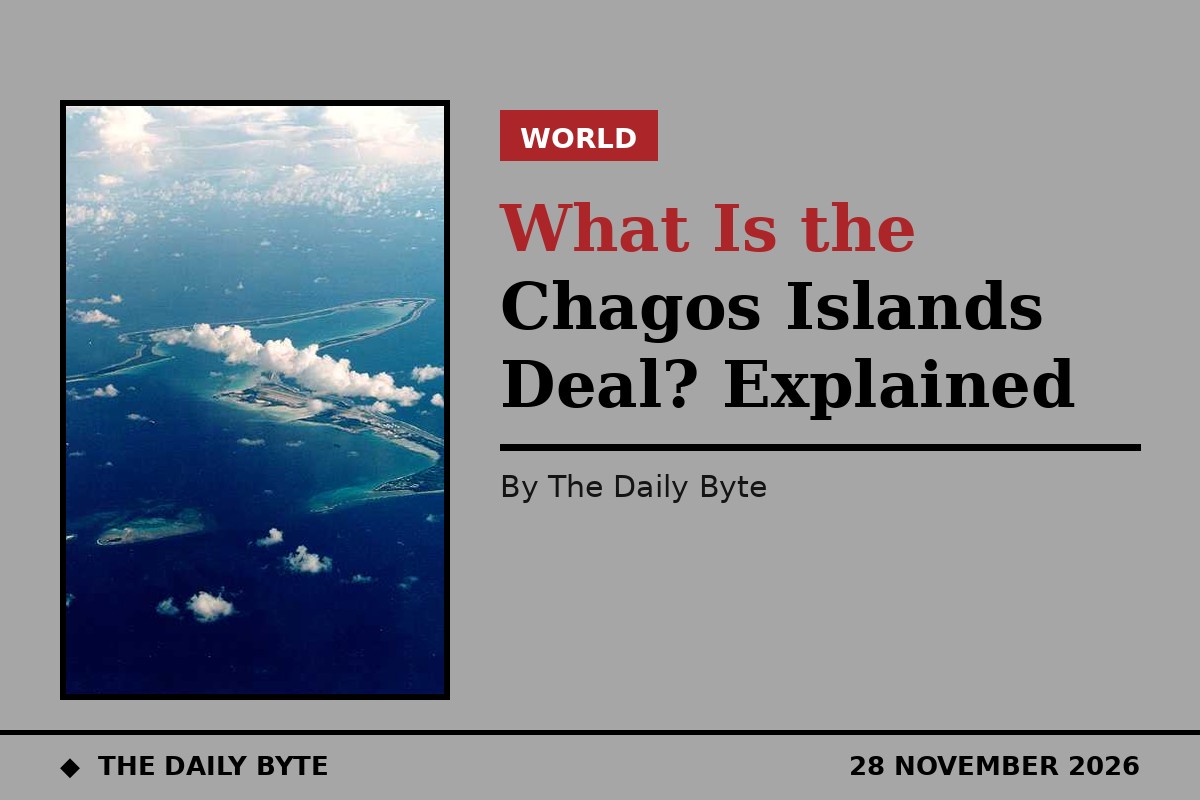
The Chagos Archipelago is a group of more than 50 small islands in the middle of the Indian Ocean, about 560 kilometres south of the Maldives and roughly 1,600 kilometres south-west of Sri Lanka. The largest island is Diego Garcia, a V-shaped coral atoll enclosing a sheltered lagoon. The archipelago has no permanent civilian population. The only people living there are military personnel and civilian staff working at the base on Diego Garcia, who number around 3,200.
The islands are remote, but their position is strategically valuable. They sit between Africa, the Middle East and South-East Asia, close to the shipping lanes that carry oil and goods through the Indian Ocean. That location is the reason a military base was built there, and the reason the question of who owns the islands has mattered to governments in London, Washington and Port Louis for decades.
Why Britain controls the islands
Britain's control of the Chagos Islands dates to 1965, three years before Mauritius became independent. The British government detached the archipelago from Mauritius, which was then a colony, and created a new territory called the British Indian Ocean Territory. The stated purpose was to make the islands available for defence. The following year, Britain agreed with the United States that Diego Garcia would host a joint military base.
Between 1967 and 1973, the entire population of the archipelago, around 1,500 to 2,000 people known as Chagossians, was removed from the islands. Many were taken to Mauritius and the Seychelles, where they arrived with little money and no homes. The removal was carried out so the islands could be used for military purposes without a civilian population. Chagossians and their descendants have campaigned ever since for the right to return, and British courts and international bodies have repeatedly examined the legality of what happened.
Mauritius has always maintained that the detachment of the islands was unlawful, and that the archipelago is part of its territory. Britain, for decades, insisted that the islands would be returned to Mauritius only when they were no longer needed for defence, a day that never came.
The long legal challenge
The legal turning point came in February 2019, when the International Court of Justice gave an advisory opinion that Britain's continued administration of the Chagos Archipelago was unlawful and should be brought to an end as rapidly as possible. The court found that the detachment of the islands in 1965 had not been based on the free and genuine expression of the will of the people of Mauritius, because Mauritius had not been independent at the time.
Three months later, in May 2019, the United Nations General Assembly voted by 116 votes to 6 to demand that Britain withdraw its administration of the islands within six months. Britain did not comply, and the archipelago remained under British control. Advisory opinions of the International Court of Justice are not binding in the way a court judgment is, but the opinion and the General Assembly vote left Britain diplomatically isolated, with almost no international support for its position.
Negotiations between Britain and Mauritius began in earnest after that, and continued through changes of government in London. The talks were complicated by the military base: any transfer of sovereignty had to preserve the operation of Diego Garcia, which both Britain and the United States regard as essential.
What the 2025 deal says
The treaty signed on 22 May 2025 is formally called the Agreement concerning the Chagos Archipelago including Diego Garcia. Its core bargain is simple. Britain accepts that Mauritius is sovereign over the Chagos Archipelago in its entirety, including Diego Garcia. In return, Mauritius authorises Britain to exercise its sovereign rights over Diego Garcia for an initial period of 99 years, so that the joint British-American military base can continue to operate.
The financial terms are substantial. Britain agreed to pay Mauritius 165 million pounds a year for the first three years, and 120 million pounds a year after that, with the payments linked to inflation from the fourteenth year. On top of that, Britain agreed to pay 40 million pounds into a trust fund for Chagossians, and 45 million pounds a year for 25 years for development projects in Mauritius. The British government put the average cost at 101 million pounds a year in 2025-26 prices, and the net present value of the whole package at 3.4 billion pounds. Opponents of the deal cited a much larger nominal total of about 35 billion pounds over the full 99 years, a figure the government said was misleading because it added up a century of payments without adjusting for inflation.
The treaty also opens the way for Chagossians to return to the islands, except for Diego Garcia itself, where the base will remain. A resettlement programme would be funded from the trust fund. For many Chagossians, who have waited more than fifty years, the prospect of return matters more than the money.
The Chagos Islands deal at a glance. Treaty signed: 22 May 2025. Parties: the United Kingdom and Mauritius. Sovereignty: passes to Mauritius over the whole archipelago, including Diego Garcia. Diego Garcia lease: an initial period of 99 years for the joint UK-US military base. Payments: 165 million pounds a year for three years, then 120 million pounds a year, indexed to inflation from year fourteen. Trust fund for Chagossians: 40 million pounds. Development funding: 45 million pounds a year for 25 years. Government estimate of cost: 101 million pounds a year on average, 3.4 billion pounds net present value. Status as of November 2026: signed but not in force.
Why the deal is stalled
A signed treaty does not take effect by itself. It must be ratified, and Britain must pass the legislation needed to give it effect. That process has stalled, and the reason is the United States.
President Donald Trump withdrew his support for the agreement earlier in 2026, describing it as a bad deal and raising concerns about the security of the military base. Without American backing, the British government paused the legislation required to implement the treaty, saying it could not proceed without the full support of both Mauritius and the United States. A written answer to Parliament on 6 November 2026 confirmed that no payments had been made to Mauritius, because the agreement would only be implemented once it had that support.
Prime Minister Andy Burnham has said he is committed to finding a solution that secures the base on Diego Garcia. Speaking to the Economist, he said he wanted progress on the stalemate by the end of the year. The government has been in discussion with the United States about how to move forward in a way that protects national security for all three countries, but those talks have excluded Mauritius, which has grown increasingly frustrated.
That frustration boiled over in November 2026. On 17 November, the Mauritian Prime Minister, Navin Ramgoolam, told the National Assembly in Port Louis that Mauritius would not wait forever for the deal to become reality. His government set a deadline of December 2026 for the United Kingdom to make progress, warning that it could pursue legal action if the agreement remains stalled. Eighteen months after the treaty was signed, it still has no legal force, and Mauritius is openly considering its options.
What it means for Chagossians
For the Chagossians, the deal is about more than sovereignty and money. It is the first agreement that offers them a realistic route home. Under the treaty, Mauritius would be able to resettle Chagossians on the outer islands of the archipelago, funded by the trust fund, while Diego Garcia itself remains a military base with no civilian population.
Not all Chagossians support the deal. Some argue that the agreement was negotiated over their heads, between governments, and that they were never properly consulted. Others object to Mauritius taking sovereignty, saying their claim is to the islands themselves rather than to any particular flag. And some point out that a right to return to the outer islands is not the same as a right to return to Diego Garcia, where most of their families lived. These disagreements are real, and they have not been resolved.
What is not in doubt is that the current position leaves Chagossians with nothing. The treaty is signed but not in force, the trust fund has not been paid, and no resettlement has begun. If the deal collapses, the financial package worth roughly 3.4 billion pounds disappears with it, and the right of return is delayed again, perhaps for years.
Why Diego Garcia matters so much
Diego Garcia is one of the most strategically important military bases in the world. Its location in the middle of the Indian Ocean puts it within reach of the Middle East, East Africa and South-East Asia, and its long runway can handle heavy bombers. The base has supported American and British military operations for decades, and it is also used for logistics, surveillance and the pre-positioning of ships and supplies.
That is why the United States has a veto in practice, even though it is not a party to the treaty. The base is a joint facility, and Washington's agreement is needed for the lease arrangements to work. It is also why the financial cost of the deal has been so contested in Britain: critics ask why the taxpayer should pay billions to lease back a base on territory Britain already controls, while supporters argue that the cost of the deal is less than the cost of losing the base altogether, and less than running an aircraft carrier for a year.
What happens next
The immediate focus is the December 2026 deadline set by Mauritius. Three paths are open. The first is a breakthrough: Britain and the United States agree on revised arrangements that satisfy Washington's security concerns, the legislation is passed, and the treaty comes into force. The second is delay: the deadline passes without progress, Mauritius begins legal action, and the deal remains frozen while the dispute moves to an international court. The third is collapse: the United States and Britain abandon the May 2025 agreement entirely and start again, leaving sovereignty, the base and the Chagossians' right of return unresolved for years.
None of these outcomes is certain, and the history of the dispute suggests that delay is the most likely. The Chagos Islands have been contested since 1965, and every deadline so far has passed without a final settlement. What has changed is that Mauritius is no longer prepared to wait quietly, and the December deadline is the clearest signal yet that its patience has run out.
Frequently asked questions
What is the Chagos Islands deal? It is a treaty signed by the United Kingdom and Mauritius on 22 May 2025 under which Britain recognises Mauritian sovereignty over the Chagos Archipelago, including Diego Garcia, while leasing back Diego Garcia for an initial 99 years so the joint UK-US military base can keep operating.
How much will the deal cost the UK? Britain agreed to pay Mauritius 165 million pounds a year for the first three years and 120 million pounds a year after that, plus a 40 million pound trust fund for Chagossians and 45 million pounds a year for 25 years for development projects. The government puts the average cost at 101 million pounds a year and the net present value at 3.4 billion pounds.
Why has the deal not come into force? The treaty has not been ratified and the implementing legislation has been paused. The United States withdrew its support for the agreement earlier in 2026, and Britain says it cannot proceed without American backing as well as the agreement of Mauritius.
Who are the Chagossians? The Chagossians are the people who lived on the Chagos Islands until they were removed by the British government between 1967 and 1973 to make way for the military base on Diego Garcia. Many settled in Mauritius and the Seychelles, and they and their descendants have campaigned for the right to return ever since.
Can Chagossians return to the islands under the deal? The treaty provides for resettlement of Chagossians on the outer islands of the archipelago, funded by the trust fund, but not on Diego Garcia itself, which remains a military base. No resettlement can begin until the treaty comes into force.


