What Is the Court of Arbitration for Sport?
The Court of Arbitration for Sport, known as CAS, is an independent tribunal based in Lausanne, Switzerland, that settles disputes in sport through arbitration and mediation. It is the body that decides some of the biggest arguments in world sport — doping bans, eligibility rules, election disputes and club punishments — and its rulings are binding. It is in the news today because it is due to deliver its decision on Tuesday 24 November 2026 in one of the most extraordinary football cases in years: Senegal’s appeal against being stripped of the Africa Cup of Nations title, after the Confederation of African Football (CAF) declared Morocco champions despite Senegal winning the final on the pitch.
CAS is often called the supreme court of world sport, a phrase first used by Switzerland’s Federal Supreme Court. But it is not a court in the ordinary sense. It has no judges appointed by a government, it cannot hear a case unless the parties have agreed to its jurisdiction, and its decisions can only be challenged in very narrow circumstances. Understanding how it works explains why its ruling on Senegal will be final in practice — and why the case took so long to decide.
Why is CAS in the news today?
Senegal beat Morocco 1-0 after extra time in the Africa Cup of Nations final in Rabat in January 2026. The match itself was chaotic: Senegal walked off the pitch for 14 minutes after a penalty was awarded against them late in regulation time, with several players returning to the dressing room in protest before they resumed play. Morocco missed the penalty, sending the match into extra time, where Senegal scored the winner.
Two months later, CAF’s Appeal Board ruled that Senegal had forfeited the match by walking off, overturned the result and awarded a 3-0 victory to Morocco — making Morocco champions. Senegal appealed to CAS, lodging the case on 25 March. The appeal was heard in Lausanne on 8 October by a three-person panel chaired by French sports law expert Gerald Simon, assisted by Italian international law professor Luigi Fumagalli and Ulrich Haas, a Hamburg-based attorney and professor of law at the University of Zurich.
Senegal’s core argument, as reported by Reuters, is that the referee’s decision is final and that he allowed the match to be completed. CAS initially promised a decision within days of the hearing, but then decided to issue a complete ruling including its legal grounds — known as a CAS Award — a process that takes several weeks. The court said the decision would be rendered on Tuesday 24 November 2026 in the course of the afternoon, without giving a time. This article was written before that ruling, so it does not report the outcome. Whatever CAS decides, the award will carry the same weight as a national court judgment and will be enforceable under the New York Convention on the Recognition and Enforcement of Foreign Arbitral Awards.
What does CAS actually do?
CAS describes itself as an independent tribunal that resolves sports disputes worldwide through arbitration and mediation. It was established in Lausanne in 1984 to render impartial decisions on sporting matters, and sports organisations and athletes assign it the judicial authority to uphold the fair application of the relevant laws and sports regulations. It works with more than 450 expert arbitrators, and more than 12,000 cases have been registered with the court since its creation, at an average of about 900 cases a year.
Its caseload covers almost every kind of dispute sport produces. CAS lists employment disputes, doping, election contestations, match-fixing, eligibility, governance concerns and unethical behaviour among the procedures it handles. That range is the point: a single body sits above the individual federations, so that an athlete banned by one federation, a club punished by another, or a federation official challenging an election can all end up before the same tribunal, applying the same procedural rules.
CAS also runs mediation, a voluntary process in which a neutral mediator helps the parties reach their own settlement, rather than imposing a decision. Mediation is faster and private, but it produces an agreement, not an award — so it is used for commercial and contractual disputes rather than for doping or disciplinary cases, where a binding ruling is needed.
How does a case reach CAS?
A dispute can only be submitted to CAS if the parties have agreed to its jurisdiction. In practice that agreement is almost always built into the rules of the sport itself: athletes, clubs and federations accept CAS arbitration when they sign up to a competition, join a federation or agree to an anti-doping code. The Olympic Charter goes further — its rule 61 provides that all disputes connected with the Olympic Games can only be submitted to CAS — and all Olympic international federations have recognised CAS jurisdiction for at least some disputes.
CAS operates two main divisions. The Ordinary Arbitration Division hears disputes submitted to it for the first time, such as a commercial claim under a contract that names CAS as the forum. The Appeals Arbitration Division is the one most people hear about: it reviews decisions already taken by a sports federation or other sports body, such as CAF’s decision to strip Senegal of the title. The Senegal case is an appeal, which is why CAS is reviewing CAF’s ruling rather than deciding the facts of the final from scratch.
Cases are decided by panels of one or three arbitrators drawn from CAS’s closed list. The parties each nominate one arbitrator in a three-person panel, and the chair is chosen by agreement or by CAS itself. The panel hears evidence, usually at a hearing in Lausanne, and then issues an award setting out its decision and its reasons. In the Senegal case the panel chose to issue a full award with legal grounds, which is why the decision took weeks rather than days.
How binding is a CAS decision?
A CAS award is final and binding on the parties, and it has the same value as a judgment of a national court. Under the 1958 New York Convention, which governs the recognition of arbitral awards, a CAS award can be enforced by sports federations or by state courts, depending on the circumstances. A federation that ignores an award risks its own standing in world sport; a party that refuses to comply can find the award enforced against it in an ordinary court.
There is only one route of challenge: an appeal to the Federal Supreme Court of Switzerland. Those appeals rarely succeed, because the Swiss court does not re-examine the merits of the case. It looks mainly at whether procedural requirements were met and whether the award is compatible with public policy. That narrow review is deliberate. Arbitration is chosen precisely because it is final, and a system that allowed every losing party to relitigate the facts would defeat its purpose.
The limits of that system were tested in the case of Caster Semenya, the South African middle-distance runner. CAS upheld athletics’ rules limiting testosterone levels in certain women’s events, and the Swiss Federal Supreme Court dismissed her bid to set the award aside in September 2020. She then took her fight to the European Court of Human Rights — a separate human rights forum, not an appeal against the award itself.
What is the Ad Hoc Division?
During major sports events, CAS opens temporary offices called Ad Hoc Divisions. Their purpose is to resolve disputes in an expedited timeframe, sometimes within 24 hours, so that a competition is not left waiting for a ruling. Ad Hoc Divisions operate at the Olympic Games and at football tournaments organised by FIFA and UEFA, deciding issues such as last-minute eligibility challenges and accreditation disputes while the event is still running.
The Ad Hoc Division is the reason CAS can act quickly when it needs to — and the reason the Senegal timetable is not unusual. A 24-hour ruling is possible when the panel is convened for a single event and the facts are narrow. A full award in a complex appeal, with a three-person panel, written submissions from three parties and legal grounds to draft, takes weeks. CAS first told the parties to expect the Senegal decision within days, then switched to a complete award, which is what pushed the ruling to late November.
Where did CAS come from?
CAS was created in 1984 on the initiative of the International Olympic Committee, whose president at the time, Juan Antonio Samaranch, wanted a specialist body for the rising number of international sports disputes. For its first decade it was closely tied to the IOC, which paid its operating costs — a connection that drew a legal challenge. In 1992, in the Gundel case, an equestrian rider challenged a CAS decision before the Swiss Federal Supreme Court, questioning the tribunal’s impartiality. The court ruled that CAS was a true court of arbitration, but drew attention to its many links with the IOC.
The response was a fundamental reform. Under the Paris Agreement of 1994, the International Council of Arbitration for Sport (ICAS) was created as a Swiss foundation to administer and finance CAS and to safeguard its independence, and a new Code of Sports-related Arbitration came into force on 22 November 1994. ICAS is composed of 22 members representing the Olympic movement, sports federations, athletes and the legal sector, and it appoints CAS arbitrators, manages its finances and adopts its rules. In 2003, in the Lazutina and Danilova case, the Swiss Federal Supreme Court reaffirmed CAS’s independence and described it as the “true Supreme Court of world sport”.
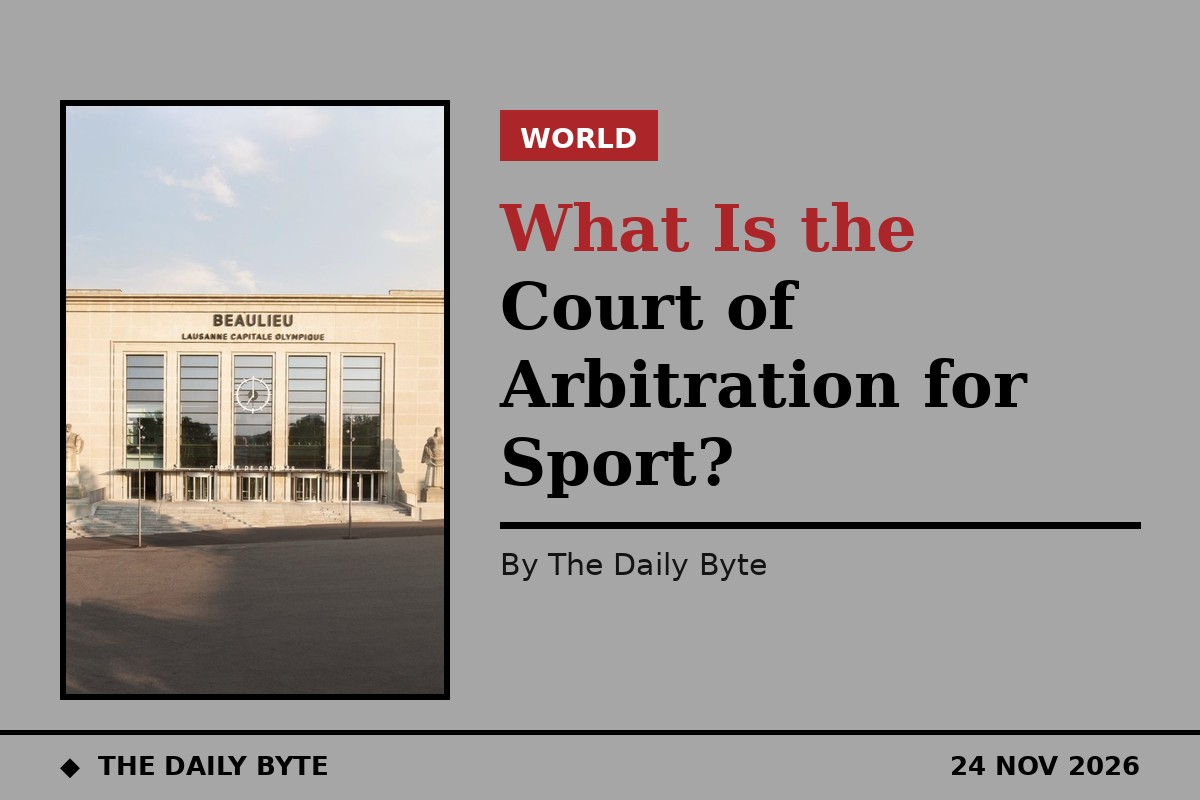
CAS has also moved home several times. It began near the Olympic Museum in Lausanne, moved to the Château de Béthusy in 2005, and in March 2022 moved into its first permanent home: the south wing of the Palais de Beaulieu in Lausanne, bought by ICAS in 2019 and rebuilt at a cost of 37,176,629 Swiss francs. The new headquarters, inaugurated on 27 June 2022, covers 6,000 square metres over five levels, with three hearing rooms, a mediation room and a 92-seat auditorium. CAS also has a decentralised office in Sydney and alternative hearing centres in Shanghai, Cairo, Abu Dhabi, Kuala Lumpur and Lima.
What are CAS’s most famous cases?
Two cases show the range of what CAS decides. In February 2020, UEFA banned Manchester City from European competition for two years and fined the club 30 million euros for breaching financial fair play rules by overstating sponsorship revenue. City appealed, and in July 2020 CAS overturned the ban and cut the fine to 10 million euros, finding that most of the alleged breaches were either not established or time-barred, and that a ban was not an appropriate punishment for the club’s failure to cooperate with UEFA’s investigation alone. The ruling cleared City to play in the Champions League and remains one of the most consequential sports arbitration decisions ever made.
The Semenya case, by contrast, shows CAS deciding the rules of sport itself. Her challenge to the testosterone regulations was one of the most closely watched eligibility cases in athletics, and the award — upheld on the narrow Swiss appeal — set the framework within which the sport still operates. Between those poles sit thousands of less famous cases: doping suspensions, transfer disputes, election challenges and governance rows that never make the front pages but decide careers. That is the everyday work of the court, and it is why a ruling on a single football final can carry so much weight: the same tribunal, the same rules and the same finality apply to all of them.
Frequently asked questions
Is CAS a real court? CAS is an independent arbitral tribunal, not a state court. Its awards have the same value as national court judgments and can be enforced under the New York Convention, but it only hears cases the parties have agreed to submit to it, and it applies the rules of the sport concerned alongside the law.
Can a CAS decision be appealed? Only to the Federal Supreme Court of Switzerland, and only on limited grounds such as procedural errors or incompatibility with public policy. The Swiss court does not re-hear the facts of the case, so successful challenges are rare.
What is the Senegal case about? Senegal won the 2026 Africa Cup of Nations final 1-0 against Morocco after extra time, but CAF’s Appeal Board later ruled that Senegal had forfeited the match by walking off the pitch for 14 minutes and awarded the title to Morocco 3-0. Senegal appealed to CAS, arguing that the referee’s decision is final and that he allowed the match to be completed.
When will the Senegal ruling be announced? CAS said the decision would be rendered on Tuesday 24 November 2026 in the course of the afternoon. This article was written before the ruling was issued, so it does not report the outcome.
Does CAS only handle football cases? No. Football produces some of its most high-profile cases, but CAS covers all sports. Its caseload includes doping, employment disputes, election challenges, match-fixing, eligibility and governance cases across the Olympic and non-Olympic sports.
Sources: Court of Arbitration for Sport; Reuters. Background on the court’s history and headquarters: LawInSport; Lexology. Manchester City ruling: TNT Sports.


