What Is the ECHR? Human Rights Convention Explained
The ECHR is the European Convention on Human Rights, an international treaty that protects the basic rights and freedoms of more than 700 million people across Europe. It was signed in Rome on 4 November 1950, came into force on 3 September 1953, and today binds all 46 member states of the Council of Europe, including the United Kingdom. Its promises are enforced by a real court, the European Court of Human Rights in Strasbourg, whose judgments are legally binding on the states that have signed up.
The Convention matters in Britain right now because leaving it has become a live political argument. The Conservative Party announced in October 2025 that it would take the UK out of the ECHR, Reform UK announced in August 2025 that it would leave and repeal the Human Rights Act, and former prime minister David Cameron publicly backed leaving in November 2026. Prime Minister Andy Burnham's Labour government, by contrast, says the UK will stay in the Convention while pushing for reform of how it is interpreted. This explainer sets out what the ECHR is, what rights it protects, how it works in UK law, and what leaving it would actually involve.
What is the ECHR?
The full name of the treaty is the Convention for the Protection of Human Rights and Fundamental Freedoms. It was drawn up by the newly formed Council of Europe in the aftermath of the Second World War and was directly inspired by the United Nations' Universal Declaration of Human Rights of 1948. The United Kingdom helped to draft it and was one of the first states to ratify it, in 1951. It was originally signed by 12 states; it now has 46 parties, and every member state of the Council of Europe must ratify it.
What makes the Convention different from most human rights declarations is that it is enforceable. Individuals can complain to the European Court of Human Rights in Strasbourg if they believe a state has violated their rights, and the Court's judgments bind the state concerned. The Court has described the Convention as a "living instrument", meaning it is interpreted in light of present-day conditions rather than frozen in 1950. The Committee of Ministers of the Council of Europe supervises whether states carry out the Court's judgments.
What rights does the ECHR protect?
The Convention protects civil and political rights. The most frequently relied on articles are listed below. Some rights, such as the ban on torture, are absolute and can never be restricted. Others, such as the right to respect for private and family life, can be limited where the law allows it and the restriction is necessary in a democratic society, for example for national security or the prevention of crime.
| Article | Right | What it means in practice |
|---|---|---|
| Article 2 | Right to life | The state must not take life unlawfully and must investigate deaths it may be responsible for. |
| Article 3 | Prohibition of torture | Absolute ban on torture and inhuman or degrading treatment, with no exceptions. |
| Article 5 | Right to liberty and security | No one may be detained arbitrarily; detention must follow a lawful procedure. |
| Article 6 | Right to a fair trial | Criminal and civil cases must be heard fairly, publicly and within a reasonable time. |
| Article 8 | Private and family life | Respect for privacy, family life, home and correspondence, subject to lawful limits. |
| Article 9 | Freedom of thought, conscience and religion | Freedom to hold beliefs and to practise a religion, alone or with others. |
| Article 10 | Freedom of expression | Freedom to hold opinions and to share information and ideas. |
| Article 11 | Freedom of assembly and association | Freedom to protest peacefully and to join trade unions and other groups. |
| Article 14 | Prohibition of discrimination | The Convention's rights must be secured without discrimination. |
| Protocol 1, Article 1 | Protection of property | Peaceful enjoyment of possessions; the state may not seize property arbitrarily. |
| Protocol 1, Article 2 | Right to education | No one may be denied the right to education. |
| Protocol 1, Article 3 | Right to free elections | Regular elections by secret ballot, under conditions ensuring free expression of opinion. |
| Protocol 13 | Abolition of the death penalty | The death penalty is abolished in all circumstances for states that ratified it. |
Two articles dominate the current British debate. Article 3 has been central to cases about deporting people to countries where they face torture, because it is absolute: a government cannot argue that the public interest outweighs it. Article 8 is central to deportation cases involving family life in the UK, because courts must weigh the individual's right to family life against the state's interest in immigration control. That balancing exercise is exactly what the government's reform efforts are aimed at.
What is the European Court of Human Rights and how does it work?
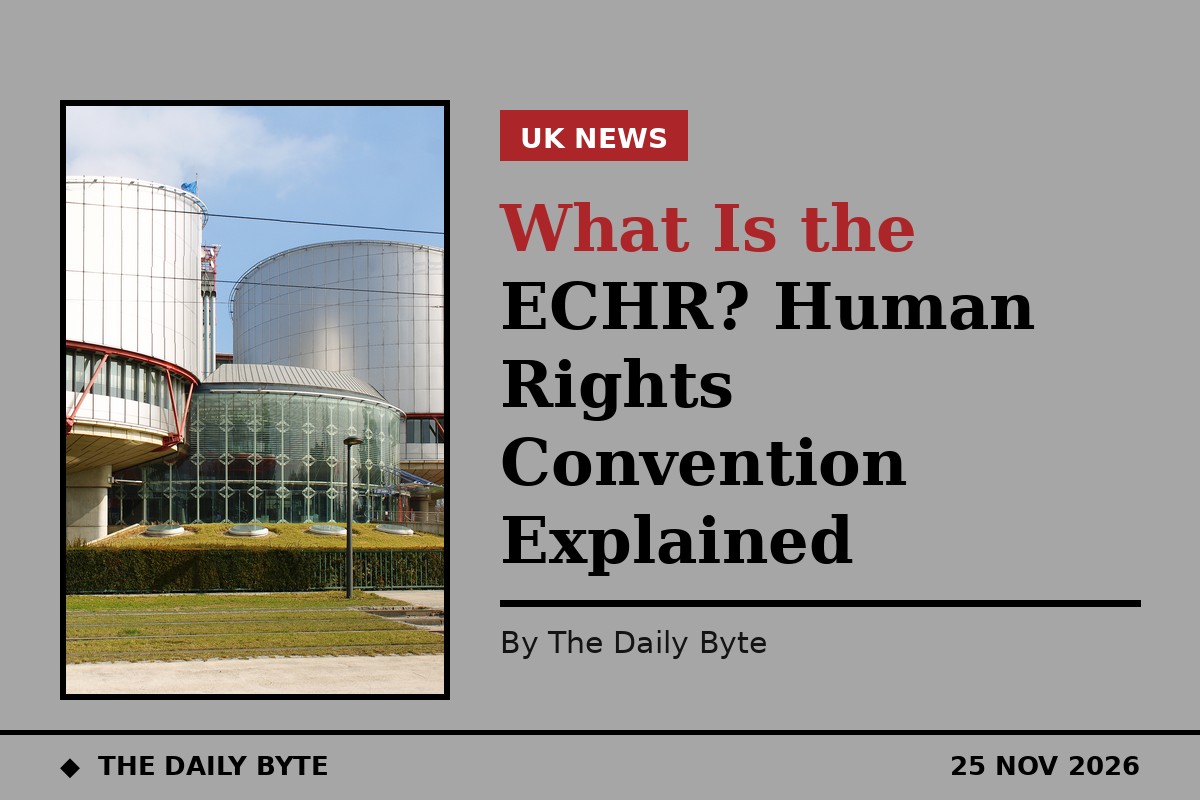
The European Court of Human Rights, often called the Strasbourg court, was established in 1959 to make sure states keep the promises they made in the Convention. It sits in Strasbourg, France, in a building designed by the British architect Richard Rogers and completed in 1994. There is one judge for each of the 46 member states, elected by the Parliamentary Assembly of the Council of Europe.
A person who believes their Convention rights have been violated can apply to the Court, but only after they have used the remedies available in their own country's courts. The Court first decides whether the application is admissible. Most applications are rejected at this stage. Those that pass are examined, the state is asked to respond, and the Court then gives a judgment. If it finds a violation, it can award compensation, and the state is obliged under Article 46 of the Convention to carry out the judgment. The Committee of Ministers monitors that process, which can take years for complex cases.
The Court does not strike down laws. It rules on whether a state's actions, or its laws as applied, breached the Convention. It is the state that must then decide how to fix the problem, whether by changing a law, changing a practice, or paying compensation. The Court's judgments also build up a body of case law that national courts across Europe take into account.
Is the ECHR part of the EU?
No. This is one of the most common misunderstandings about the Convention. The ECHR belongs to the Council of Europe, an international organisation founded in 1949 to promote human rights, democracy and the rule of law. The Council of Europe is entirely separate from the European Union. All 46 Council of Europe member states, including the 27 EU member states, are bound by the Convention, but the EU itself is not a party to it.
That is why leaving the EU changed nothing about the UK's membership of the ECHR. The UK left the EU on 31 January 2020 and remained a party to the Convention throughout. Leaving the ECHR would be a separate act, and it would also mean leaving the Council of Europe, since membership of the Council requires being a party to the Convention. The UK's departure from the EU therefore has no bearing on the current debate, whatever either side claims.
How does the ECHR work in UK law?
Before 1998, a person in the UK whose Convention rights had been violated had to go all the way to Strasbourg to get a remedy, because the Convention was not part of domestic law. The Human Rights Act 1998 changed that by incorporating the Convention's rights into UK law. It took effect in October 2000.
The Act works in three main ways. First, section 2 requires UK courts to take relevant Strasbourg judgments into account, though they are not strictly bound by them. Second, section 3 requires courts to read and give effect to legislation in a way that is compatible with Convention rights, so far as it is possible to do so. Third, section 7 allows people to bring proceedings in UK courts if a public authority has acted incompatibly with their rights, and section 8 allows the court to grant a remedy.
There is one important limit. UK courts cannot strike down an Act of Parliament. If a court finds that a provision of primary legislation is incompatible with a Convention right, section 4 allows it to issue a declaration of incompatibility. The law stays in force until Parliament itself changes it. Parliament remains sovereign, and that is why supporters of the Act argue that it respects the UK's constitutional arrangements while giving people a remedy at home instead of in Strasbourg.
The UK accepted the right of individuals to petition the Strasbourg court in 1965, more than three decades before the Human Rights Act. That means British citizens have been able to take cases to Strasbourg for 60 years, and some of the most significant rulings about UK law, on issues from prisoners' rights to surveillance, have come through that route.
What happens if a country leaves the ECHR?
Article 58 of the Convention sets out the exit route. A state may denounce the Convention only after it has been a party for at least five years, and only on six months' notice to the Secretary General of the Council of Europe. A state that stops being a member of the Council of Europe also stops being a party to the Convention.
There are only two precedents. The first was Greece, which left the Council of Europe in 1969 under its military government and returned in 1974 after democracy was restored. The second was Russia. After its full-scale invasion of Ukraine, Russia was suspended from its rights of representation on 25 February 2022 and expelled from the Council of Europe on 16 March 2022. In line with the six months' notice period in Article 58, Russia ceased to be a party to the Convention on 16 September 2022, although the Court remains competent to deal with violations that occurred before that date.
Leaving would not remove human rights from UK law overnight. The Human Rights Act would still be in force unless Parliament repealed it, and many Convention rights are also protected in other laws and in the common law. Reform UK has said it would repeal the Human Rights Act as well as leave the Convention. The Conservatives have said they would leave the Convention; the detail of what would replace the Human Rights Act remains part of the debate.
There would also be consequences beyond the courtroom. The Good Friday Agreement, which underpins peace in Northern Ireland, is built on the UK remaining a party to the ECHR, and the Windsor Framework rests on the same foundation. Kemi Badenoch has argued that there is no conflict between leaving and the Agreement, while conceding that implementing the policy would require cooperation with Stormont and the Republic of Ireland. Critics of leaving also point to the UK's international reputation and to the fact that the UK helped to write the Convention in the first place.
Why is the ECHR in the news in November 2026?
The debate sharpened through the autumn of 2026. On 22 October, the Oxford Union voted 192 to 54 against a motion calling for the UK to withdraw from the Convention. On 13 November, David Cameron publicly said the UK should leave the ECHR while confirming he is advising Conservative leader Kemi Badenoch, arguing that the country must do whatever it takes to stop small-boat crossings and allow tougher deportations.
The government, meanwhile, is pursuing reform rather than withdrawal. On 15 May 2026, the Council of Europe's ministers agreed by consensus the Chisinau Declaration, which sets out how the Convention should be interpreted and applied in cases involving illegal and mass migration and the deportation of foreign national offenders, with the aim of resetting the approach to Articles 3 and 8. In a written answer on 6 November 2026, the government said it remains committed to the Convention and to membership of the Council of Europe, and that it is translating the declaration into practical change, including through the Immigration and Asylum Bill.
The positions of the main parties, as recorded in November 2026, are clear. Labour, in government, says the UK will stay in the ECHR while seeking reform with other states. The Conservatives, who announced in October 2025 that they would leave, argue that withdrawal is needed to restore control over deportations and to put Parliament, rather than judges in another country, in charge. Reform UK, which announced in August 2025 that it would leave and repeal the Human Rights Act, takes the same position. The Liberal Democrats and the Greens oppose leaving. The argument is therefore not only about human rights law; it is about sovereignty, immigration control, and the UK's place in Europe.
Frequently asked questions
Does the ECHR stop the UK deporting foreign criminals? Not outright. The Convention does not give anyone an absolute right to remain in the UK. Courts weigh the individual's Article 8 right to family life against the public interest in deportation, and many deportations go ahead. Article 3, which is absolute, can block removal only where there is a real risk of torture or inhuman treatment in the destination country.
Can the Strasbourg court overrule the UK Supreme Court? No, not directly. The Strasbourg court rules on whether the UK has breached the Convention. It cannot quash a UK court judgment or strike down an Act of Parliament. It is for the UK to decide how to comply with a finding of a violation.
Did Brexit take the UK out of the ECHR? No. The ECHR is a Council of Europe treaty, not an EU treaty. The UK left the EU in 2020 and remained a party to the Convention.
How long would it take the UK to leave the ECHR? Under Article 58, a state that has been a party for at least five years can denounce the Convention on six months' notice. The UK has been a party since 1951, so the formal notice period would be six months, although the political and legislative steps, including the future of the Human Rights Act, would take longer.
Sources: House of Lords Library, "75th anniversary of the European Convention on Human Rights"; Council of Europe, "European Union accession to the European Convention on Human Rights — Questions and Answers"; House of Commons Library, "Work of the Council of Europe"; UK Parliament written answer, 6 November 2026; Oxford Chronicle, 14 November 2026.