What Is the EPP? European Parliament Group Explained
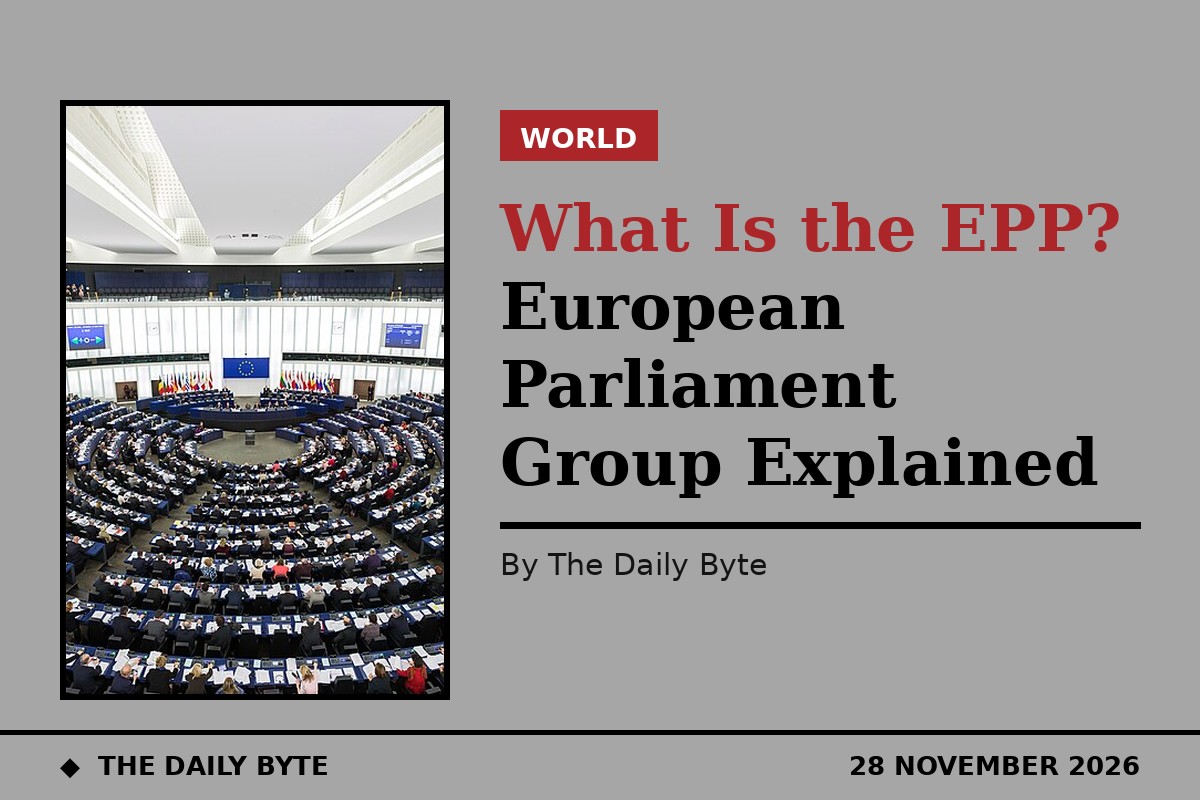
The EPP is the European People's Party Group, the largest political group in the European Parliament. Its full name is the Group of the European People's Party (Christian Democrats), and it brings together centre-right MEPs from national parties across the European Union, including Germany's CDU and CSU, Spain's Partido Popular, France's Les Republicains and Poland's Civic Coalition. The group is chaired by the German MEP Manfred Weber, who has led it since 2014 and has been president of the wider European People's Party since 2022. It is in the news in late November 2026 because the Parliament's two other centrist groups, the Socialists and Democrats and Renew Europe, suspended talks with it on a cooperation deal for the second half of the parliamentary term, after the EPP again voted with far-right groups to pass changes to environmental assessment rules. The suspension has put the re-election of the Parliament's president, Roberta Metsola, in doubt.
The EPP is often described as one organisation, but it is really two linked ones, and the distinction matters. The European People's Party is a European political party, founded in 1976, which brings together national centre-right parties from across the continent. The EPP Group is the group's formation inside the European Parliament: the MEPs who belong to those national parties sit together as one group, vote together on most issues, and negotiate as a bloc with the other groups. The group itself is older than the party. It traces its origins to June 1953, when the Common Assembly of the European Coal and Steel Community first allowed political groups to form, and it has existed in one form or another ever since, making it one of the oldest groups in European politics. Its formal name has changed over the decades, from the Christian Democratic Group to the Group of the European People's Party (Christian Democrats), but its position at the centre-right of European politics has stayed broadly the same.
How big is the EPP and who leads it?
The EPP Group is the largest of the Parliament's political groups. The European Parliament's own list of MEPs records 185 members in the Group of the European People's Party (Christian Democrats), out of 720 seats in the Parliament as a whole, which makes it by far the biggest single group. Its size is the source of its influence: no legislation can pass the Parliament without either the EPP's support or a coalition that goes around it, and the group holds the largest share of committee chairs and senior posts. The group's members come from most EU member states, and its national delegations include some of the largest parties in Europe. Germany's Christian Democrats and Christian Social Union form the biggest national contingent, alongside Spain's Partido Popular, Poland's Civic Coalition, Romania's National Liberal Party, France's Les Republicains and the Dutch Christian Democratic Appeal, among others.
The group is chaired by Manfred Weber, a German politician from the Christian Social Union, the Bavarian sister party of the Christian Democratic Union. Weber has been a Member of the European Parliament since 2004, has led the EPP Group since June 2014, and has been president of the European People's Party itself since 1 June 2022, when he succeeded Donald Tusk. He is therefore the central figure in both the party and the parliamentary group, and the person who negotiates on the group's behalf with the leaders of the other groups and with the European Commission. In 2018 he was the EPP's lead candidate, its Spitzenkandidat, for the presidency of the European Commission, although the post ultimately went to Ursula von der Leyen, herself a member of Germany's CDU and the EPP family.
What does the EPP stand for?
The EPP Group describes itself as Christian democratic, conservative and liberal-conservative. In practice that means a centre-right programme: support for the European Union and the single market, a market economy with social protections, controlled migration, a strong security and defence policy, and action on climate change through market-based measures rather than heavy regulation. The group's 2024 manifesto reflected those priorities, and its MEPs have generally backed the European Commission under Ursula von der Leyen, whose re-election as Commission President in 2024 depended on a centrist majority made up of the EPP, the Socialists and Democrats and Renew Europe. That three-way centrist arrangement is the backdrop to the current dispute: the EPP has repeatedly voted with parties to its right on migration and environmental legislation during the current term, and its centrist partners say that habit has damaged the trust the arrangement depends on.
How do political groups work in the European Parliament?
The European Parliament is organised into political groups rather than national delegations. After each European election, MEPs from national parties that share a political outlook form groups, and the groups then divide up committee seats, speaking time, funding and senior posts in proportion to their size. A group needs at least 23 MEPs from at least seven member states. There are currently eight groups, plus a small number of non-attached members who belong to no group. The groups negotiate with each other to build majorities, because no single group holds an overall majority: with 720 seats, a majority needs 361 votes, and even the EPP, with 185 seats, needs partners for every vote. That is why coalition habits matter so much. The EPP has traditionally built majorities with the Socialists and Democrats and Renew Europe, the two other pro-European centrist groups, but it can also build a majority to its right, with the European Conservatives and Reformists, Patriots for Europe and Europe of Sovereign Nations. Which partner it chooses on any given vote is a political decision, and it is that choice that is now at the centre of the row.
Why is the EPP in the news in November 2026?
On 25 November 2026 the Parliament voted on a revision of environmental assessment rules, part of the Commission's Omnibus VIII simplification package, which aims to speed up environmental assessments for industrial projects. The vote passed by 367 votes to 268, with 25 abstentions. The dispute was over an amendment from the European Conservatives and Reformists group calling for a review of the Birds and Habitats Directives, the EU's nature laws, and a legislative proposal to revise them within twelve months of the future regulation entering into force. The EPP supported the amendment, and the Socialists and Democrats said they would only support the overall deal if the amendment was rejected. When the amendment passed with EPP support, the Socialists and Democrats and Renew Europe suspended talks on a written midterm cooperation agreement with the EPP.
The talks the two groups suspended were led by Manfred Weber for the EPP, Iratxe Garcia Perez for the Socialists and Democrats, and Valerie Hayer for Renew Europe. They were meant to set out a cooperation agreement for the second half of the 2024-2029 parliamentary term, including a joint push to re-elect Roberta Metsola as president of the Parliament in January 2027. Metsola, a Maltese EPP MEP, is seeking an unprecedented third term as president. The Socialists and Democrats and Renew Europe are demanding a written commitment from the EPP to stop voting with the far-right groups before they will back her re-election, and they say they will only return to the talks if they receive guarantees to prevent this kind of voting behaviour on policy files. Weber, at a press conference on 24 November, stopped short of agreeing to an arrangement that would oblige the EPP to vote consistently with its centrist partners, saying the group should be able to cooperate with other groups on particular files. A spokesperson for the Renew Europe group said all negotiations on the midterm agreement were suspended until further notice.
The suspension is not the same as dissolving a coalition, because there is no formal coalition in the European Parliament in the way there is in a national parliament. The EPP, the Socialists and Democrats and Renew Europe are the three groups that support Ursula von der Leyen's Commission, and that support has not been withdrawn. What has been suspended is the negotiation of a written agreement for the second half of the term, and with it, for now, the deal on Metsola's re-election. The Parliament's president herself has called for majorities built from the political centre, saying that such majorities strengthen the institution's negotiating position. Her remarks came after a meeting with EU leaders in Brussels, although she did not personally confirm that the talks had been suspended.
What happens next?
The immediate question is whether the three groups can repair the damage before January 2027, when the Parliament's senior posts, including the presidency, committee chairs and vice-presidents, come up for re-election at the midpoint of the term. Metsola's future as president depends on the support of the Socialists and Democrats and Renew Europe as well as her own group, and the EPP had hoped to announce her candidacy in the week of the suspension but held back after resistance from the liberals and socialists. If no agreement is reached, the presidency could become a contested vote, and the EPP would need to look for support elsewhere. The longer question is about the direction of the Parliament: whether the centre-right continues to build majorities with the centre, as it did for most of the Parliament's history, or whether it keeps building them with the right, as it has increasingly done during this term on migration and environmental files. The row over the environmental assessment vote is the latest test of that choice, and the suspension of the talks is the clearest sign yet that the EPP's centrist partners are no longer willing to accept it without a written guarantee.
Frequently asked questions
Is the EPP a political party or a parliamentary group? Both, in linked forms. The European People's Party is a European political party founded in 1976. The EPP Group is the parliamentary group of its MEPs in the European Parliament, and it has existed since 1953 in earlier forms.
How many MEPs does the EPP have? The European Parliament lists 185 MEPs in the Group of the European People's Party (Christian Democrats), making it the largest group in the 720-seat Parliament.
Who leads the EPP? Manfred Weber, a German MEP from the Christian Social Union, has led the EPP Group since 2014 and has been president of the European People's Party since June 2022.
What is the row about in November 2026? The Socialists and Democrats and Renew Europe suspended talks on a midterm cooperation deal after the EPP voted with far-right groups on 25 November 2026 to pass an amendment on environmental assessments. They want a written EPP pledge not to vote with the far right, and the dispute has put Roberta Metsola's re-election as Parliament president in January 2027 in doubt.
Does the suspension affect the European Commission? No formal support for Ursula von der Leyen's Commission has been withdrawn. The suspension concerns the negotiation of a written cooperation agreement between the three centrist groups for the second half of the parliamentary term.
Sources: European Parliament, Group of the European People's Party (Christian Democrats) MEP list, 185 members; Politico, EU Parliament's socialists and liberals halt talks with EPP, 25 November 2026; Euronews reporting via SWOI Media, Socialists and Liberals suspend coalition talks after EPP again sides with far right, 25 November 2026.


