What Is the European Central Bank?
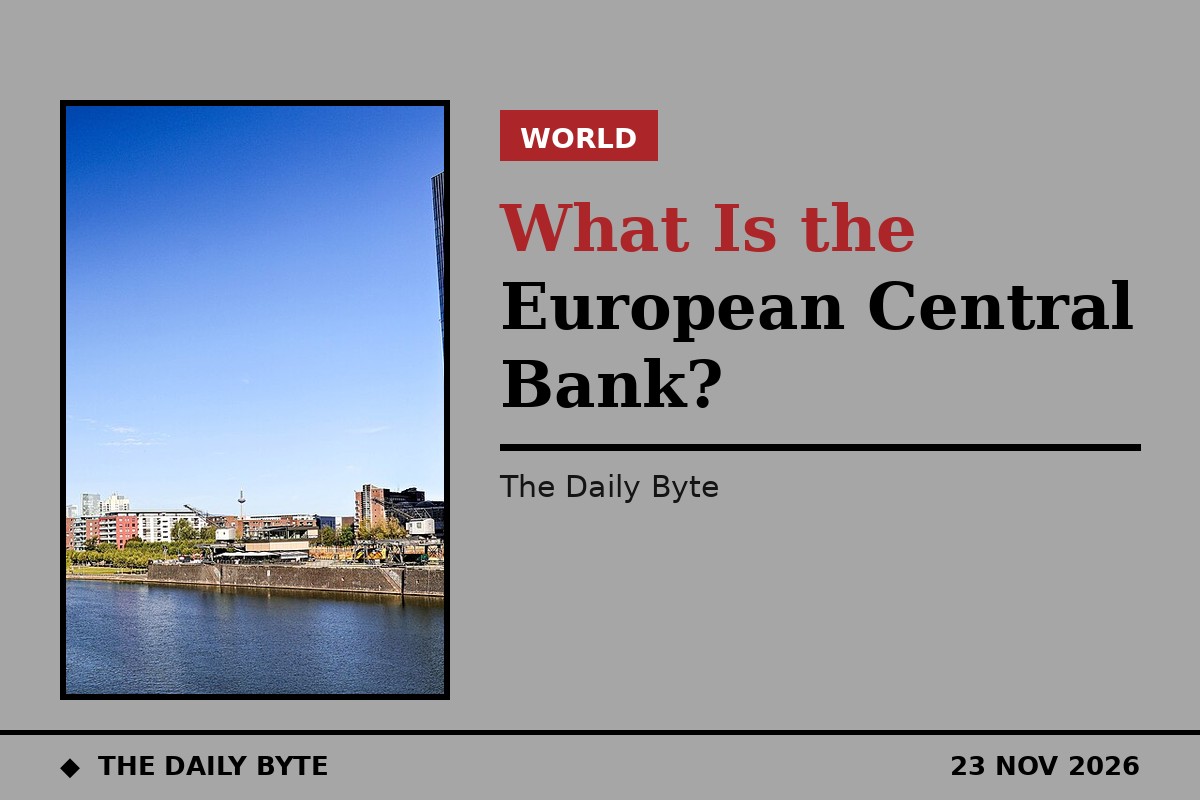
The European Central Bank, or ECB, is the central bank for the euro area — the countries that use the euro as their currency. Based in Frankfurt, Germany, it sets interest rates for the euro area, works to keep prices stable, and supervises the region's largest banks. Its president is Christine Lagarde.
In short, the ECB does for the euro area what the Bank of England does for the UK and the Federal Reserve does for the United States: it is the institution in charge of monetary policy. Its primary objective, set out in the EU treaties, is to maintain price stability, which it defines as inflation of 2% over the medium term.
What does the ECB do?
The ECB's main job is to define and implement monetary policy for the euro area. Its most visible tool is interest rates: it sets the rates at which commercial banks can borrow from, or deposit money with, the central bank. By raising rates it can cool an overheating economy and bring inflation down; by cutting them it can support lending and growth. The European Union's own description of the bank sums it up as managing the euro and framing and implementing EU economic and monetary policy, with the main aim of keeping prices stable and thereby supporting economic growth and job creation.
Beyond interest rates, the ECB manages the euro area's foreign currency reserves, carries out foreign exchange operations, and operates the payment systems that move money between banks. It has the exclusive right to authorise the issue of euro banknotes, and it monitors price trends and assesses risks to price stability. It also supervises the euro area's largest banks under the Single Supervisory Mechanism, working with national supervisors.
Who decides ECB policy?
Monetary policy is decided by the Governing Council, the ECB's main decision-making body. It is made up of the six members of the Executive Board plus the governors of the national central banks of the countries that use the euro. The Executive Board — the President, the Vice-President and four other members — handles the day-to-day running of the bank, implements monetary policy and prepares Governing Council meetings. A third body, the General Council, brings together the President, the Vice-President and the governors of all EU countries' central banks, and has an advisory and coordination role, including preparing for new countries joining the euro.
The current president is Christine Lagarde, the vice-president is Luis de Guindos, and the chief economist is Philip R. Lane. The ECB works with the national central banks of all EU countries; together they form the European System of Central Banks.
What are ECB interest rates now, and what happens in December?
The ECB's key rate is the deposit facility rate, the rate banks earn on money they deposit with the central bank overnight. As of 23 November 2026 it stands at 2.5%. The Governing Council held it there at its meeting on 29 October 2026, after raising it twice earlier in the year — in June, to 2.25%, and in September, to 2.50%.
The next decision is due at the Governing Council's meeting on 17 December 2026, and a further rise is widely expected. All 71 economists polled by Reuters between 10 and 12 November expected the ECB to raise the deposit rate by 0.25 percentage points to 2.75% in December. The reason is inflation: euro-area inflation reached 4.0% in October on the flash estimate, the highest since September 2023, with energy inflation at 20.8%. The ECB's own staff projections see inflation averaging 3.0% in 2026, 2.5% in 2027 and 2.1% in 2028 — above the 2% target for the better part of two more years. Bundesbank President Joachim Nagel, who sits on the Governing Council, said on 13 November that it was highly probable the ECB would have to raise rates again if conditions did not change, and chief economist Philip Lane has said it would be prudent to raise rates in December if the data do not shift.
The same Reuters poll found disagreement about what comes after December. A majority of 46 of the 71 economists expected the deposit rate to peak at 2.75% in December, but more than a third expected another increase, most likely in the first quarter of 2027. Markets are pricing in two to three rate rises by the end of 2027. President Lagarde has stressed that the inflation surge is predominantly energy-led, and she has not pre-committed to a December move, saying the outcome will depend on incoming data. By December the Governing Council will have the bank's full macroeconomic projections on the table, plus another round of inflation data, giving it a clearer read on whether the energy shock is spreading into wages and broader prices.
What is the Eurosystem?
The ECB does not work alone. It works with the national central banks of the countries that use the euro, and together they form the Eurosystem, which carries out the tasks of euro-area monetary policy. The wider European System of Central Banks brings in the national central banks of all EU countries, including those that have not adopted the euro.
In practice, the national central banks implement the Governing Council's decisions in their own countries — for example, by carrying out the ECB's lending operations with local banks — while the ECB itself sets the policy and the key interest rates. The ECB also works with national supervisors on banking supervision: under the Single Supervisory Mechanism it directly supervises the euro area's largest banks, while smaller banks are supervised by national authorities under its oversight. The Governing Council must meet at least ten times a year, and its monetary policy meetings are the moments markets watch most closely.
How was the ECB created?
The ECB was established on 1 June 1998, taking over from the European Monetary Institute, and it took responsibility for monetary policy in the euro area on 1 January 1999, when the euro was launched and the exchange rates of the first member countries were fixed for good. It is one of the seven institutions of the European Union and is directly governed by EU law. Its headquarters in Frankfurt, the twin-tower Skytower on the River Main, was completed in 2014.
The ECB's capital is owned by the central banks of all 27 EU member states. It employs more than 3,500 people in Frankfurt, working with the national central banks on monetary policy and banking supervision.
Frequently asked questions
Is the ECB the same as the Bank of England?
No. The Bank of England is the UK's central bank and sets Bank Rate for the UK. The ECB is the central bank for the euro area and sets interest rates for the countries that use the euro. The UK does not use the euro, so ECB decisions do not set UK interest rates, although they can affect the UK economy through trade and financial markets.
Which countries does the ECB cover?
The ECB sets monetary policy for the countries that use the euro, known as the euro area. It works with the national central banks of all EU countries, which together form the European System of Central Banks.
What is the deposit facility rate?
It is the interest rate the ECB pays banks on money they deposit with it overnight. It is the ECB's key policy rate and the one markets watch most closely: at 2.5% as of 23 November 2026, it is the benchmark for the cost of money across the euro area.
Does the ECB print euro banknotes?
The ECB has the exclusive right to authorise the issue of euro banknotes. The banknotes themselves are produced by the national central banks of the euro area countries, and member states can issue euro coins, with the volume approved by the ECB.
How often does the ECB meet to set rates?
The Governing Council must meet at least ten times a year. Its monetary policy meetings, at which it sets the key interest rates, are the ones that move markets — the next is on 17 December 2026, the final policy decision of the year.
Sources: European Union: European Central Bank (ECB); Global Banking and Finance / Reuters: ECB set for final rate hike in December; Eesti Pank: European Central Bank.


