What Is the European Sky Shield? Defence Explained
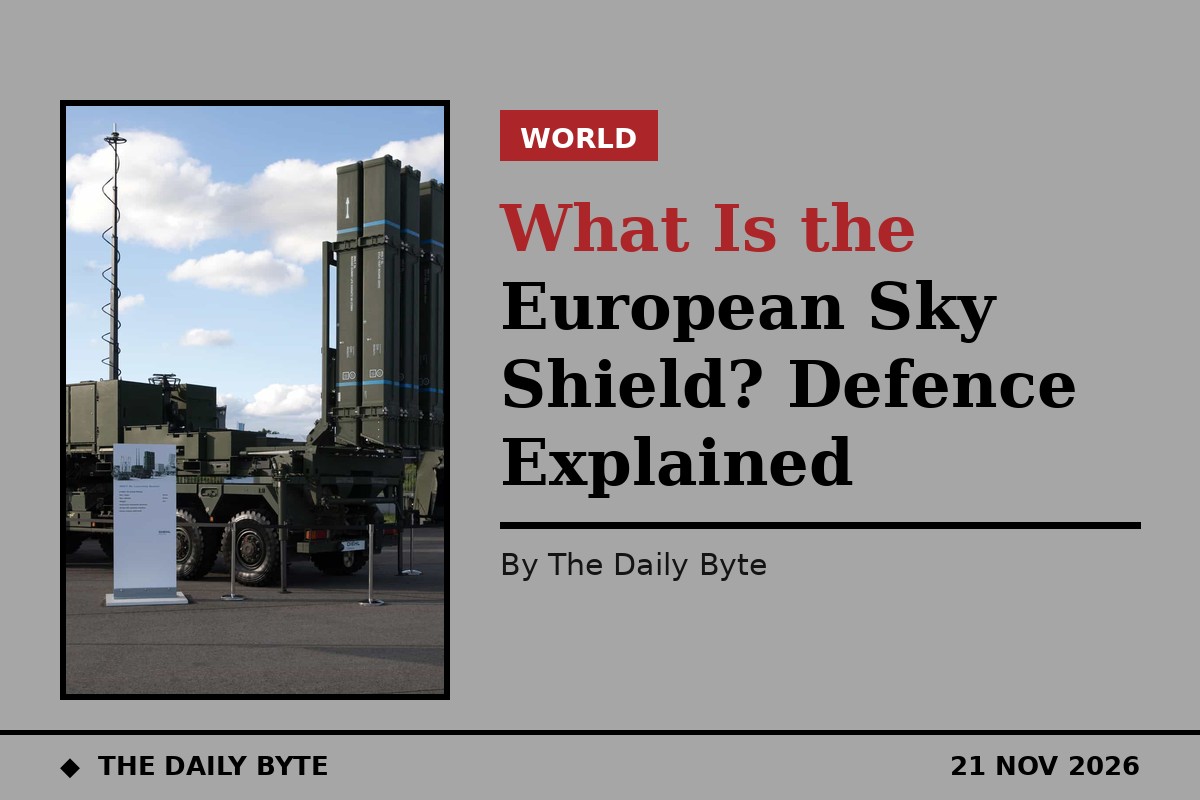
Europe's air defences are being rebuilt at a pace not seen since the Cold War, and the project at the centre of that effort has an unassuming name: the European Sky Shield Initiative. It is not an army, not an alliance and not a single weapon system. It is a German-led plan for European countries to buy compatible air defence systems together, so that missiles and drones can be intercepted anywhere from the Arctic to the Mediterranean. In October 2026 it reached 25 member states, and on 17 November Slovenia and Germany signed a new agreement to buy more missiles for the shield's workhorse system. This explainer sets out what the initiative is, how it works, who is in it, and why some of Europe's biggest countries have stayed out.
What is the European Sky Shield Initiative?
The European Sky Shield Initiative, usually shortened to ESSI, is a framework overseen by Germany to build a ground-based integrated European air defence system, including anti-ballistic missile capability. It was proposed by the then German Chancellor Olaf Scholz in a speech in Prague in August 2022, months after Russia's full-scale invasion of Ukraine had shown how vulnerable European skies were to missiles and drones. In October 2022 about 15 countries signed a letter of intent at NATO headquarters in Brussels to join. Since then membership has grown to more than 20 European states, and on 16 October 2026 the Bundeswehr, Germany's armed forces, reported that the initiative had reached 25 member states.
The most important thing to understand about ESSI is what it is not. It is not a new command or alliance, and it is not a NATO or EU body. It holds no common budget and it does not own any weapons. It is a procurement framework: members buy compatible systems together, to lower prices, speed up deliveries and simplify training and logistics. The systems themselves remain under national command, and they are integrated into NATO's Integrated Air and Missile Defence system. In other words, the shield is a shopping club with a shared catalogue, not a single European air force.
Why was it created?
The invasion of Ukraine exposed a gap that had been growing for decades. After the Cold War, European countries had run down their ground-based air defences, assuming that air superiority and expeditionary warfare made them unnecessary. Ukraine showed the opposite: a war in Europe could mean nightly missile and drone attacks on cities, power stations and ports, and the only defence against them was layered ground-based systems that could intercept threats at every altitude. Germany's own air defences were thin, and so were those of most of its neighbours. Scholz's proposal was a response to that shock: instead of each country buying its own incompatible systems, Europe would buy together, from a common menu, so that a German battery could work alongside a Dutch or a Slovenian one.
The initiative also had an economic logic. Air defence systems are expensive and slow to build, and production lines for interceptors are a bottleneck across the whole continent. Joint procurement means larger orders, lower unit prices, shared training and maintenance, and faster delivery. For smaller countries, it means access to systems they could not afford or operate alone. For Germany, the largest buyer, it means a market for its own defence industry, above all the IRIS-T system built by Diehl Defence.
What are the layers of the shield?
Air defence works in layers, because no single system can stop everything from a low-flying drone to a ballistic missile arcing through space. ESSI is built around a tiered menu, and each member chooses what to buy from it. For close-in defence against drones and low-flying aircraft there is the Skyranger gun system. For short range, up to about 10 kilometres, there is the IRIS-T SLS. For medium range, from about 10 to 70 kilometres, there is the IRIS-T SLM, made by Diehl Defence of Germany, and the NASAMS system. For long range, from about 70 to 150 kilometres, there is the American Patriot system and the Franco-Italian SAMP/T. For very long range, intercepting ballistic missiles above the atmosphere, there is the Israeli Arrow 3 system.
The IRIS-T SLM is the workhorse of the shield. It has gained a strong reputation in Ukraine, where it has been used to intercept cruise missiles and drones, and it has been ordered by eight ESSI members, including Germany, Estonia, Latvia, Slovenia, Bulgaria, Switzerland, Sweden and Denmark, with the combined pipeline worth north of 5 billion euros as of February 2026, according to the Grosswald air defence tracker. Bulgaria alone ordered the system at a cost of 1.1 billion euros. The Patriot, built by Raytheon and Lockheed Martin in the United States, is already used by many European countries, including Germany, the Netherlands, Spain, Poland, Sweden, Romania and Switzerland, and Germany ordered two replacement Patriot fire units on 2 November 2026. The Arrow 3 is the most visible element of the whole project: Germany signed a contract in 2023 worth about 3.6 to 4 billion euros, the largest defence deal in Israel's history at the time, and the first Arrow 3 unit was declared operational at Holzdorf air base in eastern Germany around the end of 2025, with further sites planned.
Who is in the initiative?
The 15 founding signatories of October 2022 were Belgium, Bulgaria, the Czech Republic, Estonia, Finland, Germany, Hungary, Latvia, Lithuania, the Netherlands, Norway, Romania, Slovakia, Slovenia and the United Kingdom. Since then the membership has grown to include Austria, Switzerland, Denmark, Sweden, Greece, Turkey, Poland, Albania and Portugal, among others, reaching 25 states by October 2026. The list is striking for what it includes: neutral Austria and Switzerland, which are not members of NATO, sit alongside Nordic and Baltic countries and the major European NATO states. The initiative is deliberately wider than NATO and wider than the EU, and that breadth is part of its appeal.
Three major European states have not joined: France, Italy and Spain. As of July 2026 they had made no decision to join, and France and Italy in particular have been vocal critics of the initiative. Their objection is industrial rather than military: ESSI's menu is dominated by German, American and Israeli systems, and they argue that European money should strengthen Europe's own defence industry instead. France and Italy build the SAMP/T system, and France ordered four more SAMP/T NG sections on 21 October 2026, bringing its total to twelve. In June 2023 President Emmanuel Macron hosted an air defence conference in Paris and argued that Europe should buy European systems to strengthen its industrial base and avoid dependence on non-European suppliers and export rules.
What has happened lately?
The initiative has moved quickly in the autumn of 2026. On 17 November, Slovenia and Germany signed an amendment to their bilateral air defence procurement agreement, opening the way for additional missile purchases as Ljubljana prepares to receive its first IRIS-T SLM system in 2027. The Slovenian defence minister, Valentin Hajdinjak, and the German defence minister, Boris Pistorius, signed the amendment in Brussels on the sidelines of a meeting of EU defence ministers. The agreement builds on Slovenia's participation in ESSI and will allow it to buy additional guided missiles for its German-made systems, although the ministry did not disclose how many missiles, at what cost, or on what delivery schedule.
Elsewhere the orders keep coming. Germany's procurement office ordered its two replacement Patriot fire units on 2 November, after earlier Patriot systems were transferred to Ukraine. Ukraine itself is part of the same competition for interceptors: 500 PAC-3 MSE missiles for Ukraine were notified on 30 October, with no delivery date announced, and the rounds are rationed between allied stocks. The European Union has also moved into the same space: less than three weeks before ESSI reached 25 members, the Council of the European Union identified an EU federated integrated air and missile defence project as a European Defence Project of Common Interest, with an estimated overall financial size of 55 to 80 billion euros by 2040. A German-led procurement initiative, an EU policy flagship, NATO capability requirements and EU loan instruments now operate over much of the same ground, without forming a single programme.
What is the debate about?
The argument over the Sky Shield is, at heart, an argument about speed versus sovereignty. Supporters stress that proven, available systems such as Patriot and IRIS-T can be delivered quickly, and that joint purchases save money and improve interoperability between allies who may one day have to fight together. Critics argue that relying on American and Israeli systems may limit European control over production, upgrades and exports, and that EU funding should prioritise European industry. In practice the two approaches increasingly overlap: EU instruments such as SAFE and EDIP encourage common procurement, several countries buy from both camps, combining IRIS-T with SAMP/T NG or Patriot, and air and missile defence is one of the EU's declared priority areas.
The debate is likely to continue, because the binding constraint is not money or political will but production. Interceptor supply remains a bottleneck everywhere, above all on the American solid-rocket-motor production line, and whether a given capital's air defence arrives in 2027 or 2031 depends on contract values, delivery dates and a handful of production bottlenecks that no government publishes side by side. ESSI does not solve that problem on its own. What it does is give Europe a common framework for buying its way out of it, one contract at a time, and a test of whether European countries can still act together when the threat is shared. The Slovenia agreement of 17 November is the latest small piece of that test, and the shield will be judged not by how many countries sign up, but by how many interceptors actually arrive.


