What Is the European Union? Members and Powers
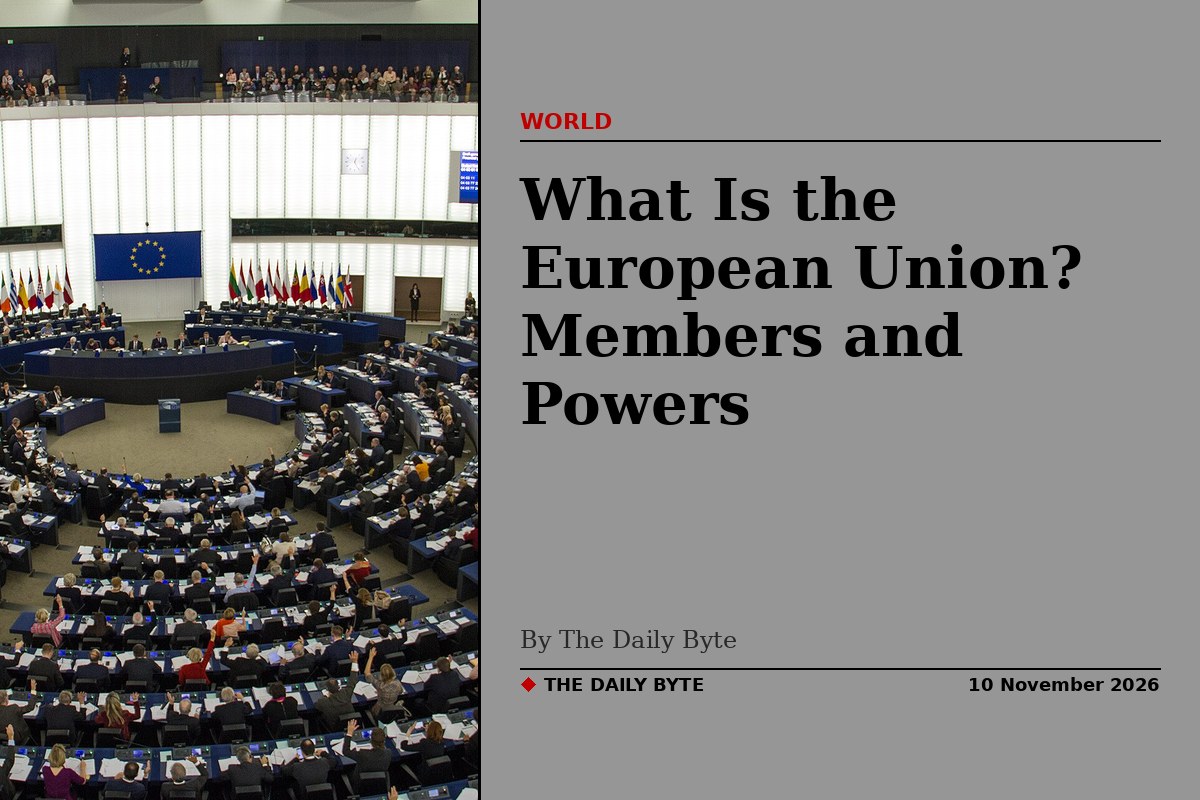
The European Union, or EU, is a political and economic union of 27 European countries. Its members share a single market, most share a single currency, the euro, and they make many laws together through shared institutions in Brussels and Strasbourg. It is not a country: each member state keeps its own government, army and foreign policy, but they have agreed to pool sovereignty in areas such as trade, competition, agriculture and the environment.
The EU is in the news on 10 November 2026 because UK ministers are in Brussels for talks with the EU ahead of a summit, and EU budget talks for 2027 are under way. Understanding what the EU is, who belongs to it and how it makes decisions is the starting point for making sense of those stories.
How did the European Union begin?
The EU grew out of the ruins of the Second World War. In 1957, six countries, Belgium, France, Germany, Italy, Luxembourg and the Netherlands, signed the Treaty of Rome and created the European Economic Community, a common market for coal, steel and then goods more widely. The idea was that countries which traded together would be less likely to fight each other.
Over the decades the community grew, taking in new members and new powers. The Maastricht Treaty, signed in 1992 and in force from 1993, created the European Union as it is known today, adding cooperation on foreign policy, justice and home affairs to the economic core. Croatia, which joined in 2013, was the last country to become a member. The United Kingdom left on 31 January 2020, the first country ever to do so, an event known as Brexit.
Which countries are in the European Union?
There are 27 member states: Austria, Belgium, Bulgaria, Croatia, Cyprus, Czechia, Denmark, Estonia, Finland, France, Germany, Greece, Hungary, Ireland, Italy, Latvia, Lithuania, Luxembourg, Malta, the Netherlands, Poland, Portugal, Romania, Slovakia, Slovenia, Spain and Sweden. Together they have a population of around 450 million people, making the EU one of the largest economies in the world.
Joining the EU is a long process. A country must meet conditions on democracy, the rule of law, human rights and a functioning market economy, and then negotiate its entry chapter by chapter. Several countries in the Balkans and Eastern Europe are currently candidates or applicants, but none has joined since Croatia in 2013.
What is the single market?
The heart of the EU is the single market, which allows goods, services, capital and people to move freely between member states, almost as if they were one country. A company in Poland can sell to customers in Spain without tariffs or customs checks. A worker from Portugal can take a job in Germany without a work permit. A bank in the Netherlands can offer services in Italy.
That freedom is backed by shared rules. EU law sets common standards for product safety, food, chemicals, data protection and competition, so that a product legal in one member state is generally legal in all of them. The European Court of Justice, based in Luxembourg, settles disputes about what EU law means, and its rulings bind national courts.
Do all EU countries use the euro?
No. Twenty-one of the 27 member states use the euro as their currency, forming the euro area. Bulgaria became the 21st member on 1 January 2026, replacing the lev with the euro. The six EU countries that still use their own currencies are Czechia, Denmark, Hungary, Poland, Romania and Sweden. Denmark has a formal opt-out from the euro, agreed in 1992; the others are expected to join once they meet the economic conditions.
The euro is managed by the European Central Bank in Frankfurt, which sets interest rates for the whole euro area, much as the Bank of England does for the UK or the Federal Reserve does for the United States. Some countries outside the EU also use the euro, including Montenegro and Kosovo, and Andorra, Monaco, San Marino and Vatican City use it under formal agreements.
What is the Schengen area?
The Schengen area is the passport-free travel zone that covers 29 countries, most of them in the EU plus Iceland, Liechtenstein, Norway and Switzerland. Inside it, people can cross borders without showing a passport. It is separate from EU membership: Ireland is in the EU but not in Schengen, while Norway and Switzerland are in Schengen but not in the EU. Bulgaria and Romania joined Schengen in 2025.
How does the European Union make decisions?
The EU has three main institutions. The European Commission, based in Brussels, proposes new laws and makes sure member states follow them. The European Parliament, whose members are directly elected by voters across the EU every five years, debates and votes on those laws, meeting mainly in Strasbourg and Brussels. The Council of the European Union, made up of ministers from each member government, also votes on laws. Most laws need the agreement of both the Parliament and the Council.
Above them sits the European Council, the regular meeting of the EU's heads of state and government, which sets the overall political direction. Its president chairs the summits where the biggest decisions, such as the EU budget, enlargement or sanctions, are taken. The EU budget itself, which funds farming, regional development, research and aid, is agreed by the member states and the Parliament together, and the 2027 budget is being negotiated in Brussels now.
What powers does the EU have, and what stays national?
The EU has exclusive power over trade policy, competition rules and monetary policy for the euro area. It shares power with member states in areas such as agriculture, the environment, consumer protection and transport. But taxation, defence, education, health and most welfare policy stay mainly with national governments. That balance is a constant argument: some say the EU should do more, others say it already does too much, and the tension shapes every summit.
Frequently asked questions
Is the United Kingdom still in the European Union? No. The UK left the EU on 31 January 2020 after the Brexit referendum, and it is no longer a member of the single market or the customs union.
Is the European Union a country? No. It is a union of 27 sovereign countries that have agreed to share decision-making in certain areas. Each member keeps its own government, flag and seat at the United Nations.
Do all EU countries use the euro? No. Twenty-one of the 27 use the euro. The other six, Czechia, Denmark, Hungary, Poland, Romania and Sweden, keep their own currencies.
What is the difference between the EU and Europe? Europe is a continent of around 50 countries. The EU is a political and economic union of 27 of them. Countries such as the UK, Norway, Switzerland, Ukraine and Turkey are European but not EU members.
Where is the EU based? Its main institutions are in Brussels, Belgium, with the European Parliament also meeting in Strasbourg, France, and the European Central Bank in Frankfurt, Germany.
Sources: European Union — EU countries and Countries.World — European Union members.


