What Is the F-35? Stealth Fighter Explained
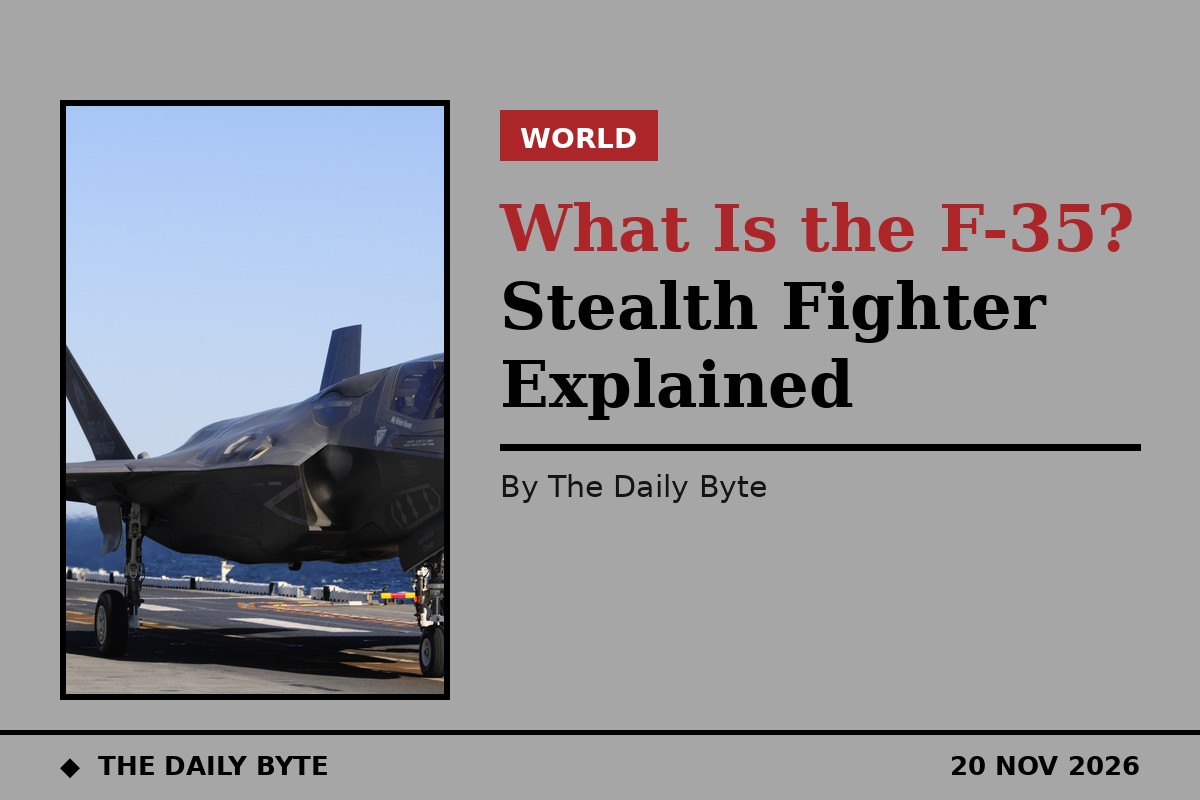
The F-35 Lightning II is a stealth fighter jet built by the American defence company Lockheed Martin, and it is one of the most expensive and most widely flown military aircraft in the world. It is in the news after a US military F-35B made an unscheduled landing at Kochi Ryoma Airport in western Japan on Friday 20 November 2026, touching down at about 11.07am local time with no injuries reported. This guide explains what the F-35 is, how the three versions differ, who flies it, and why it matters.
The short answer is that the F-35 is a single-seat, single-engine, supersonic stealth fighter designed to do three jobs in one airframe: fight other aircraft, strike targets on the ground, and gather intelligence. It is the most produced Western fifth-generation fighter, with more than 1,300 aircraft built, and it flies with the United States and 19 allied nations. Its pilots call it a flying computer as much as a fighter jet, because its sensors and software are as important as its speed and stealth.
What is the F-35 Lightning II?
The F-35 came out of the Joint Strike Fighter programme, a US-led effort in the 1990s to build one aircraft that could replace several different fighters used by the Air Force, Navy and Marine Corps. Lockheed Martin is the prime contractor, with Northrop Grumman and BAE Systems as major airframe partners, and Pratt and Whitney builds the F135 engine. Lockheed Martin's X-35 design beat Boeing's X-32 in October 2001, and the first F-35 flew on 15 December 2006.
The aircraft is a family of single-seat, single-engine, supersonic stealth strike fighters. It is the second fifth-generation fighter to enter US service, after the F-22, and the first operational supersonic stealth fighter capable of short take-off and vertical landing. The US Air Force considers it its primary strike fighter for suppressing enemy air defences and for air interdiction missions, and the United States has a programme of record for 2,456 aircraft across the Air Force, Navy and Marine Corps.
What are the three F-35 variants?
All three versions of the F-35 share the same engine core, sensors and software, but they differ in structure and in how they take off and land. The differences are big enough that each variant is effectively a different aircraft built around the same systems.
The F-35A is the conventional take-off and landing version, designed for ordinary runways. It is flown by the US Air Force and most export customers, and it is the only variant with an internal 25-millimetre gun. It entered US service on 2 August 2016. The F-35B is the short take-off and vertical landing version, known as STOVL. It has a lift fan behind the cockpit and a swivelling rear nozzle, which let it take off from short runways and land vertically, like the Harrier jump jet it replaces. It is flown by the US Marine Corps, the United Kingdom, Italy and Japan, and it was the first variant to enter service, on 31 July 2015. The F-35C is the carrier version, built for catapult launch and arrested landing on aircraft carriers. It has a larger wing with folding wingtips and stronger landing gear, and it is flown by the US Navy. It entered service on 28 February 2019.
The trade-offs between the variants are straightforward. The F-35B's lift fan costs it fuel and range, because the fan takes up space that would otherwise hold fuel. The F-35C's bigger wing gives it more range and a gentler landing speed, but makes it heavier. The F-35A, free of both complications, is the lightest and longest-ranged of the three.
What makes the F-35 a fifth-generation fighter?
Fifth-generation is the label used for aircraft that combine low radar visibility with networked sensors and heavy onboard computing. Three things set the F-35 apart from the fourth-generation fighters it replaces, such as the F-16 and the F/A-18.
The first is stealth. The shape of the airframe, radar-absorbing materials and weapons carried inside the fuselage all reduce the distance at which enemy radars can detect and track the jet. The aircraft carries its weapons in two internal bays, each with two stations, so that nothing hangs off the wings to reflect radar. External weapons can be added on six more stations, but only when stealth is less important than firepower.
The second is sensor fusion. The F-35 gathers data from its radar, cameras, electronic warfare systems and other sensors, and combines it into a single picture that is shown to the pilot on a helmet-mounted display. The pilot can effectively see through the floor of the aircraft, because cameras around the airframe feed a 360-degree view into the helmet. The third is networking: the jet shares what it sees with other aircraft, ships and ground forces, so one F-35 can guide weapons fired by another platform. That ability to act as a sensor and a command node, rather than just a shooter, is the core of the design.
Who flies the F-35?
Lockheed Martin says the F-35 flies with the United States and 19 allied nations. Twenty countries are in the programme: the United States, Australia, Belgium, Canada, the Czech Republic, Denmark, Finland, Germany, Greece, Israel, Italy, Japan, the Netherlands, Norway, Poland, South Korea, Romania, Singapore, Switzerland and the United Kingdom. As of April 2026, both F-35As and F-35Bs were operated by Italy and Japan, F-35As by Australia, Belgium, Denmark, the Netherlands, Norway, Poland and South Korea, and F-35Bs by the United Kingdom.
Japan is one of the most important operators. It flies both the F-35A and the F-35B, and it is one of only three countries where final assembly takes place, alongside the United States at Fort Worth in Texas and Italy at Cameri. The F-35B is particularly important for Japan, because it can operate from the country's helicopter destroyers, which have been modified to carry fixed-wing aircraft. That is why a US Marine Corps F-35B operating in Japanese waters is a routine sight, and why an unscheduled landing at a civilian airport in Japan draws so much attention.
How many F-35s are there and what do they cost?
More than 1,300 F-35s have been built, and Lockheed Martin delivered a record 191 jets in 2025, with 51 more in the first half of 2026. The company counts more than 1,375 aircraft delivered, operating from 55 bases, with over 3,610 pilots and 21,980 maintainers trained. The latest production contract, covering Lots 18 and 19, is for 296 jets worth about 24.3 billion dollars.
The programme is the most expensive weapons programme in history, and its cost has been a source of political argument in the United States for two decades. Supporters argue that the cost falls with every production lot and that the aircraft's capabilities justify the price; critics point to delays, software problems and the cost of maintaining a stealth fleet. Both sides agree on one fact: no other Western fighter is being built in anything like the same numbers, and for most allied air forces the F-35 is now the only option for a new frontline fighter.
What aircraft does the F-35 replace?
The F-35 was designed to replace a whole generation of fighters: the F-16 Fighting Falcon in the US Air Force, the F/A-18 Hornet in the US Navy, and the AV-8B Harrier jump jet in the US Marine Corps. The idea was that one aircraft, in three versions, could do the jobs that previously needed three separate designs, with common parts, common training and common software reducing the cost of running them.
That plan has largely worked, though not without friction. The Marine Corps retired its Harriers as F-35Bs arrived, and the Air Force is replacing its older F-16s with F-35As. The Navy, which still flies the F/A-18 Super Hornet alongside the F-35C, has been slower to switch, because carrier operations put different demands on an aircraft. The F-35 has also become the standard fighter for America's closest allies: Britain, Italy, the Netherlands, Norway, Denmark, Australia, Japan, South Korea and Israel all fly it, which means their air forces can operate together using the same data links and the same weapons.
What happened at Kochi airport?
The incident that put the F-35 back in the headlines happened on Friday 20 November 2026, when a US military F-35B made an unscheduled landing at Kochi Ryoma Airport in western Japan. The jet touched down at about 11.07am local time, and nobody was hurt. Kyodo News described the landing as an emergency landing, citing local authorities, while officials in Kochi Prefecture were more cautious, telling TBS News that they suspected it was a precautionary landing and were checking with the regional defence bureau and the transport ministry.
The cause of the unscheduled landing was not immediately known. The Kochi prefectural government told Kyodo News that nobody was hurt, and the airport office said there were no reports of delays to other aircraft and that flights were operating normally. Television crews filmed a person believed to be the pilot walking around the jet and checking it over just after noon, and TBS reported that no external abnormality was visible on the aircraft at that stage. As of Friday afternoon, the United States military had not publicly confirmed which unit the aircraft belonged to or the reason it diverted to Kochi.
Unscheduled landings by military jets at civilian airports are not unusual, and they are usually precautionary: a warning light, a suspected fault or a weather problem is enough for a pilot to choose the nearest suitable runway rather than continue to base. The Kochi landing drew attention because it involved the F-35, because it happened at a busy civilian airport, and because it came on the same day that the aircraft was already in the news. The jet's safe landing, with no injuries and no disruption to civilian flights, is the outcome the system is designed to produce.
Why does the F-35 matter?
The F-35 matters for two reasons, one military and one political. Militarily, it is the aircraft that the United States and its allies will rely on for the next thirty years, and its ability to share data between aircraft, ships and ground forces is changing how air wars are fought. A single F-35 can detect a target, pass the information to a ship or another aircraft, and have the shot taken by a platform the enemy never sees.
Politically, the F-35 is the glue of the Western alliance's air power. Because so many countries fly the same aircraft, they can train together, share spare parts and fight together without the compatibility problems that used to plague coalition operations. That is also why arguments about the aircraft's cost, its software and its availability are never just technical debates: they are arguments about what kind of air force the United States and its allies will have for a generation. The jet that landed safely at Kochi on 20 November is one of more than 1,300 already flying, with hundreds more on order.


