What Is the FCC Cyber Trust Mark?
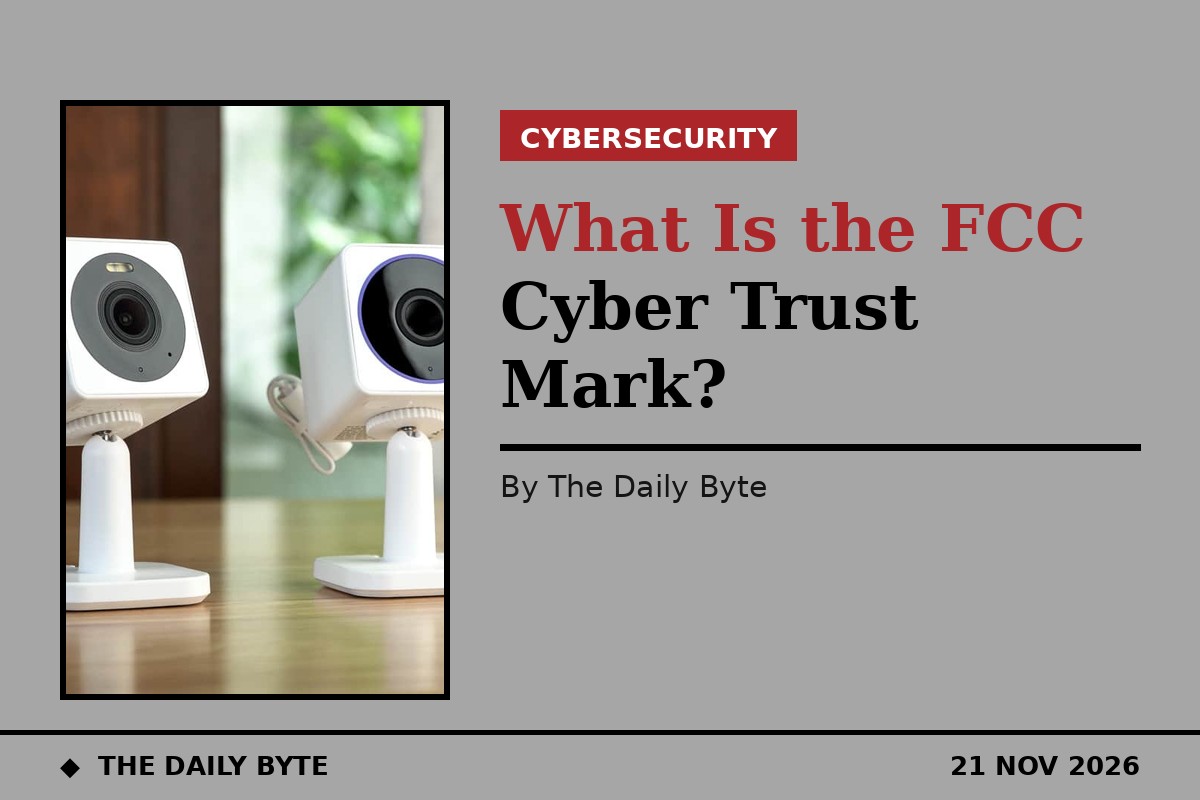
The FCC Cyber Trust Mark is a voluntary cybersecurity label for wireless smart devices sold in the United States. When it appears on a product's packaging, it will mean the device has been tested against baseline cybersecurity standards and passed. A QR code printed next to the mark will let shoppers scan for plain-language details about the product's security, including how long the manufacturer will support it and whether security updates install automatically.
The programme is back in the news because the Federal Communications Commission is about to publish the detailed rules that would make it work. Cybersecurity Dive reported on 20 November 2026 that the FCC will propose the regulatory details in a Federal Register notice scheduled for publication on Monday 23 November, with public comments open through 23 December. The proposal covers the design and placement of the label, how product registry information is displayed, certification renewal, post-market surveillance, and procedures for complaints, noncompliant products and programme administrators that withdraw or lose their authority.
For now, shoppers cannot look for the mark on any shelf. No product can carry it yet, and the FCC still has to finalise its requirements before the programme can become operational. But the latest moves suggest it is closer than it has been at any point since the rules were first adopted in March 2024.
What the label actually is
The Cyber Trust Mark is a shield-shaped logo that qualifying products will be allowed to display on their packaging. It is accompanied by a QR code, and that code is doing most of the work. Scanning it will open a registry page for that specific product, showing easy-to-understand security information: how to change the default password, how to configure the device securely, whether updates and patches are automatic and, if not, how to get them, and the end date of the product's minimum support period. If a manufacturer does not support the device at all, the registry will say so plainly, so buyers are not left guessing.
The online information has been described as a "cyber nutrition label" for connected devices, by analogy with the food labels that summarise what is inside a packet. The comparison is deliberate. Just as the Energy Star logo helped shoppers recognise energy-efficient appliances, the FCC wants the Cyber Trust Mark to help shoppers recognise devices built to a recognised security baseline, and to give manufacturers a commercial reason to meet that baseline.
The label is binary: a product either earns it or it does not. There are no star ratings or tiers. The FCC's October 2026 public notice describes a single label, and the physical label proposed is at least one inch by two inches, carrying the mark and the QR code, with smaller formats under consideration for products with less packaging space.
Which products can carry it, and which cannot
The programme applies to wireless consumer Internet of Things products. The FCC's own examples of eligible products include internet-connected home security cameras, voice-activated shopping devices, smart appliances, fitness trackers, garage door openers and baby monitors. Those are the devices that sit in people's homes, connect to Wi-Fi, and are most often attacked because they ship with weak default passwords or stop receiving security updates.
Several categories are excluded. Medical devices regulated by the Food and Drug Administration are out, as are motor vehicles and equipment regulated by the National Highway Traffic Safety Administration. Wired devices are excluded, as are products primarily used for manufacturing, industrial control or enterprise applications. Personal computers, smartphones and routers are also outside the programme; the National Institute of Standards and Technology is working separately on cybersecurity requirements for consumer-grade routers.
There are also national-security exclusions. Equipment on the FCC's Covered List is barred, as are products from companies on the Department of Commerce's Entity List, the Department of Defense's list of Chinese military companies, and entities banned from federal procurement. Manufacturers outside the United States will be eligible to apply, as long as they are not otherwise prohibited from participating.
How a product earns the mark
The security baseline comes from the National Institute of Standards and Technology. The FCC adopted NIST IR 8425, the Profile of the IoT Core Baseline for Consumer Products published in September 2022, as the foundation for the programme. That document sets out the core cybersecurity capabilities a consumer IoT product should have, such as secure configuration, protection of stored and transmitted data, and the ability to receive software updates.
Before a manufacturer can apply to use the mark, its product must be tested by an accredited laboratory recognised by the FCC, known as a CyberLAB, to show it meets the programme's requirements. The manufacturer then submits an application with supporting documents to a Cybersecurity Label Administrator, which reviews the application and either approves or denies use of the label. The administrators and the laboratories must be accredited to international standards, ISO/IEC 17065 for the administrators and ISO/IEC 17025 for the laboratories.
Certification is not a one-off event. Under the proposals published for comment, manufacturers would have to renew their certifications every three years, rather than the five-year period recommended by industry stakeholders, because the FCC is concerned that a longer period would not keep pace with evolving threats. Renewal applications would have to be submitted at least 90 days before a certification expires, and the administrators would have 90 days to complete their evaluations.
Who runs the programme
The programme is owned by the FCC, but the day-to-day work is done by third parties. A Lead Administrator recommends cybersecurity standards, testing procedures and label design to the Commission, develops a consumer education campaign, and acts as a liaison with the other administrators. Cybersecurity Label Administrators handle applications and decide whether a product may use the label. CyberLABs do the testing.
The Lead Administrator role has already changed hands once. UL Solutions was first selected for the role in December 2024, but withdrew around the end of 2025, a disruption that stalled the programme and raised questions about whether the FCC's new leadership remained committed to it. In April 2026 the FCC selected the ioXt Alliance as the new Lead Administrator, and in October 2026 the FCC's Public Safety and Homeland Security Bureau issued a public notice seeking comment on label design, certification renewal and post-market surveillance. Later that month, FCC Chair Brendan Carr announced that Commissioner Olivia Trusty would lead the programme's rollout, working with the bureau that manages it. "Our goal is a program that is practical for manufacturers, credible to consumers, and effective in encouraging better security across the marketplace," Trusty said.
The Consumer Technology Association and the ioXt Alliance have proposed technical standards for the programme, and the FCC is expected to seek comment on the technical cybersecurity requirements and testing procedures in the coming months.
Checks after products reach the shops
The proposals now out for comment also cover what happens after a certified product goes on sale. The FCC wants post-market surveillance by the administrators, including product sampling and independent testing, carried out by a recognised laboratory rather than the manufacturer's own in-house laboratory. Products that no longer meet the requirements could lose their authorisation to display the mark, and the mark would have to be removed from the affected products and marketing materials.
The FCC is also proposing a system of "ad-hoc surveillance" to investigate potentially systemic weaknesses after a major cyberattack involving hacked devices. At the Commission's direction, programme administrators would develop a testing plan, collect devices from vendors, test them and report back to the FCC. The proposed rule asks commenters whether administrators should be able to start such checks without instruction from the Commission.
Complaints about misuse of the label would also be handled under the new procedures, including cases where a product carries the mark without authorisation or where a certified product has stopped meeting the standard.
Why it has taken so long
The programme has been in development since 2023. The FCC first proposed it in July of that year, sought public comment in August, and adopted the rules establishing its framework on 14 March 2024, in Report and Order FCC 24-26. The rules took effect in September 2024, and the FCC then had to stand up the machinery: accredit administrators and laboratories, agree standards and test procedures, design the label and build the registry.
That work moved slowly, and the withdrawal of the first Lead Administrator cost the programme months. The renewed momentum in 2026, with a new Lead Administrator, a commissioner put in charge of the rollout, and the October public notice, is the clearest sign yet that the FCC intends to finish the job. Commissioner Trusty has signalled that the mark could begin appearing on consumer products within a year, although that depends on the remaining requirements being finalised.
What shoppers should do now
Until the mark appears, there is no label to look for, and no shortcut for judging whether a smart device is secure. The questions the Cyber Trust Mark will answer are the ones worth asking anyway: how long will the manufacturer provide security updates, do updates install automatically, can the default password be changed, and does the product have a camera, microphone or location tracking. The FCC's proposal would require disclosure of whether a product has camera, audio or location-tracking capabilities, and the registry information would be presented in English and Spanish and made accessible to people using assistive technologies.
When the label does arrive, it will not guarantee that a device can never be hacked. No label can do that. What it will guarantee is that the product passed an independent test against a published baseline, that its support period is stated in writing, and that someone other than the manufacturer is checking that it keeps meeting the standard. For a market in which the least secure products have historically been the cheapest and the most popular, that is the change the programme is designed to make.


