What Is the FTSE 100? Explained
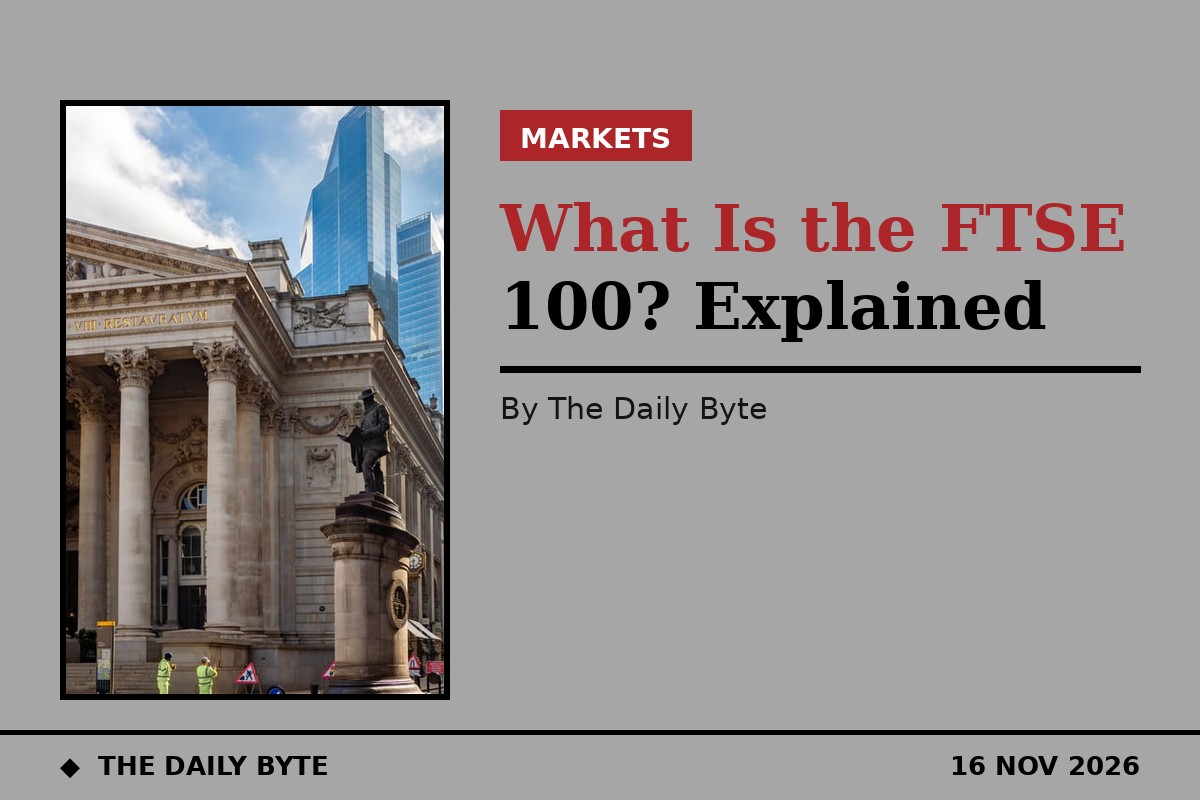
The FTSE 100 is an index of the 100 largest companies listed on the London Stock Exchange, ranked by the value of their shares. It is the most widely quoted measure of how the UK stock market is performing, and it is pronounced "footsie". When news reports say the London market rose or fell, they are usually talking about the FTSE 100.
The index closed at 10,902.56 points on Friday 13 November 2026, a three-month high and its highest level since early August. It rose 39.47 points, or 0.36 percent, on the day and gained 2.2 percent over the week, helped by energy, healthcare, utility and consumer shares. This explainer sets out what the index is, how it is built, which companies are in it, and what its level does and does not tell you.
What does FTSE 100 stand for?
FTSE stands for Financial Times Stock Exchange. The full name of the index is the Financial Times Stock Exchange 100 Index, and the "100" refers to the number of companies it contains. The name comes from its origins as a joint venture between the Financial Times newspaper and the London Stock Exchange.
Today the index is calculated and maintained by FTSE Russell, part of the London Stock Exchange Group. The Financial Times no longer has a role in running it, but the name has stuck, and "the Footsie" remains the everyday shorthand used by traders, journalists and investors across the UK.
The FTSE 100 was launched on 3 January 1984 with a starting value of 1,000 points. That base figure is why the index is quoted in points rather than pounds: a reading of 10,902.56 means the combined value of its companies is roughly eleven times what it was, on the index's own scale, when it began. The index passed 10,000 points for the first time in January 2026 and has risen by about 10 percent since the start of the year.
How is the FTSE 100 calculated?
The FTSE 100 is weighted by market capitalisation, which is the total value of a company's shares in issue. A company's market capitalisation is its share price multiplied by the number of shares it has issued. The bigger the company, the more influence its share price has on the index.
Only shares that are freely available for the public to trade count towards a company's weighting. This is known as free-float adjustment. Shares locked up by founders, governments or controlling shareholders are excluded, so the index reflects the part of each company that ordinary investors can actually buy and sell.
The index is calculated continuously on every weekday, except UK public holidays, from the market open at 8am until the close at 4.30pm. The closing value is the figure most often reported in the news, because it is the single reference point for the day. Intraday, the level moves with every trade in its constituent shares.
Because the index is weighted by size, a sharp move in one of its largest companies matters far more than the same percentage move in one of its smallest. That is why results from a handful of giants, such as the big banks, oil producers and drug makers, can move the whole index on a single day.
Which companies are in the FTSE 100?
The index contains the 100 largest eligible companies on the London Stock Exchange's main market. They are often called blue-chip companies, meaning large, established businesses. HSBC is currently the largest constituent by market value, and the top of the index is dominated by banks, energy companies, pharmaceutical firms, miners and consumer goods groups.
Household names in the index include oil producers Shell and BP, drug makers AstraZeneca and GSK, banks such as HSBC, Lloyds and Barclays, and consumer groups such as Unilever. On Friday 13 November 2026, BP and Shell each rose by about 1.5 percent, Centrica rose 3.8 percent and insurer Aviva rose 3.4 percent after reporting a 19 percent jump in nine-month general insurance premiums. Those moves helped lift the index to its three-month high.
One of the most important things to understand about the FTSE 100 is that it is not a pure measure of the UK economy. Many of its largest companies earn most of their revenue overseas. Shell and BP sell oil around the world, HSBC is a global bank, and AstraZeneca sells medicines internationally. The index therefore reflects the fortunes of large multinational businesses that happen to be listed in London, rather than the day-to-day state of British high streets.
How often does the FTSE 100 change?
The membership of the index is reviewed every quarter, in March, June, September and December. FTSE Russell ranks eligible companies by market capitalisation and applies set rules, including buffers at the 90th and 111th places, so that companies do not keep dropping in and out of the index on small changes in value.
Changes take effect after the third Friday of the review month. A company that has grown large enough is promoted from the FTSE 250, the index of the next 250 largest companies, while a company that has shrunk is relegated to it. The 100 companies in the index today will not necessarily be the same 100 in a year's time.
Companies must also meet conditions on their listing category, the currency their shares are denominated in, and how much of their stock is freely traded. These rules are set out in the FTSE UK Index Series ground rules published by FTSE Russell, and they can change.
What is the FTSE 100 at now?
On Friday 13 November 2026 the FTSE 100 closed at 10,902.56, up 39.47 points or 0.36 percent from Thursday's close of 10,863.09. It was the index's highest close since early August, and it completed a 2.2 percent rise over the week. Energy and defensive shares led the advance, as a wobble in the global artificial intelligence trade pushed investors towards steadier sectors.
The mid-cap FTSE 250 moved the other way on the same day, falling 0.4 percent to 24,805.41, although it still finished higher over the week. The contrast shows that the two indices can tell different stories: the FTSE 100 is dominated by large international companies, while the FTSE 250 contains more domestically focused businesses.
The index had already touched a three-month high earlier in the month. On Thursday 5 November it jumped 119 points to 10,948 at the open, ahead of a Bank of England interest rate decision, and it came close to the record high reached at the end of July. Market levels change every trading day, so any figure in this article is a snapshot from the date stated.
FTSE 100, FTSE 250 and FTSE All-Share: what is the difference?
The FTSE 100 is one member of a family of UK indices. The FTSE 250 holds the next 250 largest companies after the FTSE 100. Together, the FTSE 100 and the FTSE 250 make up the FTSE 350. Add the FTSE SmallCap, which covers smaller listed companies, and you get the FTSE All-Share, the broadest measure of the London market.
The FTSE 250 is often seen as a better guide to the domestic UK economy than the FTSE 100, because its companies tend to earn more of their revenue at home. The FTSE 100, by contrast, is the benchmark that international investors watch. Both indices are calculated by FTSE Russell, and both are reviewed quarterly.
About 80 percent of the total market capitalisation of the London Stock Exchange's main market sits in the FTSE 100. That concentration is why the index carries so much weight in financial reporting, even though it contains only 100 of the hundreds of companies listed in London.
Why does the FTSE 100 matter?
The FTSE 100 matters for three reasons. First, it is the benchmark against which UK fund managers are judged. A fund that invests in large UK shares is usually compared with the FTSE 100, and its performance is measured against the index over months and years.
Second, it is the basis for a large market in tracker funds and exchange-traded funds. These funds aim to follow the index, so millions of pension savers and individual investors hold FTSE 100 shares indirectly, even if they have never bought a single share themselves. When the index rises, the value of those pension pots and savings generally rises with it.
Third, it is a barometer of investor confidence. A rising index usually means investors are willing to pay more for shares, while a falling index usually means they are worried about profits, interest rates or the wider economy. It is a barometer, not a diagnosis: the index can rise while parts of the economy struggle, and fall while others do well.
Can you invest in the FTSE 100?
You cannot buy the FTSE 100 itself, because it is only a number calculated from share prices. What you can buy are funds that track it. A tracker fund or exchange-traded fund holds shares in the same proportions as the index, so its value moves in line with the index, minus fees.
Tracker funds are generally cheaper than funds run by a manager who picks individual shares, because there is no stock-picking to pay for. They are widely held in pensions and in stocks and shares ISAs. This article is general information only. It is not financial advice, and it is not a recommendation to buy or sell any investment.
Anyone considering investing should understand that the value of investments can fall as well as rise, that past performance is not a reliable guide to the future, and that the FTSE 100's overseas earnings mean its level is affected by the pound. When sterling is strong, the overseas profits of its big companies are worth less in pounds, which can hold the index back even when those companies are doing well.
What moves the FTSE 100 up and down?
Company results are the most direct driver. When a large constituent reports profits ahead of expectations, raises its dividend or announces a share buyback, its share price often rises and pulls the index with it. The reverse happens when results disappoint.
Interest rates matter too. The Bank of England sets Bank Rate, and changes in the rate affect borrowing costs for companies and the returns available on savings and bonds. In early November 2026, the Bank was preparing an interest rate decision that markets expected to be a rise to 4 percent from 3.75 percent, its first increase since August 2023. Expectations about rates move shares, banks and housebuilders in particular.
Oil prices, the pound and global events also play a part. A higher oil price tends to help BP and Shell, which are large constituents. Geopolitical tension, such as the Gulf shipping tensions and strikes on Saudi infrastructure reported in November 2026, can push oil higher and lift energy shares. A weaker pound tends to help the index, because overseas earnings translate into more pounds.
Frequently asked questions
What is the FTSE 100 in simple terms? It is a list of the 100 biggest companies on the London Stock Exchange, turned into a single number that shows how their shares are performing together.
Is the FTSE 100 the same as the UK economy? No. Many of its companies earn most of their money abroad, so it is a measure of large London-listed companies, not of UK economic output.
What was the FTSE 100's highest level? The index reached a record high at the end of July 2026 and was close to that level again in November 2026, closing at 10,902.56 on 13 November. The exact record figure changes whenever the index sets a new high.
How often is the FTSE 100 updated? Its membership is reviewed every quarter, in March, June, September and December, but its level is calculated continuously throughout each trading day.
Does the FTSE 100 pay dividends? The index level itself is based on share prices only, but the companies in it pay dividends to shareholders, and tracker funds usually pass those dividends on to investors.
Sources: London Stock Exchange Group and FTSE Russell index methodology; interactive investor, "What is the FTSE 100?"; Reuters, "FTSE 100 closes at 3-month high as energy and defensive stocks rise", 13 November 2026; Share-Talk weekly market report, 15 November 2026.