What Is the G20? Members, Purpose and Summits
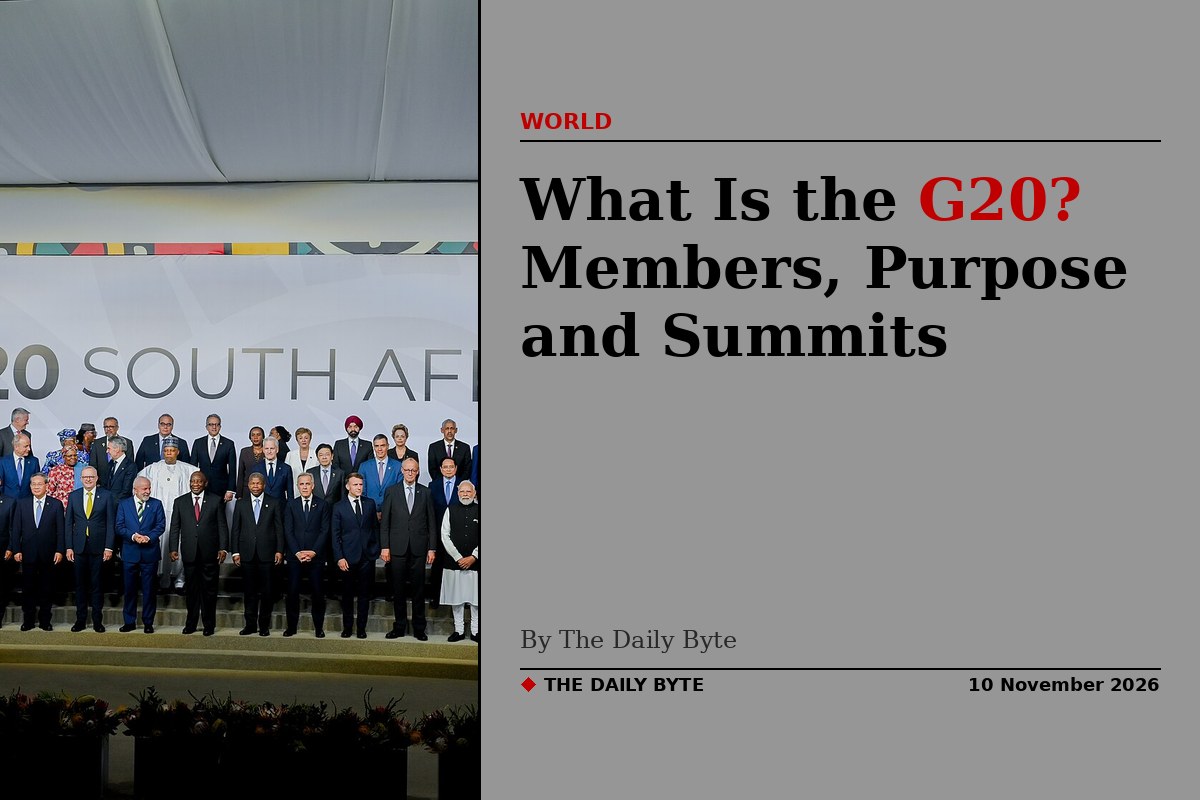
The G20, or Group of Twenty, is a forum where the leaders of the world’s biggest economies meet to coordinate economic policy. It brings together 19 countries plus the European Union and the African Union — 21 members in all — and it describes itself as the premier forum for international economic cooperation. It does not make laws, it has no permanent headquarters and no permanent staff, and its decisions are political commitments reached by consensus rather than binding legal rules.
The group matters because of the sheer weight of its members. The 19 member states account for around 85 per cent of gross world product, about 75 per cent of international trade and roughly 56 per cent of the world’s population. With the European Union and the African Union included, the forum covers close to four-fifths of humanity. When G20 leaders agree on something, it shapes the rules that govern trade, finance and development for most of the world — and when they cannot agree, that disagreement is itself a major news story.
Which countries are members of the G20?
The G20 has 21 members: 19 individual countries and two regional bodies. The countries are Argentina, Australia, Brazil, Canada, China, France, Germany, India, Indonesia, Italy, Japan, Mexico, Russia, Saudi Arabia, South Africa, South Korea, Turkey, the United Kingdom and the United States. The European Union has been a member since the group was founded, and the African Union joined as the 21st member at the 2023 summit in New Delhi, India, and was officially represented as a member from the 2024 summit in Rio de Janeiro, Brazil.
Spain is a permanent invited guest, and the country holding the presidency each year also invites other countries and international organisations to take part. The leaders of the International Monetary Fund and the World Bank, the United Nations and other bodies regularly attend, as do the chairs of regional groups. Pakistan is not a member of the G20, although it takes part in G20-related discussions through the United Nations and other forums.
The membership was deliberately chosen to mix advanced and emerging economies. The older G7 brings together only advanced economies — Canada, France, Germany, Italy, Japan, the United Kingdom and the United States, plus the European Union. The G20 adds large developing economies such as China, India, Brazil, Indonesia and South Africa, so that the countries whose growth now drives the world economy have a seat at the table.
Why was the G20 created?
The G20 was formally established on 26 September 1999, at a meeting of G7 finance ministers, with its first meeting held in Berlin in December 1999. It was a direct response to the financial crises of the late 1990s, above all the Asian financial crisis of 1997 and the Russian financial crisis of 1998, which had spread from emerging markets to the wider world economy and even threatened a major American hedge fund, Long-Term Capital Management. The lesson drawn by finance ministers was that the G7 and the post-war Bretton Woods institutions — the International Monetary Fund and the World Bank — could no longer manage financial stability on their own.
For its first decade the G20 met only at the level of finance ministers and central bank governors. That changed with the global financial crisis of 2008. In November 2008, leaders met for the first time in Washington, and leaders’ summits have been held at least once a year ever since. At the Pittsburgh summit in September 2009, the G20 declared itself the premier forum for international economic cooperation, formally taking over a role that had belonged to the G7.
How does the G20 work?
The G20 has no permanent secretariat. Instead, a different member holds the presidency for one year, sets the agenda in consultation with the other members, and hosts the leaders’ summit. To keep some continuity from year to year, the presidency is supported by a “troika” made up of the previous, current and incoming presidencies. During South Africa’s presidency in 2025, for example, the troika was Brazil, South Africa and the United States.
The work runs through two parallel tracks. The Finance Track is led by finance ministers and central bank governors, and covers the global economy, financial regulation, international taxation, debt and infrastructure investment. The Sherpa Track is led by the leaders’ personal emissaries, known as sherpas, and covers the broader political and social agenda, including development, health, climate and energy, the digital economy, agriculture, anti-corruption, education and women’s empowerment. Each track has working groups that meet through the year, and ministers in areas such as foreign affairs, trade, employment and tourism also meet.
Alongside the official tracks sit engagement groups that bring in voices from outside government, including business, civil society, labour, young people and scientists. The year’s work ends at the leaders’ summit, where heads of state and government agree a joint declaration. Because the G20 works by consensus, the declaration is negotiated line by line, and disagreements — over wars, trade or climate language — can mean a summit ends with a watered-down text or, occasionally, no joint statement at all.
What does the G20 actually decide?
G20 decisions are not laws, and there is no court or police force to enforce them. Their power comes from the fact that the members control most of the world economy: when they agree, they can direct the institutions they govern, such as the IMF and the World Bank, and they can coordinate policies at home at the same time.
Its most important achievements have been in financial stability. After 2008, G20 leaders agreed on tougher rules for banks, curbs on tax avoidance and new arrangements for dealing with countries in debt distress. The group also coordinated the response to the Covid-19 pandemic, including a freeze on debt payments by the poorest countries. In recent years its agenda has widened well beyond finance, covering climate action, food security, global health, digital regulation and reform of the international institutions themselves.
The limits are real, too. A leaders’ declaration is only as strong as the willingness of each government to carry it out, and members with sharply different interests can block agreement. That is why summits are often judged by what they fail to agree on as much as by what they produce.
What is the G20 doing in 2026 and 2027?
The United States holds the G20 presidency in 2026, and the leaders’ summit is scheduled for Miami in December 2026. The 2025 summit was held in Johannesburg, South Africa, on 22 and 23 November 2025, under the theme “Solidarity, Equality, Sustainability”, and it produced the Johannesburg Declaration. The 2026 presidency has already been marked by division: G20 foreign ministers met in Atlanta in October 2026 amid tension over the American decision to invite Russia to the meeting, and the United States has invited President Vladimir Putin to the Miami summit.
The United Kingdom takes over the presidency in 2027, and the leaders’ summit will be held in Manchester in November 2027, at the Manchester Central Convention Centre, over two days. It will be the first time the UK has hosted a G20 leaders’ summit since London in 2009. Prime Minister Andy Burnham has said that President Putin will not be invited to the Manchester summit because of sanctions against senior Russian figures, a contrast with the American invitation for Miami. The prime minister told The Economist that Mr Putin “will not be coming because of an outstanding sanction”, and noted that the Manchester meeting should instead be an opportunity to work with China on the safety of artificial intelligence.
How is the G20 different from the G7 and the UN?
The G7 is a smaller club of advanced economies that meets to coordinate among like-minded allies, while the G20 is larger, more diverse and includes the big emerging economies. The United Nations, by contrast, has nearly every country in the world as a member and can pass binding Security Council resolutions, but its size makes agreement slow and difficult. The G20 sits between the two: small enough to negotiate seriously, and large enough to represent most of the world economy. It is not a rival to the UN — the UN secretary-general attends its summits — but a forum where the biggest economies try to settle their differences before taking them to the wider world.
Why do people criticise the G20?
The most common criticism is that the G20 is too exclusive: most of the world’s countries are not members, and Africa is represented only through the African Union and South Africa. Critics also point out that the group has no power to enforce its decisions, so promises made at summits are often not kept. Others argue that it undermines existing institutions such as the United Nations by moving key decisions into a smaller room. Summits are also regularly met by protests, particularly from anti-globalisation campaigners, and by heavy security that disrupts the host city. Supporters reply that no other forum brings the biggest economies together at leaders’ level, and that without it there would be no regular place at all where the United States, China, the European Union, India and others negotiate the rules of the world economy face to face.
Frequently asked questions about the G20
Is Pakistan a member of the G20? No. Pakistan is not one of the 19 member countries, although it engages with the group’s work through the United Nations and other international bodies.
Who chairs the G20 in 2026? The United States holds the presidency in 2026 and hosts the leaders’ summit in Miami in December. The United Kingdom takes over in 2027 and hosts the summit in Manchester.
Does the G20 make laws? No. Its declarations and communiqués are political commitments agreed by consensus. They are carried out through national laws and through institutions such as the IMF and the World Bank, not by the G20 itself.
Is Russia still a member of the G20? Yes. Russia remains a member despite its full-scale invasion of Ukraine in 2022, but President Vladimir Putin has not attended a leaders’ summit in person since the invasion began, and the UK has said he will not be invited to the 2027 Manchester summit.
What is a G20 sherpa? A sherpa is the personal representative of a leader who prepares the summit, negotiates the declaration and coordinates the work of the Sherpa Track through the year.


