What Is the House of Lords? Powers and Members
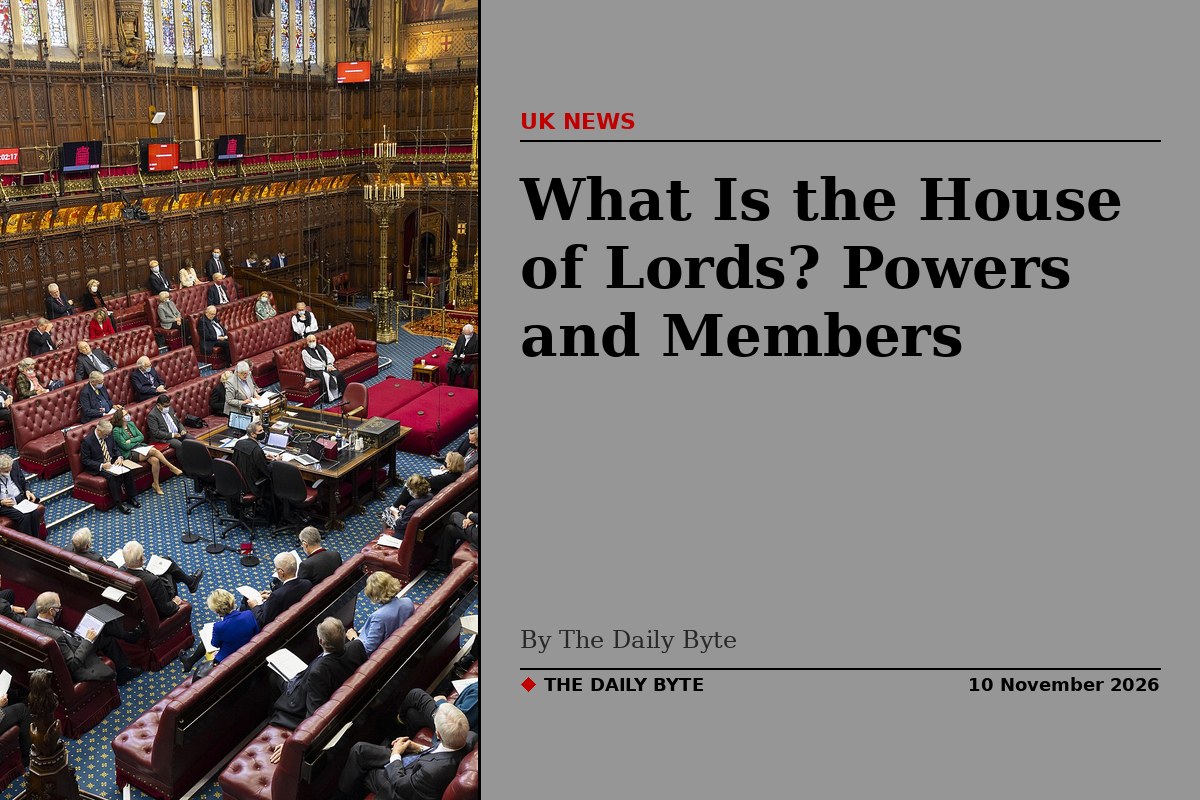
The House of Lords is the upper house of the Parliament of the United Kingdom. It meets in the Palace of Westminster in London, alongside the elected House of Commons, and its job is to scrutinise legislation, hold the government to account, and examine public policy. Unlike MPs, members of the Lords are not elected: most are appointed for life as peers, and the House also includes up to 26 archbishops and bishops of the Church of England. As of 21 October 2026 it has 797 sitting members, which makes it the only upper house in the world that is larger than its lower house.
The Lords is often called a revising chamber, because its main work is improving the detail of laws that the Commons has already debated. It can delay a bill for up to one year, and it can ask the Commons to think again, but it cannot ultimately stop most laws from passing. That balance — real influence, but no final veto — is the result of more than a century of argument about what an unelected chamber should be allowed to do, and it is still debated today.
Who sits in the House of Lords?
There are two kinds of member. The Lords Temporal are peers who sit for life, and the Lords Spiritual are the archbishops and bishops of the Church of England. As of 21 October 2026 the House has 797 sitting members, not counting 19 peers who are on leave of absence or otherwise disqualified or suspended. The political balance is: Labour 232, forming the government benches; the Conservatives 247, as the official opposition; the Liberal Democrats 80; the Democratic Unionist Party 6; the Ulster Unionist Party 3; the Green Party 2; Plaid Cymru 2; one independent; 44 non-affiliated peers; and 154 crossbenchers, who sit independently of any party. There are also 25 bishops, and the Lord Speaker, who presides over the House.
Most peers are life peers, appointed for life under the Life Peerages Act of 1958, on either a political or a non-political basis. Many are former MPs, ministers, judges, business leaders, scientists, doctors and academics, and supporters of the House argue that this experience is its greatest strength. The Lords Spiritual are the Archbishops of Canterbury and York and the Bishops of Durham, London and Winchester, together with 21 other bishops. The United Kingdom is one of only three countries in the world to give religious figures a permanent seat in the legislature, the others being Iran and Vatican City.
For most of its history the House was dominated by hereditary peers, who inherited their seats. That changed in 1999, when hereditary membership was limited to 92 excepted hereditary peers, and in 2026 hereditary membership was abolished altogether. Since 2014, a peer may also give up membership voluntarily, or be expelled from the House. Peers receive no annual salary, but they are paid a tax-free daily allowance and expenses for the days they attend.
What does the House of Lords do?
The House has many of the same functions as the Commons. It scrutinises legislation, holds the government to account, and considers and reports on public policy. Peers can introduce legislation themselves and can propose amendments to bills sent up from the Commons. Much of the detailed work happens in committees, which examine draft laws and investigate subjects such as the economy, science, the constitution and international relations.
The Lords also has a ceremonial and constitutional role. The King’s Speech, which sets out the government’s programme for the parliamentary session, is delivered in the House of Lords chamber during the State Opening of Parliament. The House also has a Church of England role: Church measures must be tabled in the House by the Lords Spiritual. Peers may serve as government ministers, but in practice they are usually appointed only as junior ministers, except for the Leader of the House of Lords, who sits in the Cabinet. The current Leader of the House is Baroness Smith of Basildon, a Labour peer, who has held the post since 5 July 2024.
Can the House of Lords block a law?
Usually, no. The House of Lords can delay a bill, amend it, and send it back to the Commons, but under the Parliament Acts of 1911 and 1949 the Commons can eventually pass a bill without the Lords’ consent. The Lords may delay the enactment of most bills for up to one year. Money bills, which deal with taxation and public spending, become law one month after being sent to the Lords, with or without its agreement, once the Speaker of the Commons has certified them as money bills.
There are a few limited exceptions, including bills to extend the life of a Parliament, which the Lords can still block. The Lords also cannot bring down a government: it does not control the term of the prime minister, and only the House of Commons can vote to require the prime minister to resign or to call an election. In practice, the Lords rarely pushes a dispute to the limit. When the two Houses disagree, the bill goes back and forth in a process known as ping-pong, and the Lords usually gives way rather than force the Commons to use the Parliament Acts.
How did the House of Lords begin?
The House of Lords is one of the oldest institutions in the world. It developed from the Great Council, or Magnum Concilium, that advised the king in medieval times, dating back to the early 11th century. Parliament clearly separated into two chambers during the reign of Edward III in the 14th century: the House of Commons, made up of representatives of the shires and boroughs, and the House of Lords, made up of archbishops, bishops, abbots and the nobility.
For centuries the Lords was the more powerful chamber, because its members were the great landowners and church leaders of the realm. Its power declined as the Commons grew, and it suffered a dramatic interruption in the 17th century: after the execution of Charles I, the Commons abolished the House in 1649, declaring it “useless and dangerous to the people of England”. It returned when the monarchy was restored in 1660.
The decisive clash came in the early 20th century. In 1909 the Lords rejected the “People’s Budget” of the Liberal Chancellor David Lloyd George, which proposed new taxes on the wealthy. The crisis led to the Parliament Act of 1911, which stripped the Lords of its power to veto money bills and limited its delaying power over other bills. The law lords, the judges who sat in the House and acted as the country’s final court of appeal, were removed in 2009 when the Supreme Court of the United Kingdom was created. The 1999 reform removed most hereditary peers, and the 2026 reform removed the rest.
Who runs the House of Lords?
The House is presided over by the Lord Speaker, who chairs debates and represents the House on ceremonial occasions. The current Lord Speaker is Lord Forsyth of Drumlean, who took up the post on 2 February 2026. The Lord Speaker is politically neutral and, unlike the Speaker of the Commons, does not call speakers or rule on points of order in the same way: the Lords is famously self-regulating, and peers are expected to behave with courtesy and to give way to one another without being told.
Day-to-day business is organised by the Leader of the House, a government minister, and by the government and opposition whips. The Senior Deputy Speaker, Lord Ponsonby of Shulbrede since 13 May 2026, deputises for the Lord Speaker. Because no party has an overall majority in the Lords — Labour, with 232 peers, is the largest group on the government benches but the Conservatives hold 247 seats — the government must win arguments rather than rely on votes, which is why crossbenchers and independent-minded peers can be decisive.
Why do people want to reform the House of Lords?
Reform has been argued about for more than a century, and the argument has two sides. Critics say it is wrong in a democracy that nobody in the Lords is elected, and that the Prime Minister can appoint new peers, which lets governments reward supporters and change the balance of the House. They also point to its size: with 797 members it is the second-largest legislative chamber in the world, behind only the National People’s Congress of China, and it has no fixed limit on numbers.
Supporters reply that the Lords works precisely because its members are not chasing re-election. They say the House brings in experts the Commons cannot, gives laws a careful second reading, and can speak freely because peers do not depend on party managers for their seats. The reforms of 1999 and 2026, which ended hereditary membership, were presented as steps towards a House based on appointment for merit and experience rather than birth. Whether the next step should be a smaller appointed House, an elected senate, or abolition altogether remains one of the longest-running arguments in British politics.
Frequently asked questions about the House of Lords
Are members of the House of Lords elected? No. Most members are appointed for life as peers, and the House also includes up to 26 Church of England archbishops and bishops. Hereditary peers, who inherited their seats, were abolished as a category in 2026.
Can the House of Lords stop a law? Almost never. It can delay most bills for up to one year and ask the Commons to reconsider, but the Commons can pass the bill anyway under the Parliament Acts of 1911 and 1949. Money bills become law after one month.
Do peers get paid? Peers receive no annual salary. They are paid a tax-free daily allowance and expenses for the days they attend the House.
How many members does the House of Lords have? As of 21 October 2026, it has 797 sitting members. The number is not fixed, and it changes as new peers are appointed and others retire or die.
What is the difference between the House of Lords and the House of Commons? The Commons is elected by voters, controls the government and has the final say on laws and taxes. The Lords is appointed, revises and scrutinises legislation, and holds ministers to account, but it cannot remove a government or block most laws.