What Is the ICC Case Against Rodrigo Duterte?
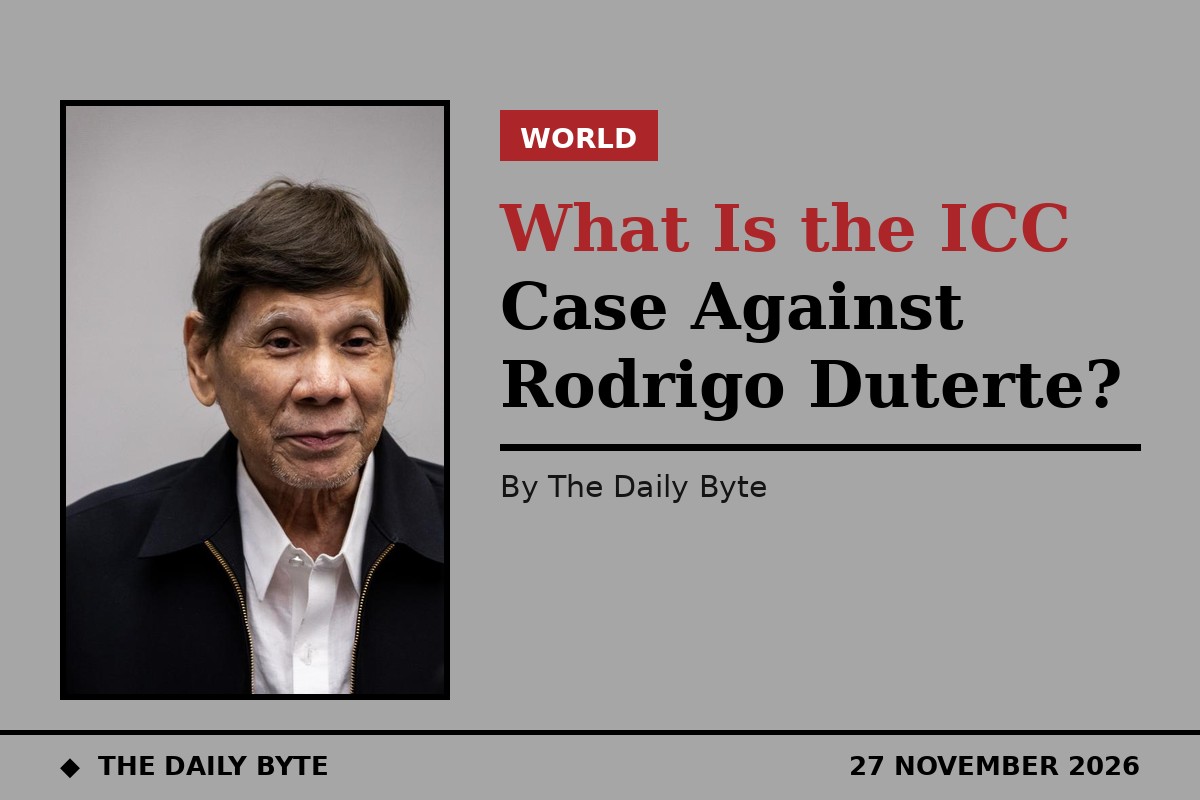
Rodrigo Duterte, the former president of the Philippines, goes on trial at the International Criminal Court (ICC) in The Hague on Monday 30 November 2026. He is charged with crimes against humanity of murder and attempted murder, allegedly committed during his anti-drugs campaign in the Philippines between 1 November 2011 and 16 March 2019. The trial is the first time a former Asian leader has faced trial at the ICC, and only the second time a former national ruler has appeared before the court for crimes allegedly committed while in power.
Who is Rodrigo Duterte?
Rodrigo Roa Duterte was born on 28 March 1945 in the Philippines. He served as mayor of Davao City for more than two decades, with periods as vice mayor, before winning the Philippine presidency in 2016. He was president until 2022. His presidency was defined by a violent campaign against illegal drugs, under which thousands of people were killed by police and unidentified gunmen. The ICC says he was allegedly the founder and head of the Davao Death Squad, a group prosecutors link to killings carried out while he was mayor of Davao City. Duterte has denied wrongdoing and has said the killings were part of a legitimate law-enforcement campaign. He is 81 years old. His lawyers told the court he suffers from cognitive decline and is not well enough to stand trial, but on 8 October 2026 the trial chamber found that he is fit to stand trial and adopted measures to help him take part in the proceedings.
What is he charged with?
Duterte is charged with crimes against humanity of murder and attempted murder under article 7(1)(a) of the Rome Statute, the treaty that founded the ICC. The charges cover alleged killings committed as part of what prosecutors describe as a widespread and systematic attack against the civilian population in the Philippines. The confirmed charges concern the murders of at least 76 people and the attempted murder of two others, according to Reuters. Prosecutors have pointed to a far larger death toll from the drugs campaign as a whole, saying as many as 30,000 people were killed, a figure Duterte's supporters dispute and which is not the number of victims named in the confirmed charges. The distinction matters: the trial will test the specific counts confirmed by the judges, not every death attributed to the drugs campaign. The case is listed as The Prosecutor v. Rodrigo Roa Duterte, case number ICC-01/21-01/25, and it is being heard by Trial Chamber III. The presiding judge is Joanna Korner, sitting with judges Keebong Paek and Nicolas Guillou. The Philippines withdrew from the ICC in 2019, which is why the period covered by the charges ends on 16 March 2019. The court has held that it keeps jurisdiction over alleged crimes committed while the Philippines was still a member of the court.
The three counts explained
The prosecution case is built around three counts, each covering a different period and a different pattern of alleged killings. Count 1 covers murders in or around Davao City during Duterte's time as mayor, between 2013 and around June 2016, allegedly carried out by the Davao Death Squad. This count reaches back to his years running the southern city, long before he became president, and it is the part of the case that deals with his record as a local leader. Count 2 covers the murders of so-called high-value targets across the Philippines during the early part of his presidency, between around July 2016 and July 2017. These were people identified by the authorities as senior figures in the drugs trade. Count 3 covers murder and attempted murder in barangay clearance operations across the Philippines between around July 2016 and September 2018. A barangay is the smallest local government unit in the Philippines, and clearance operations were police-led drives to clear neighbourhoods of suspected drug users and dealers. The prosecution says Duterte is criminally responsible as an indirect co-perpetrator, and in the alternative for ordering, inducing, aiding and abetting the crimes. In plain terms, the prosecution does not say he personally carried out the killings. It says he designed, funded and directed the system that carried them out, and that he therefore bears responsibility for them.
How did the case reach trial?
The road to trial has taken more than a year and a half since Duterte's arrest. The ICC issued a warrant for his arrest on 7 March 2025. He was arrested by the Philippine authorities and surrendered to the court on 12 March 2025, and he made his first appearance before the court on 14 March 2025. Since then he has been held at the ICC detention centre in Scheveningen, in The Hague. A confirmation of charges hearing took place from 23 to 27 February 2026, at which the judges tested whether there was enough evidence to send the case to trial. On 23 April 2026, the pre-trial chamber unanimously confirmed all three counts and committed Duterte to trial. The trial chamber was constituted the following day, and on 27 May 2026 it set 30 November 2026 as the opening date. More than 500 victims have been admitted to take part in the proceedings, represented by lawyers known as common legal representatives of victims. A redacted version of the prosecution's charging document, released in February 2026, identified eight other people as alleged co-perpetrators alongside Duterte, and the ICC is continuing to investigate other alleged crimes connected to the drugs campaign.
What happens when the trial opens on 30 November?
The trial opens at 10:00 Hague time on Monday 30 November 2026. The judges will first check that Duterte understands the charges against him and ask him whether he admits guilt or pleads not guilty. His legal team has already said he rejects the allegations, and he is expected to plead not guilty. The court will then hear opening statements: the prosecution has two hours and fifteen minutes, the lawyers for the victims have one hour and thirty minutes, and the defence has one hour to outline its case. The first prosecution witness is due to be called immediately after the opening statements, with witnesses due to start giving evidence from Tuesday. Daily hearings will in principle run in four sessions, from 10:00 to 11:00, 11:30 to 12:30, 13:30 to 14:30 and 15:00 to 16:00 Hague time. The hearings can be followed with a 30-minute delay on the ICC website and on its Facebook and YouTube accounts. Prosecutors expect to call fewer than 100 witnesses and say they need about 150 hours to present their core evidence. The first week of hearings is set aside for opening arguments, with the detailed evidence to follow over the months ahead.
How long will the trial last, and what sentence could he face?
The trial is expected to last well into 2027, and a verdict is not likely until 2028, according to Reuters. The ICC has said the trial may last several years, depending on how complex the case proves and on any challenges that arise along the way. If Duterte is found guilty of even a single charge of crimes against humanity, the judges can sentence him to up to life imprisonment. The ICC has no death penalty. A guilty verdict would also open the way for reparations to victims, a separate stage of the proceedings that follows any conviction. If he is acquitted, he would be released, although the prosecution could appeal. Either side can appeal against the verdict and the sentence, which is one reason the full process could run for years after the trial itself ends.
Why does this trial matter?
The trial matters for three reasons. First, it is a test of whether a former head of state can be held to account by an international court for a domestic security campaign. Duterte will be the first former Asian leader tried by the ICC, and the court has previously tried only a small number of former national leaders. Second, it matters for the victims and their families in the Philippines, many of whom have waited years for any formal process to examine the killings. Third, it matters for the ICC itself. The court is under heavy political pressure: the United States imposed sanctions on the institution as a whole on 9 October 2026, and Amnesty International has described the trial as a defining test for the future of international accountability. The opening of the trial coincides with the start of the Assembly of States Parties, the annual gathering of the court's member states, which has been moved from New York to The Hague this year because of the impact of the US sanctions. Whatever the verdict, the trial will shape how the world judges both Duterte's presidency and the court's ability to try powerful former leaders.
Frequently asked questions
Is Duterte already guilty? No. He is charged, not convicted. The trial exists to test the prosecution's evidence, and he is presumed innocent until the judges decide otherwise. His lawyers say he rejects the allegations and he is expected to plead not guilty.
Why is the ICC trying him if the Philippines left the court? The Philippines withdrew from the Rome Statute in 2019, but the court has held that it retains jurisdiction over alleged crimes committed while the country was still a member. That is why the charges stop on 16 March 2019, the date the withdrawal took effect.
How many people is he accused of killing? The confirmed charges name at least 76 murder victims and two attempted murder victims. Prosecutors have cited a much larger figure, as many as 30,000 deaths, for the drugs campaign as a whole, but that wider toll is not the number of victims in the confirmed charges.
Can the public watch the trial? Yes. Hearings are streamed with a 30-minute delay on the ICC website and on the court's Facebook and YouTube accounts, in line with the court's usual practice for public proceedings.
What happens if he is found guilty? The judges can impose a prison sentence of up to life imprisonment. The ICC has no death penalty. A conviction would also lead to a separate stage dealing with reparations for victims.


