What Is the Independent Football Regulator? Licensing, Owners' Tests and What It Means for Fans
By The Daily Byte
·20 Nov 2026
·10 min read
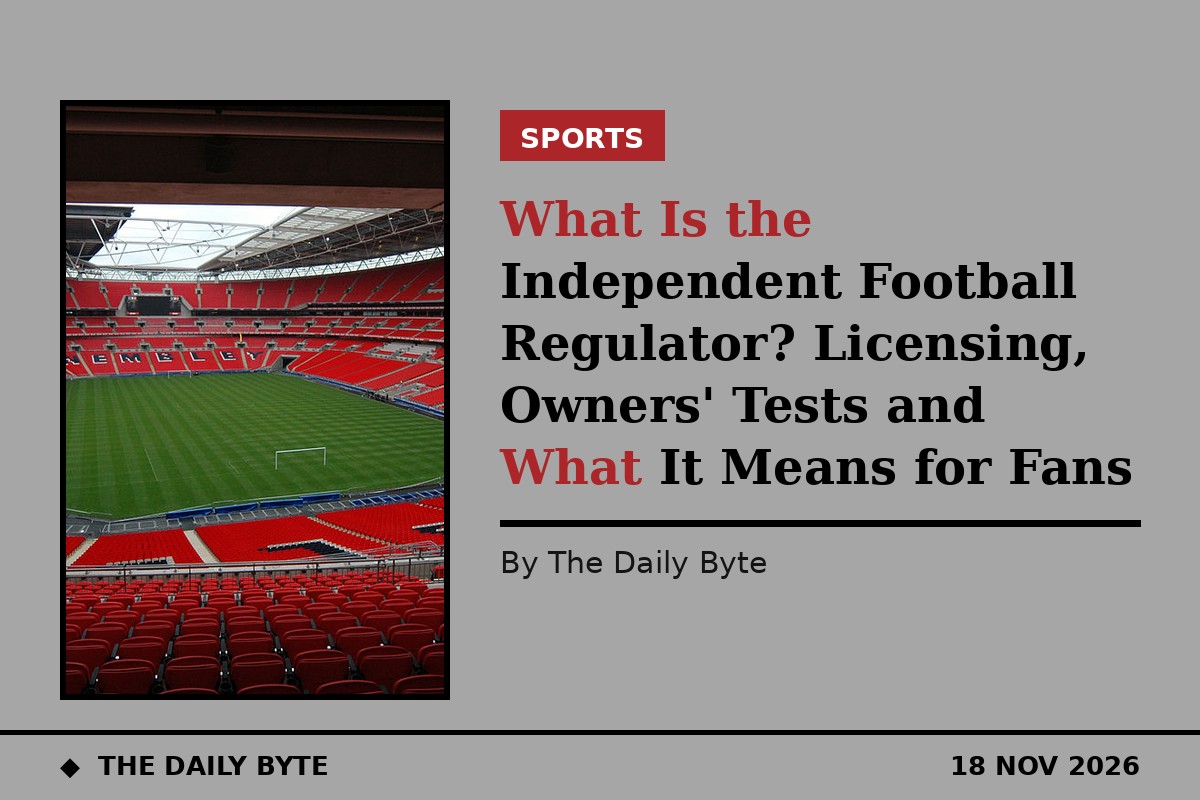
The Independent Football Regulator is a new statutory regulator for English men's football, created by the Football Governance Act 2025. From the start of the 2027-28 season, every club in the top five divisions of English football — 116 clubs in all — will need a licence from the regulator to compete. As of 18 November 2026, the window for clubs to apply for a provisional licence is open, running from 2 November 2026 to 26 February 2027. The regulator can test whether club owners and directors are fit to run a club, demand that clubs prove they can pay their bills, and, as a last resort, force an owner to sell.
The regulator is the biggest change to how English football is run in the modern era, ending more than a century of self-regulation by the game's own authorities. This guide explains what it is, why it was created, which clubs it covers, how licensing works, what it means for owners and fans, and what it does not do.
## Why was a football regulator created?
The push for an independent regulator began with two shocks. The first was the attempted European Super League breakaway in April 2021, when six English clubs signed up to a closed competition without consulting supporters. The second was a string of financial collapses and near-collapses at lower-league clubs — most notably Bury, expelled from the English Football League in 2019, and Macclesfield Town, wound up in 2020 — which showed that clubs could be run into the ground with little outside oversight.
The government commissioned a Fan-Led Review of football governance, chaired by former sports minister Tracey Crouch MP, which in 2021 recommended an independent regulator. The government accepted the recommendation, and after a white paper and two attempts at legislation, the Football Governance Act 2025 received Royal Assent on 21 July 2025. The Independent Football Regulator was formally established under the Act, with David Kogan, the former football administrator and media executive, appointed as its chair.
The regulator's statutory objectives are to promote the financial soundness of clubs and the systemic resilience of English football, and to safeguard the cultural heritage of the game. It does not run the competitions themselves — the Premier League, the English Football League, the National League and the Football Association continue to do that.
## Which clubs does the regulator cover?
The regulator covers the 116 clubs in the top five divisions of the English men's football pyramid: the Premier League, the Championship, League One, League Two and the National League (Step One). Clubs in National League North and South will come into scope once their promotion to the National League is confirmed.
The women's game is not covered by this regulator, and neither are grassroots clubs below the National League. The regulator's remit is English football: clubs in Scotland, Wales and Northern Ireland have their own arrangements.
## How does licensing work?
Licensing is the regulator's main tool. From the 2027-28 season, a club cannot compete in the top five divisions without a licence. The final licensing rules and guidance were published on 1 July 2026, after a pilot scheme with selected clubs.
Clubs in the top five divisions during the 2026-27 season must submit their application for a provisional licence between 2 November 2026 and 26 February 2027. The application is made through an online portal and includes a strategic business plan, with financial forecasts to the end of the following season, and a personnel statement identifying the club's owners — including its ultimate owner — and its senior managers. Clubs must publish the personnel statement online once the regulator approves it. The regulator has three months to decide on a complete application and expects to have decided all of them by the end of May 2027, before the leagues hold their annual general meetings. You can read the official guidance here: [Independent Football Regulator, provisional licensing guidance](https://www.footballregulator.org.uk/provisional_licensing_guidance).
A provisional licence lasts up to three years. During that time the club must comply with four mandatory licence conditions: submitting and acting in accordance with a financial plan; submitting and updating a corporate governance statement explaining how it applies the regulator's Football Club Corporate Governance Code; consulting fans on key matters; and making an annual declaration of compliance. The regulator can also impose extra conditions on higher-risk clubs.
A club moves to a full licence when the regulator is satisfied it meets the full licence test, including threshold requirements on financial resources, governance and fan engagement. For clubs licensed ahead of the 2027-28 season, the earliest that can happen is June 2028, after a year of reporting under the mandatory conditions, and the latest is the end of the 2029-30 season. Refusing a licence is described by the regulator as a last resort, but a club without one cannot play in the top five divisions.
## The owners' and directors' test
One of the most talked-about parts of the new regime is the Owners, Directors and Senior Executives test, known as the ODSE test. It requires owners, directors and senior executives to show honesty and integrity, competence and financial soundness — and owners must also satisfy the regulator about the source of their wealth.
The test has applied to anyone taking control of a club in the top five tiers since 5 May 2026. The regulator said in October 2026 that it had already carried out advanced checks on 40 owners, directors and senior executives under the regime. Existing owners and officers are also being assessed: the regulator can re-examine people already in post where it has grounds for concern.
If an owner fails the test, the regulator has far-reaching powers. Under the Football Governance Act, it can disqualify an individual, direct an owner to take reasonable steps to sell the club within a set period, and ultimately issue an ownership removal order. The regulator's chair, David Kogan, has said publicly that the regulator has the power to require an owner to step away where a club is run in a way that is neither fit, fair nor done with propriety. Whether it will use those powers against a major club is the question every supporter is asking — and the answer will shape how seriously the new regime is taken.
## How is the regulator paid for?
The regulator is funded by the clubs it regulates, through an annual levy. On 23 October 2026 it published a proposed levy of £20.3 million for the 2027-28 season, to fund a budget of £18.3 million in operating costs, a £1 million litigation fund, and £1 million in the first year towards recovering set-up costs over ten years. The levy would rise to £20.9 million the following year.
The levy is tiered by league and income. Premier League clubs that play in European competition and earn more than £150 million a year in commercial revenue fall into the top band and would pay up to £1.8 million each in the first year. The figures are a consultation proposal, not final bills: clubs and other interested parties can respond before the regulator confirms the final rates, and the amounts will be updated when invoices are issued from August 2027.
## The cash-reserves consultation
On 10 November 2026 the regulator opened a six-week consultation on risk-based cash reserves, which closes on 18 December 2026. The proposal is aimed at a specific weakness the regulator has identified: some clubs cannot survive for long if their owner stops putting money in. The regulator's chair has said several clubs told it they could not survive a month without their owner's money.
Under the proposal, higher-risk clubs in the English Football League and the National League would need to hold one month's wages plus five months of operating losses, built up in stages by summer 2030. No standard starting reserve is proposed for Premier League clubs, where the regulator considers liquidity risk less acute. Annual financial plans would be due from May 2028, and clubs would need to meet an "appropriate financial resources" test for a full licence by May 2030. Complying with a league's own spending rules would not automatically satisfy the cash test.
The regulator also published its first draft State of the Game report in October 2026, setting out the financial health of the game. The report found that debt across the game was on course to pass £5 billion by the end of this season — a measure of why the regulator believes the current model needs a backstop.
## What does it mean for fans?
For supporters, the regulator's most visible effects will be on consultation and heritage. Licensed clubs must consult fans on key matters, and the Act gives fans protections over the things that define a club's identity: its badge, its home shirt colours and its home ground cannot simply be changed on an owner's whim. The regulator also has powers to stop clubs joining breakaway, closed-shop competitions like the proposed European Super League.
The regulator also has a backstop power over money: if the Premier League and the English Football League cannot agree on how broadcast revenue is shared down the pyramid, the regulator can impose a settlement. That power is designed to end years of stalemate over parachute payments and solidarity funding, though it has not yet been used. For a fuller summary of the regime from official sources, see this explainer: [8 things to know about the Football Regulator](https://www.footballbusinessnews.com/8-things-to-know-about-the-independent-football-regulator/).
## What the regulator does not do
It is worth being clear about the limits. The regulator does not organise fixtures, decide results or run the leagues — that remains the job of the Premier League, the EFL, the National League and the FA. It does not set ticket prices, approve transfers or pick teams. It does not regulate the women's game, and it cannot intervene in a club's footballing decisions. Its job is financial sustainability, governance and heritage — the business of running a club, not the football played on the pitch.
## Frequently asked questions
**Does my club need a licence?**
If it plays in the Premier League, Championship, League One, League Two or the National League, yes — from the 2027-28 season it will need a provisional licence to compete, and it must apply between 2 November 2026 and 26 February 2027.
**Can the regulator force an owner to sell?**
In law, yes. If an owner fails the suitability test, the regulator can direct them to sell and, if they do not comply, issue an ownership removal order. It has not yet used the power, and doing so against a major club would be a landmark test of the regime.
**Who pays for the regulator?**
The 116 clubs in scope, through an annual levy. The proposed levy for 2027-28 is £20.3 million, tiered so the biggest clubs pay the most.
**When will we know if it is working?**
The first real test comes in spring 2027, when the first provisional licences are granted or refused. The longer test will be whether clubs are financially stronger, whether owners are held to account, and whether the cash-reserve rules prevent another Bury. On those questions, the regulator will be judged not by the licences it hands out this winter, but by the first time it tells a well-known club that its plan is not good enough.
Source
Independent Football Regulator — https://www.footballregulator.org.uk/provisional_licensing_guidance