What Is the Indus Waters Treaty? Explained
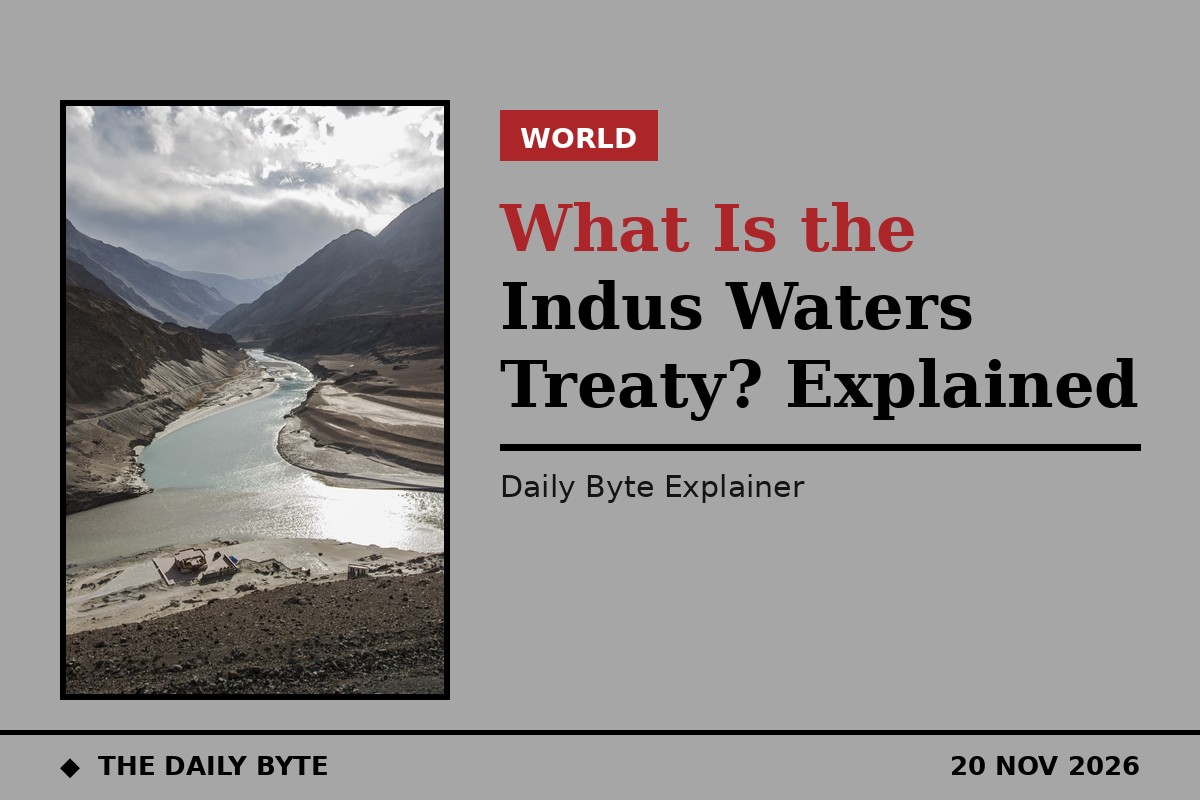
The Indus Waters Treaty is a 1960 agreement between India and Pakistan, brokered by the World Bank, that divides the waters of the six rivers of the Indus system between the two countries. It gives India control of the three eastern rivers, the Ravi, the Beas and the Sutlej, and gives Pakistan the waters of the three western rivers, the Indus, the Chenab and the Jhelum. Signed in Karachi on 19 September 1960 by Indian prime minister Jawaharlal Nehru and Pakistani president Ayub Khan, it is one of the most durable water-sharing agreements in the world, and it is back in the headlines in November 2026 because Pakistan raised it at the United Nations after India placed it in abeyance.
The treaty matters far beyond the two governments that signed it. The Indus system waters the farms and cities of Pakistan, where Pakistan says more than 240 million people depend on these flows for their livelihoods and well-being. That is why any dispute over the treaty is treated in both countries as a matter of national importance, and why the question "what is the Indus Waters Treaty?" is being searched so widely now.
Why was the treaty needed?
The problem began with the partition of British India in 1947. The new border between India and Pakistan cut across the Indus river system, leaving India upstream and Pakistan downstream on rivers that Pakistan's Punjab depended on for irrigation. In 1948 the two countries were already in dispute over water rights, and Pakistan feared that India, as the upper riparian state, could cut off or flood its supplies, especially during a conflict.
The World Bank, then called the International Bank for Reconstruction and Development, stepped in as mediator in 1951. Negotiations lasted almost a decade, and the treaty that emerged was signed in Karachi on 19 September 1960 and came into effect on 1 April 1960. Its preamble says the two countries recognise each other's rights and obligations to make the optimum use of the waters of the Indus system in a spirit of goodwill, friendship and cooperation.
How are the rivers divided?
The treaty divides the six rivers into two groups. The three eastern rivers, the Ravi, the Beas and the Sutlej, with a total mean annual flow of about 33 million acre-feet, are allocated to India for its unrestricted use. The three western rivers, the Indus, the Chenab and the Jhelum, with a total mean annual flow of about 135 million acre-feet, are allocated to Pakistan. In rough terms, India received control of about 20% of the total water carried by the system, and Pakistan received about 80%.
The division is not absolute. India is allowed to use the waters of the western rivers for limited purposes: domestic use, non-consumptive uses such as power generation, navigation, floating of property and fish culture, and specified agricultural use, including limited irrigation. The treaty lays down detailed rules for India in building projects on the western rivers, including a limit of 3.6 million acre-feet on the total storage capacity of reservoirs it may build there, and a requirement to share plans and data for hydroelectric plants and storage works in advance, so that Pakistan can raise objections within set periods.
India also made a fixed financial contribution of £62,060,000 towards the cost of replacement works, so that Pakistan could build canal systems to draw supplies from the western rivers instead of the eastern rivers it had lost. The Indus itself rises in Tibet, flows through Ladakh, and then into Pakistan; the Jhelum and Chenab flow through Jammu and Kashmir before entering Pakistan, while the Sutlej, Beas and Ravi flow through northern India and Punjab.
How are disputes settled?
The treaty created a Permanent Indus Commission, with one Commissioner for Indus Waters from each country, to implement the agreement and exchange data on river flows, water use and irrigated areas. If the commissioners cannot settle a difference, the treaty provides a three-tier process: the question can be referred to a Neutral Expert, and then to a Court of Arbitration, or settled in any other manner the two governments agree.
Most disagreements over the decades have been settled through these legal procedures, and the treaty has survived several wars between India and Pakistan without either side abandoning it. That record is why it is often described as one of the most successful water-sharing arrangements in the world, even though analysts acknowledge that it does not cover newer issues such as groundwater, water quality, climate change and ecology, because it was written to divide surface water, not to share the wider benefits of the river system.
Disputes have continued over Indian hydroelectric projects on the western rivers. Pakistan has challenged aspects of the Kishenganga and Ratle projects, arguing that particular design features do not comply with the treaty, and the two sides have pursued parallel processes, with a Neutral Expert examining technical questions and a Court of Arbitration hearing the wider dispute.
Why is the treaty in the news in 2026?
On 23 April 2025, a day after the Pahalgam attack in which 26 people were killed, India announced that it was placing the treaty in abeyance, citing national security concerns. Pakistan rejected the move as unilateral and unlawful, arguing that the treaty contains no provision allowing either side to suspend or terminate it on its own, and that any change requires the agreement of both governments.
On 31 August 2026, a Court of Arbitration administered through the Permanent Court of Arbitration issued an award on the treaty's status, concluding that the treaty remains in force and that the grounds advanced for unilateral suspension did not justify that step. It also ordered interim measures on the Ratle project, restricting India from concreting parts of the dam wall and power-intake structure above specified levels until 90 days after the World Bank-appointed Neutral Expert issues a final decision. India rejected the tribunal's authority and said its own position had not changed, so the legal disagreement continues.
The dispute reached the United Nations on 19 November 2026, when Pakistan's deputy permanent representative, Ambassador Usman Jadoon, told an informal Security Council meeting on natural resources and conflict, convened by Liberia, that India was "weaponizing water" by suspending the treaty and threatening downstream supplies. He said the move endangered the livelihoods and well-being of more than 240 million people, cited the Court of Arbitration's 31 August award, and called for disputes to be settled peacefully under Article 33 of the UN Charter. India replied that its position on the treaty was "clear and consistent" and accused Pakistan of misusing the forum.
The treaty had already been a central theme of the Margalla Dialogue in Islamabad earlier in November 2026, where Deputy Prime Minister Ishaq Dar said on 10 November that Pakistan would safeguard its rights and oppose the weaponisation of water, and Law Minister Azam Nazeer Tarar urged both countries to resolve their disputes through dialogue and United Nations mechanisms. On 12 November, Prime Minister Shehbaz Sharif raised the same warning at the COP31 leaders' summit in Antalya. Pakistan's position is that the treaty remains binding; India's position is that its abeyance decision stands. Neither side has announced a change of position.
Why does the treaty matter so much to Pakistan?
The Indus system is the backbone of Pakistan's agriculture and water supply. The western rivers flow into Pakistan and feed the canal networks that irrigate Punjab and Sindh, supply drinking water to towns and cities, and support industry. Because Pakistan sits downstream, any reduction in flows, or any uncertainty about them, directly affects harvests, food security and household water supplies.
That dependence is why the treaty was written to give Pakistan the unrestricted use of the western rivers, subject only to India's limited uses, and why the treaty requires India to let the waters flow and not to interfere with them except as the treaty permits. It is also why Pakistan treats any suggestion that the flows could be stopped as a serious threat: at the Margalla Dialogue, Senate Chairman Yousuf Raza Gilani was reported as saying that any unilateral Indian action to deprive Pakistan of its legitimate water rights would amount to an act of war.
For India, the treaty has always involved a trade-off. It gave up most of the system's water to the downstream state, while retaining the eastern rivers and limited rights on the western ones. Indian governments have periodically argued that the treaty is unfair to India and restricts its ability to build hydroelectric projects in Jammu and Kashmir. That argument, and Pakistan's insistence that the treaty is binding and cannot be suspended unilaterally, are the two positions that now stand opposed, with the Court of Arbitration having sided with Pakistan on the legal question and India rejecting the court's jurisdiction.
Frequently asked questions
What is the Indus Waters Treaty? A 1960 water-sharing agreement between India and Pakistan, brokered by the World Bank, that divides the six rivers of the Indus system: the eastern rivers to India and the western rivers to Pakistan.
Which rivers does Pakistan get under the treaty? The three western rivers: the Indus, the Chenab and the Jhelum, with a total mean annual flow of about 135 million acre-feet, roughly 80% of the system's water.
Which rivers does India get? The three eastern rivers: the Ravi, the Beas and the Sutlej, with a total mean annual flow of about 33 million acre-feet.
Can India build dams on the western rivers? Yes, but only within strict limits. The treaty allows hydroelectric power generation and other non-consumptive uses, caps total storage at 3.6 million acre-feet, and requires India to share project data in advance so Pakistan can object.
Is the treaty still in force? That is the dispute. A Court of Arbitration ruled on 31 August 2026 that the treaty remains in force and cannot be suspended unilaterally. India disputes the tribunal's authority and says its April 2025 abeyance decision stands. Pakistan raised the matter at the United Nations on 19 November 2026.
Who signed the treaty? It was signed in Karachi on 19 September 1960 by Indian prime minister Jawaharlal Nehru and Pakistani president Ayub Khan, with the World Bank as mediator. It came into effect on 1 April 1960.
Sources: Vajiram and Ravi, Indus Water Treaty 1960; CSIS, Can India Cut Off Pakistan's Indus River Lifeline?; MIT OpenCourseWare, Water Diplomacy case study on the Indus; Tez Khabar, Pakistan warns India against weaponizing shared rivers, 19 November 2026.


