What Is the International Court of Justice? Explained
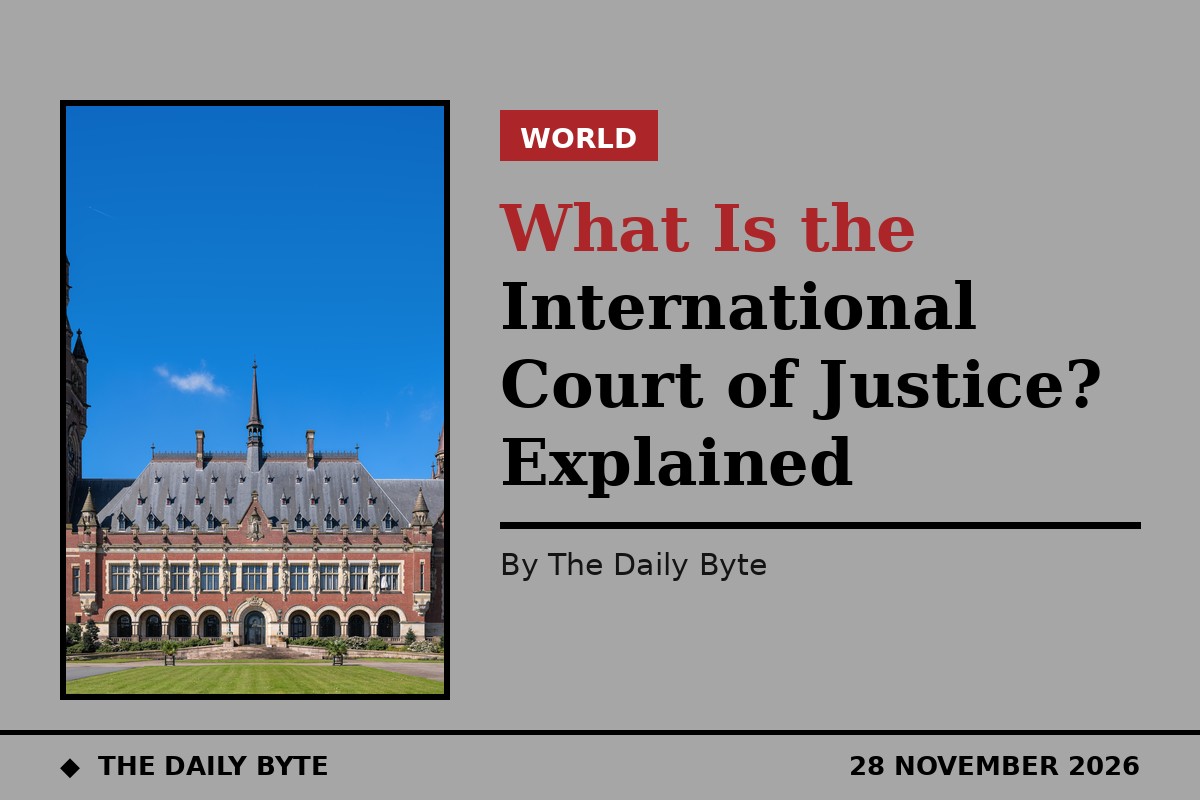
The International Court of Justice, often called the World Court, is the United Nations' highest court. It settles legal disputes between countries and gives advisory opinions on legal questions referred to it by UN bodies. It is the only international court that deals with disputes between states, and its judgments are final and binding on the parties to a case.
The court returned to the headlines on 19 November 2026, when it ruled that Myanmar committed genocide against the Rohingya people during the military's 2017 clearance operations in Rakhine State. It was the first time in the court's 80-year history that it had held a state directly responsible for committing genocide. This explainer sets out what the court is, how it works, what it can and cannot do, and why that ruling matters.
What does the International Court of Justice do?
The court's role, as stated by the court itself, is to settle legal disputes submitted to it by states in accordance with international law, and to give advisory opinions on legal questions referred to it by authorised United Nations organs and specialised agencies. That gives it two distinct kinds of work.
The first is contentious cases: legal disputes between states. One state brings a claim against another, both sides file written arguments and then argue their case in public hearings at the Peace Palace in The Hague. The judges deliberate in private and then deliver a judgment. The second is advisory proceedings: a UN organ, such as the General Assembly or the Security Council, asks the court a legal question, and the court gives an advisory opinion. Advisory opinions are not binding in the way judgments are, but they carry great authority and are often treated as authoritative statements of international law.
The court was established in June 1945 by the Charter of the United Nations and began work in April 1946. It is one of the six principal organs of the United Nations, alongside the General Assembly, the Security Council, the Economic and Social Council, the Trusteeship Council and the Secretariat. It is the only one of the six that is not based in New York: its seat is the Peace Palace in The Hague, in the Netherlands. Its official languages are English and French.
Who can bring a case to the International Court of Justice?
Only states can be parties in cases before the court. Individuals, companies and non-governmental organisations cannot bring a case, and the court cannot try individuals for crimes. That is a common point of confusion, and it is the key difference between this court and the International Criminal Court, which is a separate institution.
Even between states, the court can only hear a case if the states involved have consented to its jurisdiction. Consent can be given in several ways: through a special agreement to take a particular dispute to the court, through a treaty that contains a clause referring disputes to the court, or through a declaration accepting the court's compulsory jurisdiction. In the Myanmar case, for example, the case was brought under the 1948 Convention on the Prevention and Punishment of the Crime of Genocide, which contains a clause allowing disputes about the convention to be taken to the court. The Gambia filed the case in November 2019, arguing that Myanmar had breached its obligations under the convention.
All 193 member states of the United Nations are automatically parties to the Statute of the International Court of Justice, which is the document that sets out how the court works. Non-member states can also become parties to the statute on conditions set by the General Assembly on the recommendation of the Security Council.
| Fact | Detail |
|---|---|
| Full name | International Court of Justice (ICJ), also known as the World Court |
| Established | June 1945 by the UN Charter; began work in April 1946 |
| Seat | Peace Palace, The Hague, Netherlands |
| Judges | 15, elected for nine-year terms; five seats elected every three years |
| President | Judge Yuji Iwasawa (since 3 March 2025) |
| Official languages | English and French |
| Cases | Contentious cases between states; advisory opinions for UN organs |
| Judgments | Final and binding on the parties; no appeal |
How is the court organised?
The court is composed of 15 judges, elected for nine-year terms by the United Nations General Assembly and the Security Council, voting separately. Elections are held every three years for five of the seats, so the bench changes gradually rather than all at once, and retiring judges may be re-elected. No two judges may be of the same nationality, and the judges do not represent their governments: they are independent magistrates. The court's president since 3 March 2025 is Judge Yuji Iwasawa of Japan.
The court is assisted by a Registry, its administrative organ, which handles the court's administration, including the filing of documents and the organisation of hearings. Cases open with the parties exchanging written pleadings setting out the facts and law they rely on, followed by an oral phase of public hearings at which the states' agents and lawyers address the court. The judges then deliberate in private before delivering their decision. A judgment is delivered by a majority of the judges, and judges who disagree may attach dissenting opinions.
What is the difference between the ICJ and the ICC?
The International Court of Justice and the International Criminal Court are often confused because both sit in The Hague and both deal with the gravest questions of international law, but they are entirely different institutions with different jobs.
The ICJ is a United Nations organ. It hears disputes between states and gives advisory opinions. It cannot put anyone on trial, and it cannot sentence anyone to prison. The ICC, by contrast, is an independent court established by the Rome Statute, which came into force in 2002. It tries individuals accused of genocide, crimes against humanity, war crimes and the crime of aggression. When the ICC issues an arrest warrant, it is for a named person. When the ICJ delivers a judgment, it is about the responsibility of a state.
The distinction matters in practice. The ICJ's 2026 ruling on Myanmar was about whether the state of Myanmar, through its military, committed genocide. Separate accountability processes for individuals, including the work of the Independent Investigative Mechanism for Myanmar, which was created by the UN Human Rights Council in 2018 to collect evidence of the most serious international crimes committed in Myanmar since 2011, and any cases before the ICC, deal with the criminal responsibility of individual people.
What did the court decide about Myanmar and the Rohingya?
On 19 November 2026, the International Court of Justice ruled that Myanmar committed genocide against the Rohingya people in connection with the military's 2017 operations in Rakhine State. The judgment was adopted by nine votes to six. The presiding judge, Yuji Iwasawa, said during a reading lasting almost three hours that the court was of the view that the only reasonable inference that could explain Myanmar's actions was an intention to destroy the Rohingya population in northern Rakhine State.
The court found that Myanmar committed three of the acts prohibited by the Genocide Convention: killing members of the group, causing serious bodily or mental harm to members of the group, and imposing measures intended to prevent births within the group. It found that the estimate of 10,000 Rohingya violently killed during the clearance operations was supported by the evidence, and it gave particular weight to widespread acts of sexual violence, extreme acts of violence against children, and attacks on Rohingya as they fled in large numbers towards Bangladesh. The court also found that Myanmar had violated its obligations under the convention to prevent and to punish genocide.
The ruling is historic because it is the first time the court has found a state directly responsible for committing genocide under the Genocide Convention. In earlier cases, such as Bosnia and Herzegovina v. Serbia and Montenegro, decided in 2007, the court found that Serbia had failed to prevent the genocide at Srebrenica, but it did not find Serbia itself responsible for committing genocide.
The court ordered Myanmar to make reparations, including allowing and facilitating the safe, voluntary and dignified return of the Rohingya to their places of residence, reuniting families, and returning property that was lost or damaged, or paying compensation where return is not possible. Within two years of the judgment, Myanmar must report to the court on the measures of restitution it has adopted and the amounts and terms of compensation. Myanmar's military-backed government dismissed the ruling, calling it unfair and pointing out that not all 15 judges agreed.
The background to the case is that, following attacks by Rohingya militants on police stations in August 2017, Myanmar's security forces carried out a campaign against Rohingya Muslims in Rakhine State, unlawfully killing thousands, including young children, committing widespread sexual violence, torturing men and boys in detention, and burning down hundreds of villages. From 2016 onwards, the violence pushed more than 800,000 Rohingya into neighbouring Bangladesh, and an estimated 1.3 million Rohingya refugees now live in Bangladesh. On 23 November 2026, the UK government formally acknowledged that a genocide had been committed against the Rohingya, with the Foreign Secretary telling Parliament that the judgment represented the first finding of state responsibility for genocide since the 1948 Genocide Convention.
What other cases are before the court?
The Myanmar case is not the only genocide case on the court's docket. South Africa brought proceedings against Israel in December 2023, alleging violations of the Genocide Convention in Gaza, and in January 2024 the court ordered provisional measures requiring Israel to take steps to prevent genocide. That case has not yet reached a final judgment. Ukraine has also brought a case against Russia, and the court has issued provisional measures in that case as well.
The court also gives advisory opinions. In July 2024, it gave an advisory opinion on the legal consequences of Israel's policies and practices in the occupied Palestinian territory, and in July 2025 it delivered an advisory opinion on states' obligations in relation to climate change. Advisory opinions do not settle a dispute between two named parties, but they are closely studied by governments, courts and lawyers around the world.
Can the court enforce its rulings?
The court's judgments are final and binding on the parties, and there is no appeal. But the court has no police force and no formal enforcement mechanism of its own. If a state refuses to comply, the other party can take the matter to the United Nations Security Council, which has the power under the UN Charter to take measures to give effect to a judgment. In practice, compliance is uneven, and the court's authority rests largely on the willingness of states to accept its decisions and on the political and diplomatic pressure that a judgment creates.
That limit is important to understand. The Myanmar judgment is a legal finding of historic significance, and it creates obligations for Myanmar and for other states parties to the Genocide Convention, including a duty to act to prevent genocide where there is a serious risk of it occurring. But the return of refugees, the payment of compensation and the prosecution of those responsible all depend on political action by states and by the United Nations, not on the court itself.
Frequently asked questions
Is the International Court of Justice the same as the International Criminal Court? No. The ICJ settles disputes between states and gives advisory opinions; the ICC tries individuals accused of genocide, crimes against humanity, war crimes and aggression.
Can an individual take a case to the ICJ? No. Only states can be parties in contentious cases before the court. Individuals who believe their rights have been violated must use national courts or other mechanisms.
Are ICJ judgments binding? Yes. Judgments in contentious cases are final and binding on the states that are parties to the case, and there is no appeal. Advisory opinions, by contrast, are not binding, although they carry great legal authority.
Where is the ICJ based? The court sits in the Peace Palace in The Hague, in the Netherlands. It is the only principal organ of the United Nations that is not located in New York.
How many judges sit on the ICJ? Fifteen. They are elected for nine-year terms by the UN General Assembly and the Security Council, with five seats coming up for election every three years. No two judges may share the same nationality.
What was the ICJ's ruling on Myanmar? On 19 November 2026, the court ruled by nine votes to six that Myanmar committed genocide against the Rohingya people during its 2017 operations in Rakhine State, and ordered Myanmar to make reparations and report back within two years.


