What Is the Makkah Defence Pact? Explained
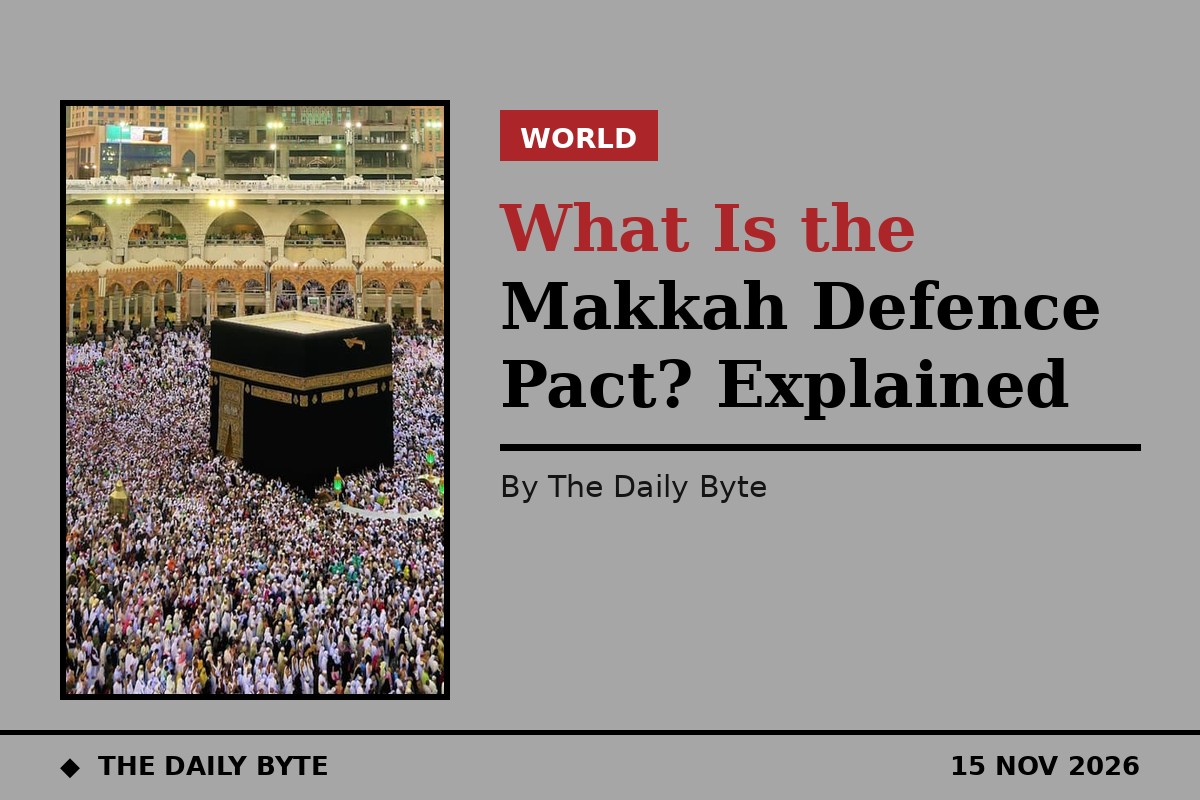
The Makkah Defence Pact is a mutual defence agreement between Saudi Arabia, Türkiye and Pakistan, signed in Makkah on 7 August 2026. Its core promise is that an armed attack on any one of the three countries will be treated as an attack on all three, and that the other two will help the country under attack. It is a 16-article treaty, it builds on an earlier Saudi-Pakistani defence pact from September 2025, and by mid-November 2026 all three countries had completed their domestic approval, with Türkiye's president signing the ratification law on 13 November and the law published on 14 November.
This guide explains what the pact is, what it actually commits the three countries to, what it does not do, where ratification stands, and why it matters. The full 16-article text was made public in October 2026 through documents submitted to the Turkish parliament, so the key clauses can now be read rather than guessed at. Where the picture is still unclear, for example on exactly when the treaty itself enters into force, this article says so.
Who signed the Makkah Defence Pact, and when?
The agreement, formally the Mecca Agreement for Joint Defence, was signed on 7 August 2026 in Makkah, at Al-Safa Palace, by Saudi Crown Prince and Prime Minister Mohammed bin Salman, Turkish President Recep Tayyip Erdoğan and Pakistani Prime Minister Shehbaz Sharif. A joint statement issued that day committed the three states to collective deterrence and declared that any armed attack against one of them would be regarded as an attack against them all.
The pact did not come out of nowhere. It builds on the Strategic Mutual Defence Agreement signed by Saudi Arabia and Pakistan on 17 September 2025 in Riyadh, which already contained a mutual defence commitment between those two countries. The Makkah agreement extends that commitment to a three-country format and adds Türkiye, NATO's second-largest army, to the arrangement.
| Date | What happened |
|---|---|
| 17 September 2025 | Saudi Arabia and Pakistan sign the bilateral Strategic Mutual Defence Agreement in Riyadh |
| 7 August 2026 | Saudi Arabia, Türkiye and Pakistan sign the Makkah Joint Defence Agreement in Makkah |
| 31 August 2026 | Senior officials meet in Istanbul and set up the Strategic Political and Defence Committee; the secretariat is based in Saudi Arabia, with Pakistan holding the first secretary-generalship for three years |
| 5 October 2026 | Saudi Arabia announces the activation of collective deterrence measures under the pact after attacks on Saudi targets |
| 20 October 2026 | Türkiye submits the agreement to parliament; the full 16-article text becomes public |
| 23 October 2026 | Pakistan completes its ratification; Saudi Arabia has also completed its domestic approval |
| 5 November 2026 | Türkiye's parliament passes the ratification bill, 279 votes to 119 |
| 13 November 2026 | President Erdoğan signs Law No. 7597 approving ratification |
| 14 November 2026 | The law is published in Türkiye's Official Gazette, issue 33430 |
What does Article 2 actually say?
Article 2 is the heart of the pact. According to the full text published in October 2026, it states that if one of the parties is subjected to an armed attack or military aggression by another country or group of countries, the parties shall immediately provide assistance to the party under attack, using the full range of mutual assistance measures available to them. The text places that cooperation within the right of self-defence recognised by Article 51 of the United Nations Charter.
Two points in the wording matter. First, the attack must be externally originating: the clause is about an outside armed attack, not about internal unrest. Second, the text does not prescribe a fixed military response. The parties are to assess the assistance needed objectively and decide its nature and extent, using the resources available to them, including military capabilities. In other words, the commitment to help is binding in form, but what help looks like in practice is decided by consultation between the three governments at the time.
The rest of the agreement covers military cooperation, intelligence sharing, joint deterrence and defence-industry collaboration, along with regular security consultations and operational coordination against terrorism. The Strategic Political and Defence Committee, which brings together the three countries' foreign ministers, defence ministers and chiefs of defence or general staff, is the body that turns the paper commitment into practical cooperation. It met in Istanbul on 31 August 2026 and again on 5 October 2026.
What the pact does not do
The most common misunderstanding about the pact is that ratification automatically sends troops. It does not. Deploying military personnel abroad would require a separate mandate from the Turkish parliament, and the same practical limit applies to the other two countries. Reuters reported before the Turkish vote that ratification gives Ankara a formal mutual defence obligation towards Saudi Arabia but does not on its own send Turkish forces there. A Turkish official said in October 2026 that the country's expected contribution was limited to military equipment, intelligence sharing and weapons systems, with no deployment under the alliance having taken place.
The pact also does not yet have the machinery of a working military alliance. As of early November 2026, the three countries had no joint military command, no shared data links, no integrated air defence network and no common command architecture, according to analysis by the Middle East Council on Global Affairs. The 5 October activation of collective deterrence measures produced a joint statement but no published operational plan, troop numbers or timeline. That gap is the main reason analysts caution against calling the pact a finished alliance: the political commitment is signed, but the operational side is still being built.
Nor is the pact aimed at a named enemy. Pakistan's Foreign Office has said the agreement is defensive, consistent with Article 51 of the UN Charter, and not directed against any particular country. Turkish Foreign Minister Hakan Fidan has described it in similar terms, saying that if one of the countries is attacked, you support its defence, and that this is not an offensive agreement. Saudi officials have said it establishes neither a military axis nor a sectarian bloc.
How does it compare with NATO Article 5?
The comparison is invited by the pact itself, because its language deliberately echoes NATO's Article 5, under which an attack on one member is treated as an attack on all. Foreign Minister Fidan reportedly called the commitment technically the same as NATO's Article 5. But the comparison has limits, and they are important.
NATO has a permanent integrated military command, common planning, joint exercises and decades of shared procedures. The Makkah pact, as signed, has a committee and a secretariat, but no joint command and no integrated forces. NATO's Article 5 also leaves each member to take such action as it deems necessary, so both agreements leave the form of the response to the members. The real difference is not the words but the machinery behind them, and that machinery does not yet exist for the Makkah pact.
Türkiye's membership of NATO is unchanged by the pact. No article in the published text addresses NATO obligations, and Türkiye remains a NATO member. The pact is a separate, additional commitment, not a replacement for the alliance.
Where does ratification stand?
By mid-November 2026, all three countries had finished their domestic approval, but the treaty-level picture needs care. Pakistan completed ratification on 23 October 2026, and Pakistan's Foreign Office confirmed on 24 October that Saudi Arabia had also completed its ratification process. Türkiye's parliament passed the approval bill on 5 November 2026 by 279 votes to 119, with 398 of the chamber's members taking part. President Erdoğan signed Law No. 7597 on 13 November, and the law was published in the Official Gazette on 14 November, which brought the approval into force under Turkish domestic law.
That is not quite the same as the treaty itself entering into force. Under the agreement, it enters into force when the last instrument of ratification is deposited with the secretariat, which is based in Saudi Arabia. As of 15 November 2026, no official announcement had confirmed that final deposit, and some reports therefore describe the pact as approved but not yet formally in force at treaty level, while others treat the Turkish gazette publication as the effective date. Readers should treat the domestic approval as complete and the final treaty step as unconfirmed until the deposit is announced.
The agreement is reported to bar withdrawal for ten years, after which a member may withdraw on at least three months' written notice, and to leave the door open to new members with the approval of the existing ones. Reports in November 2026 linked Syria with possible membership, but no formal accession had been confirmed by 15 November 2026.
Why was it signed now?
The pact emerged from several overlapping pressures. Since 2023, wars in Gaza and Lebanon, Israeli operations in Syria and Iran, Iranian attacks on Gulf states and disruption to shipping have pushed Gulf states to seek security options beyond their traditional reliance on the United States. Saudi Arabia wanted stronger guarantees for its own defence. Pakistan, which already stations thousands of troops in the kingdom, wanted a formal framework for a relationship that has long included military cooperation. Türkiye wanted a bigger strategic role in the region and a formal stake in Gulf security.
The immediate backdrop was the Houthi campaign against Saudi Arabia. The pact was signed in August 2026, and Houthi attacks on Saudi targets, including strikes on an Aramco refinery and on King Khalid International Airport in Riyadh, escalated through September and October. On 5 October, Saudi Defence Minister Prince Khalid bin Salman announced the activation of collective deterrence measures under the pact, citing attacks on the holy cities of Mecca and Medina. Pakistan said on 10 September that it was not considering an immediate military response under the pact, a sign of how carefully Islamabad weighs any step that could draw it into a conflict with Iran, with which it shares a long border.
A separate development came on 13 November 2026, when Türkiye and Qatar signed their own mutual defence agreement in Istanbul, pledging a unified stance against external armed attack on either country. That is a different, bilateral agreement from the Makkah pact, although it was signed the day before the Makkah ratification law took effect in Türkiye.
What happens next?
The next test is practical rather than legal. The three countries need to decide what joint deterrence means in concrete terms: shared intelligence, air defence coordination, joint exercises, defence-industry projects, and the question of who commands what if the pact is ever invoked. The Strategic Political and Defence Committee is the forum for those decisions, and its meetings in August and October 2026 were the first steps. A meeting of the alliance in Islamabad was reported for 27 to 28 November 2026.
The other open question is how the pact affects the wider region. Iran has not been named as a target, and the pact's members insist it is defensive, but Tehran will read it as a new alignment on its doorstep. Israel, the United States and the other Gulf states have not publicly opposed it, but Washington's attitude matters, because all three members also depend on American weapons, intelligence and diplomacy. Whether the pact becomes a working alliance or remains a political signal will be decided by what the three governments do next, not by what they signed in August.
Frequently asked questions
Is the Makkah Defence Pact an Islamic NATO? No, not in any operational sense. It borrows NATO-style language, but it has no joint command, no integrated forces and no published operational plan. Analysts describe it as a political commitment that still has to be turned into a working alliance.
Does it mean the three countries will automatically go to war together? No. Article 2 commits them to assist a member under armed attack, but the form and scale of that assistance are decided by consultation at the time. Sending troops would need separate decisions in each capital.
Is the pact aimed at Iran? The text does not name Iran or any other country. The members say it is defensive and not directed against any particular country. Iran is, however, the most obvious backdrop, given the wars and attacks in the region since 2023.
Is the pact in force? Domestic approval is complete in all three countries, and Türkiye's ratification law was published on 14 November 2026. The treaty itself enters into force when the last ratification instrument is deposited with the secretariat, and that final step had not been officially confirmed by 15 November 2026.
Can other countries join? The agreement is reported to be open to new members with the approval of the existing three. Syria's possible membership has been reported, but no formal accession had been confirmed by 15 November 2026.
Does it affect Türkiye's NATO membership? No. Türkiye remains a NATO member, and the published text contains no article on NATO obligations. The pact is an additional commitment, not a substitute.
Sources: The National, full text of the Makkah defence pact published from Turkish parliamentary documents, 21 October 2026; Reuters, 4 November 2026, on Türkiye's parliament preparing to ratify the pact; Pakistan Foreign Office weekly briefing, 24 October 2026, confirming Pakistan and Saudi Arabia had completed ratification; Clash Report, 13 November 2026, on President Erdoğan signing Law No. 7597 and its publication in the Official Gazette on 14 November 2026; Middle East Council on Global Affairs, September 2026, on the pact's operational limits. All facts as reported by 15 November 2026; where sources differ on the date the treaty enters into force, this article records the difference rather than choosing one.


