What Is the Male State? Flight Bomb Threats Explained
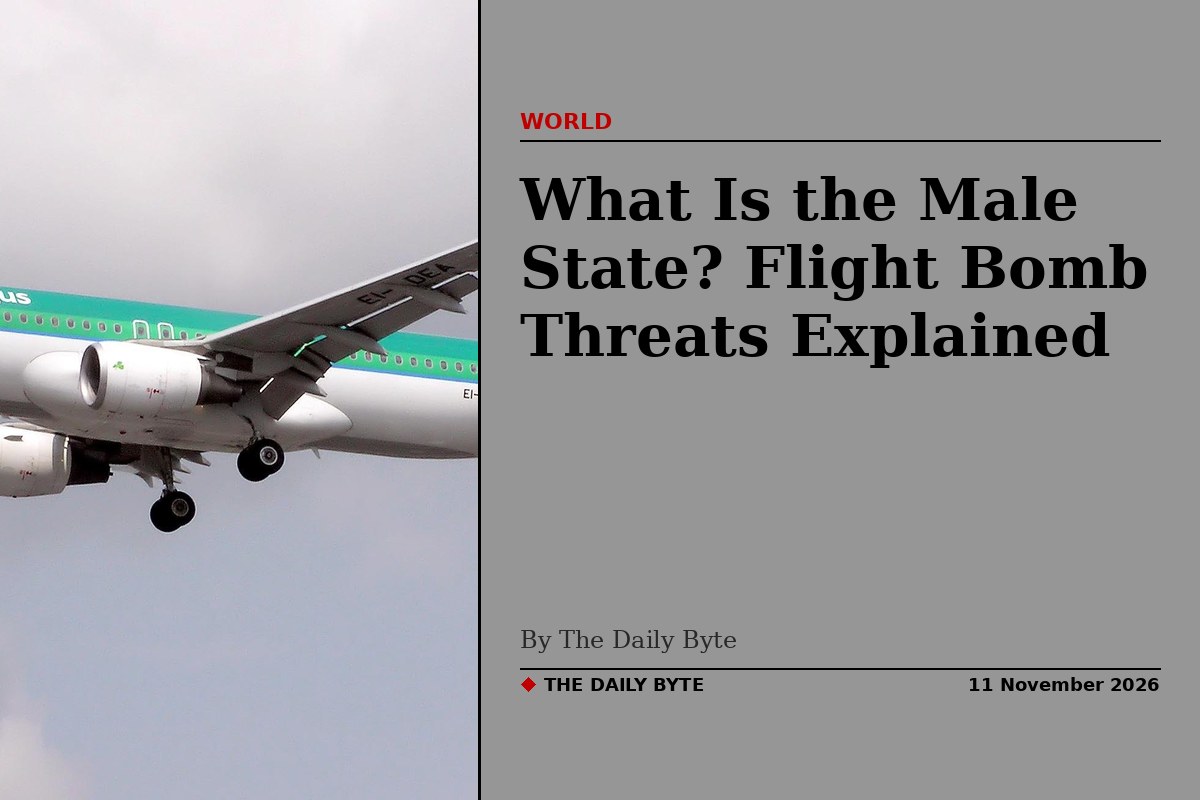
The Male State is a Russian far-right, anti-feminist movement founded in 2016, whose name appeared on a wave of hoax bomb threats emailed to European airports in November 2026. The threats forced passenger planes to divert and fighter jets to scramble, but no explosives were found on any aircraft, and no government has confirmed that the movement itself sent the messages.
The name suddenly became a search term across Europe after the second and larger wave of threats on Thursday 5 November 2026, when around 20 commercial flights were targeted in a single day. This guide explains what happened, what the Male State actually is, what the emails said, and what is still unproven.
What happened on 5 November 2026?
On the morning of Thursday 5 November, airports and airlines across Europe received emailed bomb threats naming specific flights. The BBC counted at least 18 aircraft affected that day, and other tallies put the figure at around 20 or more, with flights bound for Austria, Belgium, Bulgaria, the Czech Republic, France, Italy, Poland and Romania among those targeted.
The disruption was immediate and visible. An Aer Lingus Airbus A320 flying from Dublin to Rome was diverted to the French air base at Évreux after Italian authorities passed on the alert, with French Rafale fighter jets scrambled to escort it; 157 people were on board. Italian fighter jets escorted a Finnair flight into Rome Fiumicino, and Bulgarian MiG-29 jets escorted Ryanair flights to Sofia and Plovdiv. In the Czech Republic, four planes landing at Prague's Václav Havel Airport were targeted, according to the country's interior minister. Passengers were held on board for hours in some cases while searches were carried out. No explosives were found anywhere.
It was the second such wave in a single week. A first wave on Tuesday 3 November targeted at least seven flights and a cruise ship, according to CNN. Eurocontrol, the European air traffic organisation, recorded seven threatened flights on 3 November and 14 on 5 November. Threats continued in smaller numbers across the week, and on 6 November media organisations in Ireland, the UK, Bulgaria and France received bomb threats of their own, leading to evacuations at outlets including RTÉ and The Irish Times in Dublin.
What did the threatening emails say?
The emails sent to Rome Fiumicino Airport and Sofia Airport on 5 November were signed by the "fighters of the Male State" and were written in Italian and Bulgarian respectively. According to AFP, which saw the messages, one closed with the line: "The explosion will happen in 60 minutes. Today your sky will turn red." The messages claimed explosives had been planted on incoming flights and, in the case of Sofia, inside the airport itself, and framed the threats as retaliation against a "feminist regime".
The emails were the reason the name "Male State" spread so quickly. But a signature on an email does not prove who sent it, and that distinction matters: as of 7 November, no European country had publicly attributed the threats to any specific group or state.
What is the Male State?
The Male State (in Russian, Muzhskoye Gosudarstvo) began in 2016 as a closed group on VKontakte, the Russian social network, founded by the blogger and fitness enthusiast Vladislav Pozdnyakov. It grew into an online network promoting misogyny and ultranationalist views, and it became known for organised harassment campaigns, particularly against women and against businesses that featured women in advertising.
In October 2021 a court in Nizhny Novgorod banned the movement in Russia as extremist. The movement is part of a wider global masculinist or "manosphere" current, and in recent years it has been linked in reporting to a rise in radical and violent activity, mainly in North America and Europe.
That history is why the signature on the emails was taken seriously by investigators. It is also why the founder's response mattered: on 6 November Pozdnyakov said on Telegram that the Male State no longer existed and that those using its name were acting independently, describing the threats as provocations by others for their own interests. The Russian-language outlet Agentstvo reported that it found no posts about the incidents on Pozdnyakov's Telegram channel, and AFP said it had been unable to confirm that the movement was behind the messages.
Who is behind the threats?
That is the question investigators have not yet answered. The Paris prosecutor's office opened an investigation on 7 November into the alerts targeting aircraft flying over France, and the inquiry is also examining a possible link with foreign powers. But no arrests or charges had been announced by that date, and no state had named a culprit.
Several theories have been raised in public. Eric Schouten, head of aviation security firm Dyami, told CNN that saboteurs acting on behalf of the Russian government could be behind the threats, since most of the countries affected support Ukraine — but he presented that as an assessment, not a finding. EU Transport Commissioner Apostolos Tzitzikostas said on 5 November that it was too early to draw conclusions about whether the incidents were linked, while adding that any threats against civilians were unacceptable. The UK Transport Secretary, Heidi Alexander, described the threats as malicious hoaxes and said established processes existed for handling them.
The honest position, as of 11 November 2026, is that the sender is unknown. The emails used the name of a real, banned extremist movement, but the movement's founder denies involvement, and investigators have not confirmed the link. Anyone presenting the attribution as settled fact is going beyond what the evidence supports.
Why the threats caused so much disruption
Every bomb threat against an aircraft has to be treated as potentially real, even when it looks like a hoax. Airlines and air traffic controllers cannot gamble on a threat being fake, so planes are diverted, escorted, searched and held on the ground while bomb disposal teams work. That is expensive and frightening for passengers, and it is the point of the exercise for whoever sends the threats: maximum disruption at minimum cost, with no explosives needed.
The coordinated timing — most alerts arriving early on the morning of 5 November within a short window — suggested a coordinated operation to investigators, but coordination alone does not identify the author. Copycat threats followed the first wave, which is a familiar pattern with hoax campaigns: once one threat makes the news, others imitate it.
Key facts
| Detail | What is known |
|---|---|
| First wave | 3 November 2026: at least seven flights and a cruise ship targeted |
| Second wave | 5 November 2026: around 20 flights targeted across eight countries |
| Signature used | "Fighters of the Male State" in emails to Rome and Sofia airports |
| Explosives found | None, on any aircraft or at any airport |
| Movement founded | 2016, by Vladislav Pozdnyakov, on VKontakte |
| Movement banned | October 2021, as extremist, by a court in Nizhny Novgorod, Russia |
| Attribution | Unconfirmed; founder denies involvement; no state has named a culprit |
| Investigation | Paris prosecutor's office opened an investigation on 7 November 2026 |
Frequently asked questions
What is the Male State? A Russian far-right, anti-feminist movement founded in 2016 by Vladislav Pozdnyakov as a group on the social network VKontakte. It was banned in Russia as extremist in 2021.
Did the Male State send the bomb threats? That has not been established. The threatening emails were signed in the movement's name, but its founder denies any involvement and investigators have not confirmed the link.
Were any bombs found on the planes? No. No explosives were found on any aircraft or at any airport during the November 2026 waves, and no injuries were reported.
Which flights were affected? Flights bound for Austria, Belgium, Bulgaria, the Czech Republic, France, Italy, Poland and Romania were targeted, including an Aer Lingus flight from Dublin to Rome that diverted to France and Ryanair flights escorted by Bulgarian fighter jets.
Has anyone been arrested? No arrests or charges had been announced as of 7 November 2026. The Paris prosecutor's office has opened an investigation, and national investigations in the affected countries are continuing.
Sources: Le Monde, 6 November 2026, and reporting by AFP and the BBC as cited in that coverage; SecNews, 5 November 2026. This article was checked against both sources on 11 November 2026.


