What Is the Ovcara Massacre? Vukovar Explained
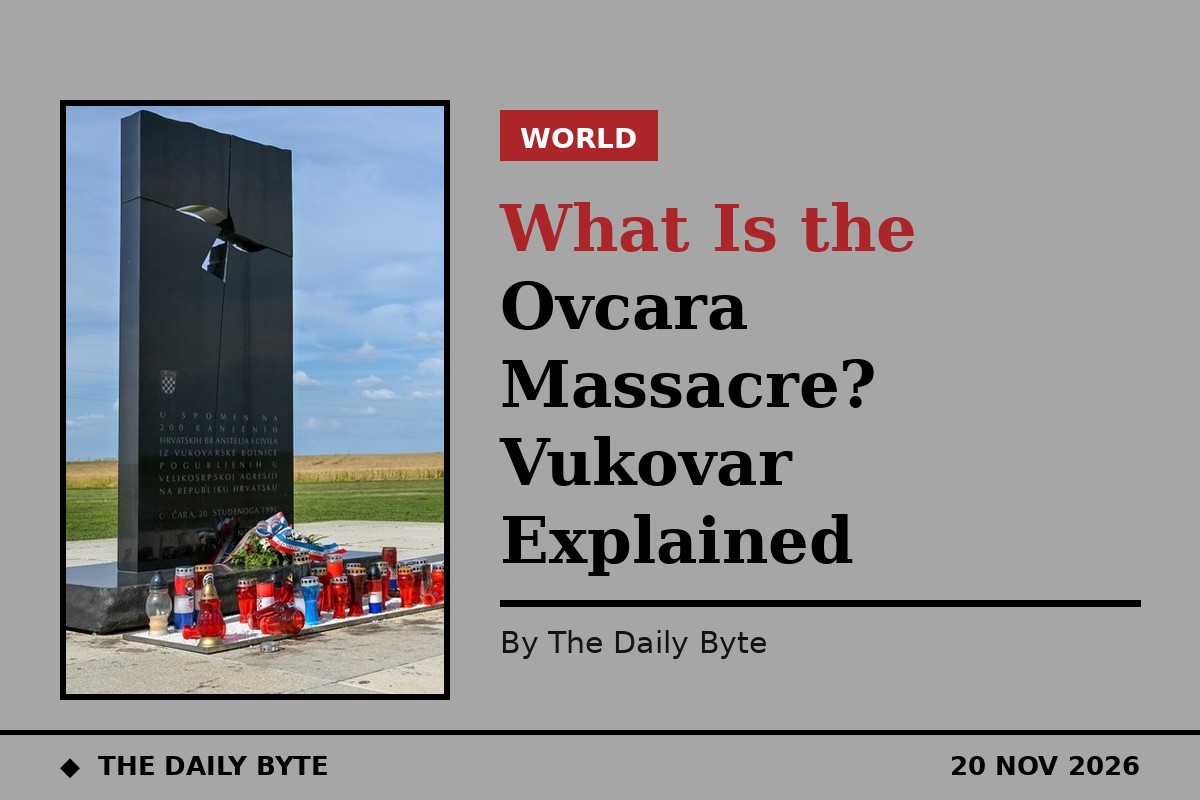
The Ovcara massacre was the killing of at least 200 Croatian prisoners of war and civilians near Vukovar on 20 November 1991, during the Croatian War of Independence. The victims had been taken from Vukovar hospital after the city fell to Yugoslav and Serb forces, driven to a farm at Ovcara, beaten, and then executed at a pre-dug mass grave. Croatia marks the 35th anniversary of the massacre on 20 November 2026. This guide explains what happened at Ovcara, who the victims were, and what the trials that followed decided.
The short answer is that Ovcara was a war crime committed at the end of the siege of Vukovar. After the city fell on 18 November 1991, Yugoslav People's Army soldiers took control of the hospital, removed about 400 men from it, and handed a large group of them to Serb paramilitaries at the Ovcara farm, about five kilometres south-east of the city. During the night of 20 and 21 November 1991, the prisoners were taken from the farm in small groups and shot at a mass grave. In 1996, investigators exhumed 200 bodies from the grave. Most estimates put the total number killed at around 260, and 48 victims have still never been found.
What happened at Ovcara?
Ovcara is a farm south-east of Vukovar, a city in eastern Slavonia on the Danube, on the border between Croatia and Serbia. In the 1991 census the Vukovar municipality had a population of 84,189, of whom 43.8 percent were Croat and 37.4 percent were Serb. In late August 1991 the Yugoslav People's Army, known as the JNA, surrounded the city and began a siege, with sustained artillery attacks that killed hundreds of people and destroyed most of the city's buildings. The siege lasted almost three months before the city fell on 18 November 1991 to the JNA, the Croatian Serb Territorial Defence and paramilitaries from neighbouring Serbia.
The massacre is also known as the Vukovar hospital massacre, because that is where the victims came from. In the final days of the battle, the evacuation of Vukovar hospital had been negotiated between the Croatian authorities, the JNA and the European Community Monitor Mission, working with the International Committee of the Red Cross. But on the afternoon of 19 November 1991, JNA units arrived at the hospital and took control of it. While medical staff were in a meeting with JNA officers, soldiers hurriedly removed about 400 men from the hospital. Among them were wounded patients, hospital staff, soldiers who had been defending the city, Croatian political activists and other civilians. About 300 of the men were loaded onto buses and held on them under JNA guard.
The night of 20 November 1991
The remaining men were driven to a building at the Ovcara farm, about four kilometres south-east of Vukovar. There, JNA and Serb paramilitary soldiers forced them to run between two lines of soldiers who beat them as they passed, and continued to beat them inside the farm building. The prisoners were then held in the farm's storage building, which was later rebuilt as a memorial centre.
In the evening, on the orders of Colonel Mile Mrksic, JNA troops withdrew from Ovcara, leaving the detainees in the hands of the Vukovar Territorial Defence and the Leva Supoderica paramilitary unit. During the night of 20 and 21 November, the detainees were taken from the hangar in groups of 10 to 20 people to the Grabovo site, where they were executed in front of a pre-dug mass grave. The killings were carried out by Serb paramilitaries to whom the prisoners had been turned over by the JNA.
How many people were killed?
The exact number of victims is still disputed, and the different figures reflect different ways of counting. The mass grave was discovered in October 1992 and guarded by the United Nations Protection Force, which had deployed to the area earlier that year. In 1996, investigators from the International Criminal Tribunal for the former Yugoslavia exhumed 200 sets of remains from the grave. Forensic analysis showed that 198 of the bodies were male and two were female, one of them a pregnant woman. The victims had an average age of 32 and a half, and included three minors. The manner of death for all 200 exhumed bodies was homicide, and for 95 percent of them the cause of death was a gunshot wound, in 67 percent of cases to the head. Traces of medical treatment and hospital workwear were found on 53 percent of the victims. In total, 96 percent of the bodies were identified, 46.5 percent by classical forensic methods and 49.5 percent by DNA analysis.
But 200 is not the full total. Croatia believes 61 others were buried in a different grave on the site, while prosecutors at the tribunal believed that figure stood at 60. The indictment issued by the tribunal said about 260 captive non-Serb men had been killed, and most sources place the number of victims at around 260. The Croatian authorities believe the total stands at 261. The Humanitarian Law Center, a Belgrade-based organisation that documents war crimes, says 265 Croatian civilians and prisoners of war were killed. Of the 200 bodies exhumed, 193 victims were identified. The remains of 17 further victims were found in nearby graves. The remains of the other 48 victims have yet to be discovered, and finding them depends on opening the archives of the Yugoslav People's Army and gathering information from people who may know where the remains were hidden.
The victims included wounded members of the Croatian armed forces and civilians, among them two women and three minors: Ruzica Markobasic, aged 32, who was heavily pregnant, Janja Podhorski, aged 60, Dragutin Balog, aged 17, Igor Kacic, aged 16, and Tomislav Baumgertner, aged 17. Their names are part of why the massacre is remembered not as an anonymous atrocity but as a list of identified individuals, most of them young men taken from a hospital.
Discovery and the memorial
The site of the mass grave is marked by a monument, and the storage building used at the Ovcara farm to hold the prisoners before their execution was rebuilt as a memorial centre in 2006. The monument is a tall black monolith inscribed in Croatian with text commemorating the 200 wounded people taken from Vukovar hospital and killed at Ovcara on 20 November 1991, topped by a dove sculpture emerging from a crack in the stone. Visitors leave candles and floral wreaths at its base, and the anniversary is marked in Croatia every year, with the 35th anniversary falling on 20 November 2026.
The trials
In November 1995 the International Criminal Tribunal for the former Yugoslavia indicted Mrksic, Major Veselin Sljivancanin and JNA Captain Miroslav Radic for war crimes related to the Ovcara massacre. The tribunal also charged Slavko Dokmanovic, the mayor of Vukovar at the time, in a sealed indictment in March 1996. The tribunal also linked the Serb paramilitary leader Zeljko Raznatovic, known as Arkan, and his formations to the massacre, but he was assassinated in Belgrade before he could be brought to trial. The tribunal also tried the former Serbian president Slobodan Milosevic for a number of war crimes, including those committed at Vukovar.
In 2007 the tribunal convicted Mrksic and Sljivancanin but acquitted Radic. Mrksic received a 20-year prison sentence. Sljivancanin was first sentenced to five years, then had his sentence increased to 17 years on appeal, and finally reduced to ten years following a review. The tribunal found that the two officers bore individual criminal responsibility for the crimes at Ovcara.
Serbia's own courts also dealt with the massacre. A trial lasting 14 years prosecuted only the direct perpetrators, for the killing of at least 200 prisoners of war at Ovcara. A total of 24 members of the Vukovar Territorial Defence and the Leva Supoderica paramilitary unit were indicted, of whom 11 were convicted with final sentences ranging from two to twenty years in prison. Of the remaining defendants, nine were acquitted, two were granted the status of cooperating witnesses, and two died during the trial.
In February 2015 the International Court of Justice ruled that the siege of Vukovar, the massacre and the simultaneous atrocities committed elsewhere in Croatia did not constitute genocide. That ruling did not deny that the massacre happened, and it did not overturn the tribunal's convictions. It decided a narrower legal question about whether the crimes met the definition of genocide under international law.
Why is Ovcara still remembered?
Ovcara is remembered for several reasons. It was one of the worst single atrocities of the Croatian War of Independence, and it happened at the end of a siege that had already become a symbol of the war. The victims were taken from a hospital, which made the crime a breach of the basic rules of war about the protection of the wounded and of medical staff. The fact that the prisoners were handed over by regular army soldiers to paramilitaries, who then killed them, became a central question in the trials. And the fact that 48 victims have still not been found means the massacre is not only history: for their families, it is an unresolved search. That is why the anniversary is still marked, why the monument still receives candles and wreaths, and why the name Ovcara is still known across Croatia and the former Yugoslavia 35 years later.


