What Is the Paris Agreement? Climate Deal Explained
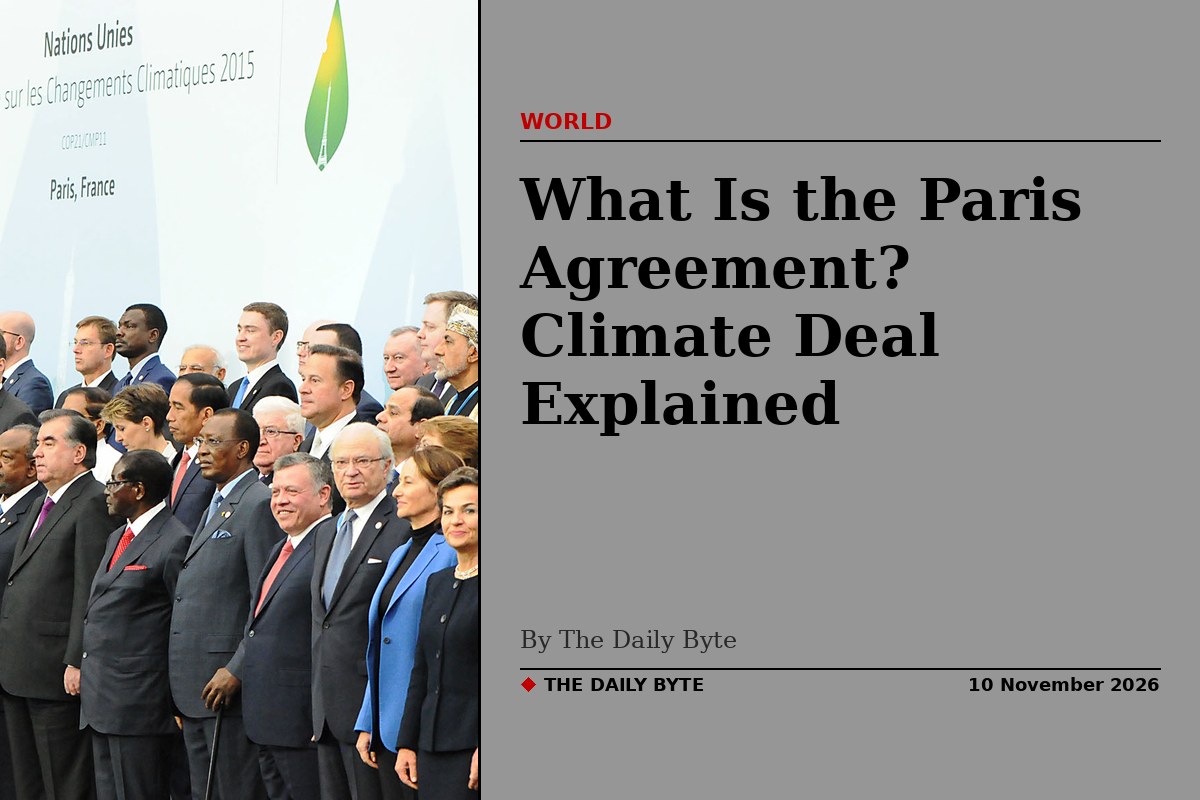
The Paris Agreement is the world's main treaty on climate change. It is a legally binding international agreement under the United Nations Framework Convention on Climate Change (UNFCCC), adopted by 195 parties at the UN climate conference in Paris, known as COP21, on 12 December 2015. It entered into force on 4 November 2016, and as of January 2026 it has 194 parties: 193 countries and the European Union. Its goal is to hold the rise in global temperatures to well below 2 degrees Celsius above pre-industrial levels, and to pursue efforts to limit the rise to 1.5 degrees.
The agreement matters because it is the first climate treaty that brings almost every country in the world into the same framework. Earlier deals covered only some countries. Paris covers nearly all of them, and it is the yardstick against which every national climate plan, every COP summit and every promise of climate finance is now measured. COP30, the latest round of those talks, opened in Belém, Brazil, on 10 November 2026.
What is the goal of the Paris Agreement?
The agreement's overarching goal is to hold the increase in the global average temperature to well below 2 degrees Celsius above pre-industrial levels, and to pursue efforts to limit the increase to 1.5 degrees. The UN's climate science body, the Intergovernmental Panel on Climate Change, has warned that crossing 1.5 degrees risks far more severe impacts, including more frequent and severe droughts, heatwaves and heavy rainfall.
To keep warming to 1.5 degrees, the UNFCCC says greenhouse gas emissions must peak before 2025 at the latest and fall by 43% by 2030. That is the scale of the task the agreement sets. Whether the world is on track is a separate question: the agreement sets the destination, but each country chooses its own route.
How does the Paris Agreement work?
The agreement works on a five-year cycle of increasingly ambitious climate action. Each country sets its own climate plan, called a nationally determined contribution, or NDC, saying how it will cut its greenhouse gas emissions and adapt to the effects of climate change. Every five years, each country is meant to submit a new NDC that is more ambitious than the last. Countries are also invited to set out long-term strategies for cutting emissions over decades.
This bottom-up design was a deliberate choice. Rather than imposing the same cuts on every country, Paris lets each government set targets that fit its own economy and circumstances. The trade-off is that the targets are only as strong as governments choose to make them. The agreement does not force any country to meet its targets, and it has no fines or penalties for missing them.
How is progress tracked?
Countries report transparently on their emissions, their actions and the support they have given or received, under a system called the enhanced transparency framework. That information feeds into a Global Stocktake, a collective check-up held every five years that assesses how far the world has come towards the agreement's goals and recommends more ambitious plans for the next round.
The first Global Stocktake, completed at COP28 in Dubai in 2023, found the world was not on track and called on countries to move away from fossil fuels. The next round of NDCs, due around 2025 and 2030, is judged against that finding. The stocktake is the agreement's main pressure mechanism: it cannot punish a country, but it can expose how far its promises fall short.
What about climate finance?
The agreement says developed countries should take the lead in providing financial help to poorer and more vulnerable countries, both to cut emissions and to adapt to climate change that is already happening. It also encourages voluntary contributions from other countries. Finance, technology transfer and help in building the capacity to deal with climate change are all part of the deal, because many developing countries argue they cannot cut emissions without support from the countries that industrialised first.
Money has been one of the hardest-fought issues at every COP since Paris. Developing countries say the finance promised has been too little and too slow. Rich countries say they are delivering, and point to new funds for the damage already caused by climate change. The argument runs through COP30 in Belém just as it did at COP21 in Paris.
Which countries are not in the Paris Agreement?
Almost every country is a party. As of January 2026, 194 parties belong to the agreement. Of the three UNFCCC member states that have not ratified it, the only major emitter is Iran. The United States, the world's second-largest greenhouse gas emitter after China, has joined and left the agreement twice: it withdrew in 2020, rejoined in 2021, and withdrew again in 2026.
A country can leave the agreement by giving formal notice, and the US has shown that the door swings both ways. That is one of the agreement's weaknesses: it binds countries that stay in, but it cannot stop a government from walking out.
How is the Paris Agreement different from the Kyoto Protocol?
The Kyoto Protocol, adopted in 1997, only set binding emissions targets for developed countries. Developing countries, including China and India, had no targets, which became a growing problem as their emissions rose. The Paris Agreement covers nearly every country, developed and developing alike, and each sets its own targets. It is broader but softer: Kyoto imposed targets from above, while Paris relies on countries volunteering them and then being held to account in public.
Frequently asked questions
Is the Paris Agreement legally binding? Yes, it is a legally binding treaty. But the binding part is mainly the framework: countries must submit climate plans and report on progress. The targets inside those plans are not enforced with fines or penalties.
What happens if a country misses its climate target? Nothing formal. There are no sanctions. The pressure comes from the transparency system and the Global Stocktake, which make shortfalls public, and from other governments, voters and investors.
When was the Paris Agreement adopted? It was adopted on 12 December 2015 at COP21 in Paris, and it entered into force on 4 November 2016.
Can a country leave the Paris Agreement? Yes. The United States withdrew in 2020, rejoined in 2021 and withdrew again in 2026.
What is COP30? COP30 is the 30th UN climate change conference, which opened in Belém, Brazil, on 10 November 2026. COP stands for Conference of the Parties, the annual meeting of the countries in the UN climate convention.
Sources: UNFCCC — The Paris Agreement and Wikipedia — Paris Agreement.


