What is the RMT and why is the Tube on strike?
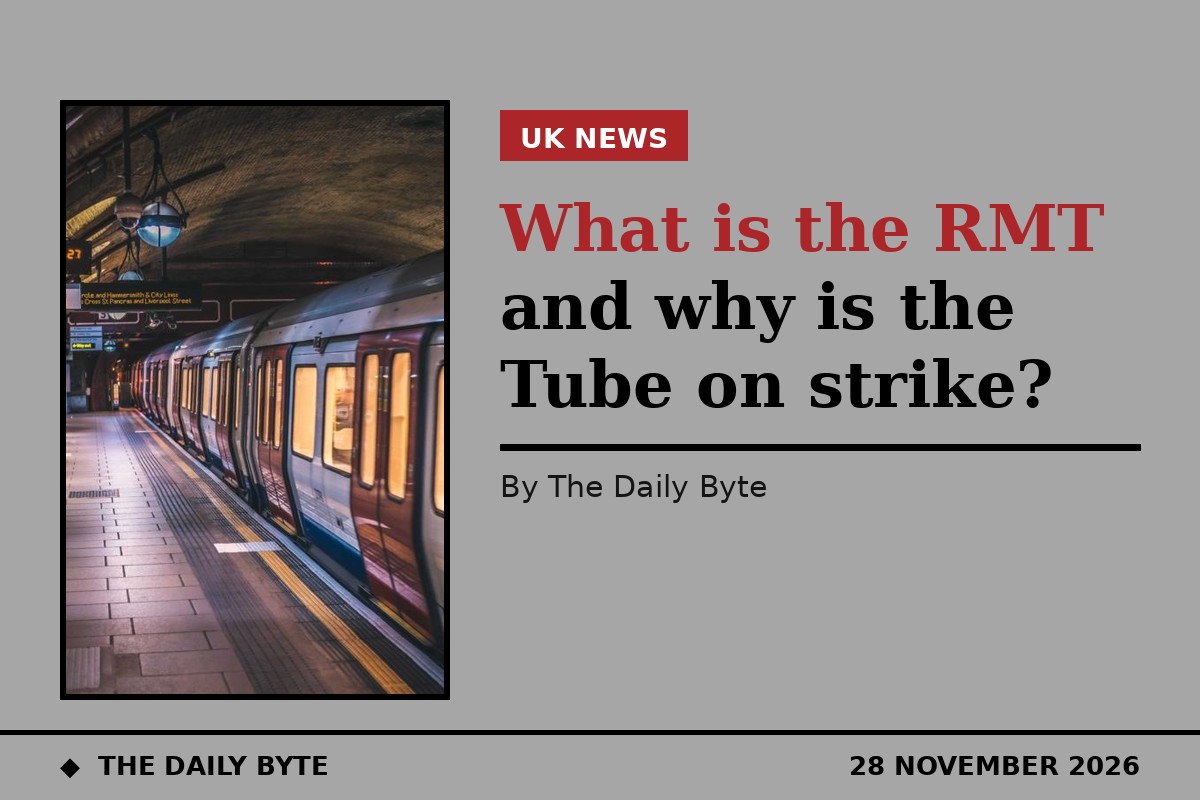
The RMT is the National Union of Rail, Maritime and Transport Workers, a British trade union with more than 80,000 members across rail, shipping, buses and road freight. It is in the news because its London Underground driver members walked out at midday on Thursday 26 November 2026, the first of eight planned 24-hour strikes running to 25 February 2027, in a dispute over London Underground's proposals for a voluntary four-day working week and a new Trains Modernisation Framework. This guide explains what the RMT is, who it represents, what each side in the dispute says, and when the Tube strikes are planned.
What does RMT stand for?
RMT stands for the National Union of Rail, Maritime and Transport Workers. It describes itself as a specialist transport union. Railways make up a large proportion of its membership, and it says it remains the largest of the three railway trade unions, but its members are increasingly found in industries connected with the broad base of transport, including shipping and offshore work, buses and road freight.
The union represents most London Underground staff, as well as many other workers in the London public transport network. Train drivers are also represented by ASLEF, the Associated Society of Locomotive Engineers and Firemen, which is a separate union. The two unions have co-ordinated disputes in the past, but in the current Tube dispute they have taken different positions, as explained below.
When was the RMT formed, and who does it represent?
The RMT was formed on 10 September 1990 through a merger of the National Union of Railwaymen and the National Union of Seamen. Both of those unions had long histories going back to the turn of the twentieth century, and their predecessor unions were founding members of the original Labour Representation Committee, the body from which the Labour Party grew.
The union says it represents more than 80,000 members in almost every sector of the transport industry, from mainline and underground rail to shipping and offshore, buses and road freight. Its annual return for the year ended 31 December 2024 recorded 80,521 members. Membership rose under and following the leadership of Bob Crow, increasing from 57,000 in 2002 to almost 81,500 in 2019.
The union's members are organised in more than 200 branches throughout the country, grouped geographically into twelve regional councils. It has seven regional offices, in Birmingham, Bristol, Doncaster, Glasgow, Liverpool, London and Southampton, and other offices in Aberdeen, Dover and South Shields. Its head office is Unity House, 39 Chalton Street, London NW1 1JD, off the Euston Road. The union opened its residential education facility in 2006, renamed the Bob Crow National Education Centre, which supports the education of around 900 RMT students each year.
Who runs the RMT?
The union's governing body is its annual general meeting, or annual conference, with around 70 delegates elected by branches. Between annual meetings the union is controlled by its National Executive Committee, which has 16 members, four for maritime grades and twelve for general grades. The union's structure also includes a president, a general secretary, two assistant general secretaries, and a national secretary and assistant national secretary for maritime matters.
The general secretaries since the union was formed have been Jimmy Knapp from 1990, Bob Crow from 2001, Mick Cash from 2014, Mick Lynch from 2021 and Eddie Dempsey from 2025. The current president is George Welch. The union is affiliated to the Trades Union Congress, the Scottish Trades Union Congress and the Irish Congress of Trade Unions, and internationally to the European Transport Workers' Federation, the International Transport Workers' Federation and the World Federation of Trade Unions. It was expelled from the Labour Party in 2004 after some Scottish branches donated to the Scottish Socialist Party, and it later co-founded the Trade Unionist and Socialist Coalition, from which it disaffiliated in 2022.
Why are RMT members striking on the Tube?
The RMT says the action is in response to London Underground plans to introduce a so-called voluntary four-day working week alongside a new Trains Modernisation Framework. The union argues that the proposals would force drivers to give up hard-won protections whether they work four or five days a week, and that drivers could face more time driving trains, earlier starts and later finishes, less predictable shifts and possible displacement from their current depots. It also says it is concerned the proposals could pave the way for hundreds of job cuts.
General secretary Eddie Dempsey said London Underground was attempting to dress up a wholesale attack on drivers' working conditions as a voluntary four-day week, adding that there was nothing voluntary about a scheme that forces drivers to give up existing protections whether they work four days or five, and threatens those who refuse with displacement from their depots. He said members were being asked to spend more time driving trains, accept longer and more unpredictable shifts and surrender agreements negotiated and defended over many years, and that the dispute was not about improving work-life balance but about squeezing more work out of fewer drivers while giving management greater flexibility at the expense of members. He added that the RMT was not opposed to a genuine four-day working week that benefits its members, but would not accept it being used as a vehicle for job cuts, intensified working and the erosion of terms and conditions, and he called on London Underground to withdraw the proposals and engage seriously with the union to reach a negotiated settlement.
What is London Underground's four-day week proposal?
Transport for London says the industrial action relates to revised proposals for a voluntary four-day week working pattern for train drivers, and that the work on the proposals was done in response to a request from trade unions. Following initial feedback and engagement with the unions, London Underground changed the options drivers can choose from, with an option to remain on a five-day week working pattern with a guarantee of remaining at the same depot now part of the proposal.
Nick Dent, director of customer operations for London Underground, said the proposals would give colleagues a real, meaningful choice on their working pattern without having to change where they work, and that drivers who choose a four-day week, and those who choose to work a five-day pattern with the same terms and conditions as the four-day pattern, would spend less time at work per year while delivering a more efficient, reliable Tube service for customers. He said it was disappointing that the RMT had called the strike action, that London Underground had been in discussion with both the RMT and ASLEF for a number of months about the voluntary proposals, and that the majority of the concerns from the RMT had now been resolved, urging the RMT to put the proposal to its members.
At present, Tube drivers work a minimum 35-hour week spread over five days. London Underground wants to introduce an option for drivers to compress those hours across four days rather than five, meaning longer shifts but a shortened working week. The RMT says its members are concerned about possible fatigue and burnout from longer shifts, which they fear would imperil passenger and driver safety, while London Underground denies that drivers are being asked to spend more time driving trains.
Why does ASLEF disagree with the RMT?
ASLEF, the other union that represents London Underground drivers, is not joining the RMT action, and its members are working normally. Finn Brennan, ASLEF's full-time organiser on London Underground, told the BBC that the union was surprised the RMT had again decided to strike to prevent Underground drivers moving to a voluntary four-day week.
Brennan said the voluntary four-day week would give Tube train drivers an extra 35 days off each year, with rosters based on a 34-hour week, in return for some changes to working conditions and a move from paper-based to electronic systems for booking on for duty. He said management had agreed that anyone wishing to keep working a five-day week could do so without suffering any detriment, and that ASLEF would hold management to that commitment, adding that a strike designed to stop people having the choice of a shorter working week and more time off was a strange choice to make. The split between the two driver unions is unusual, and it is one reason why most Tube services are still running on strike days.
When are the Tube strikes, and which lines are affected?
The RMT has announced eight 24-hour walkouts, running from 26 November 2026 to 26 February 2027. The first began at 12:00 on Thursday 26 November and ran until 12:00 on Friday 27 November. The remaining walkouts are scheduled to begin on Thursday 17 December 2026, Saturday 19 December 2026, Monday 4 January 2027, Wednesday 6 January 2027, Wednesday 17 February 2027, Tuesday 23 February 2027 and Thursday 25 February 2027, each lasting 24 hours from midday.
On the first strike day, most Tube services were expected to run but with disruption on all lines, and no service was expected on the Circle or Piccadilly lines throughout the day or on the Waterloo and City line after midday. On Friday 27 November, services were expected to start later than normal, from about 07:00, with disruption across all lines until around midday, and continued disruption through the afternoon and evening as services returned to normal by around 18:00 that evening.
The Elizabeth line is not a London Underground service and no Elizabeth line strike is currently planned, so it is expected to run normally, although it may become busier. The DLR, London Overground, National Rail services, buses and trams are also expected to continue operating as normal during the RMT action, although they may be busier than usual. Transport for London advises customers to check before travelling for the latest real-time information using the TfL Go app or website and to allow extra time for their journeys.
Will the Tube shut down completely on strike days?
No. Because the RMT does not represent a majority of Tube drivers, and because ASLEF members are working normally, a substantial service still runs across the network on strike days. During major London Underground walkouts the entire network can be affected by delays, cancellations or partial and full-line closures, but the extent of disruption varies, and during earlier action in 2026 services continued to run across most of the network.
Passengers who usually rely on the Underground may need to allow additional journey time, consider earlier departures or use alternative routes. Travellers heading to airports may be able to use alternative rail services where Underground lines are disrupted: passengers normally using the Piccadilly line to reach Heathrow could use the Elizabeth line or Heathrow Express instead, and coaches run from central and outer London, while airports remain accessible by road, although traffic levels may be higher on strike days.
The RMT dispute is separate from action taken by the TSSA union on 20 and 21 November 2026, which affected the Piccadilly and District lines. It also forms part of a wider sequence of London Underground industrial action in recent years, including strikes in 2022, 2023, 2025 and 2026.
Can the strikes still be called off?
Industrial action earlier in the year was called off by the union, and it is possible the RMT and Transport for London could reach an agreement before the strikes begin, although the chance of a compromise reduces as a strike approaches. The current period of announced industrial action is set to end on 26 February 2027, although further strikes could be called if no agreement is reached. Travellers should check the latest Transport for London and operator updates before setting out, because the situation may change before individual strike dates.
Frequently asked questions
Q: What does RMT stand for?
A: The National Union of Rail, Maritime and Transport Workers. It was formed on 10 September 1990 from a merger of the National Union of Railwaymen and the National Union of Seamen.
Q: How many members does the RMT have?
A: The union says it represents more than 80,000 members, and its annual return for the year ended 31 December 2024 recorded 80,521 members.
Q: Why are Tube drivers striking?
A: The RMT is disputing London Underground's proposals for a voluntary four-day working week and a new Trains Modernisation Framework. The union says drivers would have to give up protections, work longer and less predictable shifts and risk displacement from their depots, while London Underground says the proposals give drivers a real choice and less time at work each year.
Q: Is the Elizabeth line affected by the Tube strikes?
A: No. The Elizabeth line is not a London Underground service and no Elizabeth line strike is currently planned, so it is expected to run normally, although it may be busier than usual.
Q: When is the next Tube strike after 26 November?
A: The next announced 24-hour walkout begins at 12:00 on Thursday 17 December 2026, followed by one beginning at 12:00 on Saturday 19 December 2026.


