What Is the San Andreas Fault?
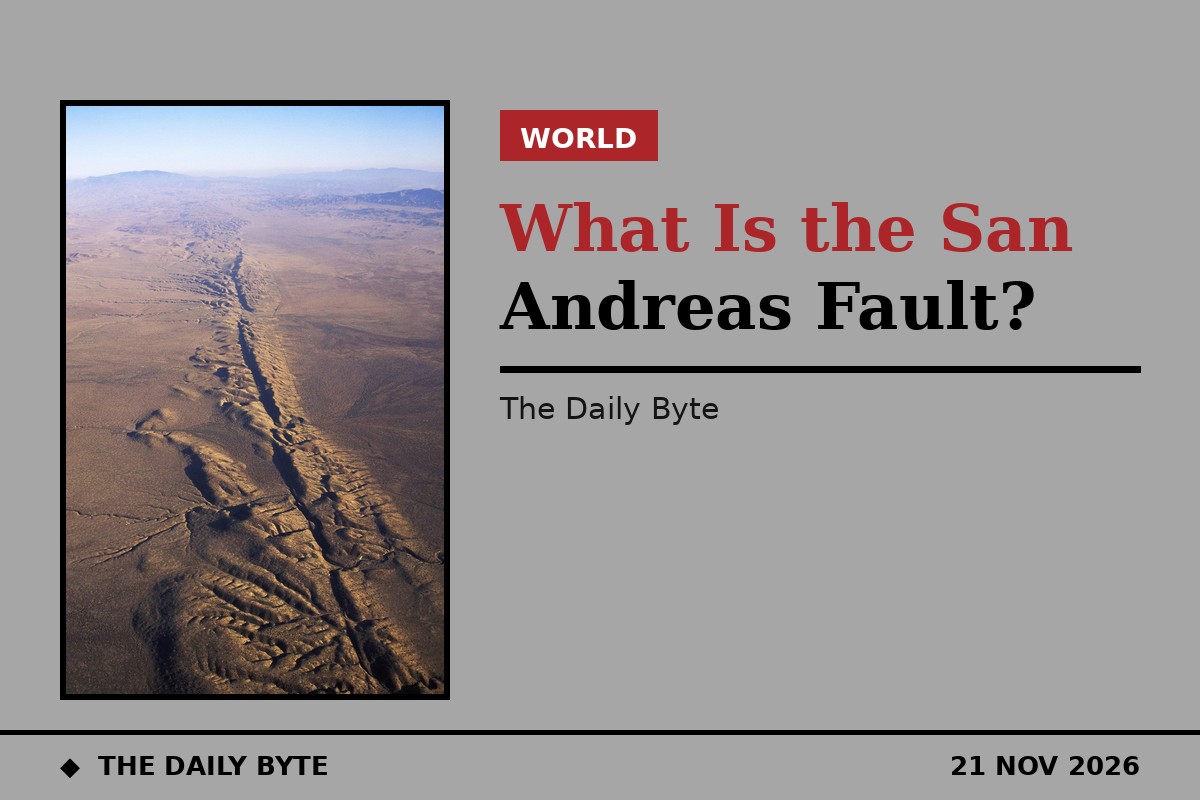
The San Andreas Fault is a fracture in the Earth's crust about 1,300 kilometres (800 miles) long that runs through California, marking the boundary where the Pacific tectonic plate slides past the North American tectonic plate. It produced the great San Francisco earthquake of 1906. The fault is in the news again after a swarm of more than 70 small earthquakes rattled central California this week, including a magnitude 5.0 tremor near Pinnacles National Park on Thursday night.
This explainer sets out what the fault is, how it moves, why some stretches are more dangerous than others, what this week's earthquakes mean, and what the “Big One” is.
Two plates sliding past each other
The Earth's outer shell is broken into huge slabs called tectonic plates, which move slowly over the hot rock beneath them. In western California two of those plates meet. To the west of the fault, the Pacific Plate carries Los Angeles, San Diego and the California coast slowly towards the north-west. To the east, the North American Plate carries the rest of the continent towards the south-east. The San Andreas Fault is the boundary between them, and it is a transform fault, also called a strike-slip fault, which means the ground on either side moves horizontally past each other rather than up and down.
The movement is slow but relentless. The plates slide past each other at roughly 20 to 35 millimetres a year along the fault, about the rate at which fingernails grow, according to the US Geological Survey. Over millions of years that adds up to hundreds of kilometres of sideways displacement, and streams crossing the fault are visibly offset where the ground has shifted. It runs from the Salton Sea near the Mexican border, past San Bernardino and Palmdale, up through the Carrizo Plain and Parkfield, along the San Francisco Peninsula, and out to sea at Cape Mendocino.
| Fact | Detail |
|---|---|
| Length | About 1,300 km (800 miles), Salton Sea to Cape Mendocino |
| Type | Right-lateral strike-slip (transform) fault |
| Slip rate | About 20 to 35 mm a year |
| Biggest quake | San Francisco, 1906, magnitude 7.9 |
Why the fault sticks, then slips
The plates do not slide smoothly. Friction locks stretches of the fault in place, sometimes for decades or centuries, while the plates keep pushing. Stress builds up until the rock finally gives way and the stored energy is released in seconds as an earthquake. The longer a stretch stays locked, the bigger the earthquake it can produce.
The fault is divided into three segments. The central segment, around Parkfield, creeps: it moves steadily a little at a time, producing many small earthquakes but rarely a large one. The northern segment, through the San Francisco Bay Area, last ruptured in 1906, when 477 kilometres (296 miles) of the fault moved and the shaking and fires killed more than 3,000 people. The southern segment, from the Salton Sea towards Parkfield, worries seismologists most: it has not produced a major rupture since the Fort Tejon earthquake of 1857, a magnitude 7.9 event, and is locked along much of its length. The USGS ShakeOut scenario modelled a plausible magnitude 7.8 rupture there, estimating roughly 1,800 deaths, 50,000 injuries and more than $200 billion in losses.
What happened this week?
Late on Thursday 19 November, a magnitude 5.0 earthquake struck about 10 kilometres north-west of Pinnacles National Park in central California, at 10:49pm local time and a depth of 6.7 kilometres, close to the San Andreas Fault. It was preceded by two foreshocks of magnitude 3.1 and 3.3, and followed by aftershocks including one of magnitude 3.4 and another of magnitude 4.4 early on Friday. The US Geological Survey counted 77 earthquakes nearby between 19 and 21 November, and shaking was felt as far north as the San Francisco Bay Area. No damage or injuries were reported.
About five hours later, at 3:25am on Friday, a separate magnitude 3.9 earthquake struck near Commerce in east Los Angeles, about 15 kilometres deep, and more than 12,000 people told the USGS they had felt it. The Los Angeles Fire Department surveyed the city from all 106 of its stations and found no damage and no injuries. The two quakes were about 300 miles apart, and nothing indicates that one caused the other: the Los Angeles quake happened on a different, reverse-thrust fault beneath the city, not on the San Andreas itself. Swarms of small earthquakes are normal near the fault, and after a moderate earthquake there is roughly a 5% chance of a larger one in the following 72 hours, so the risk is slightly above baseline for a few days, not a prediction of something bigger.
What is the “Big One”, and can it be predicted?
The “Big One” is shorthand for a very large earthquake on the San Andreas Fault, usually a magnitude 7.8 or greater rupture of the locked southern segment. It is a matter of when, not if, because the tectonic forces driving it will not stop. But no one can say when it will happen, and the USGS is blunt that earthquakes cannot be predicted: there is no reliable signal that a big earthquake is about to happen on a particular day, and claims that animals, weather or the moon can predict them have no scientific support.
What scientists can give is a probability. The USGS-led Third Uniform California Earthquake Rupture Forecast puts the 30-year chance, from 2014 to 2043, of at least one magnitude 6.7 or greater earthquake at 72% for the San Francisco Bay region and 60% for the Los Angeles region, counting all faults in each area. Those numbers describe the odds over three decades, not a timetable: a high probability does not mean the earthquake is “overdue”. One reassuring point is that the San Andreas is very unlikely to cause a large tsunami, because the fault moves sideways rather than up and down and does not displace huge volumes of seawater. The danger is the shaking itself, and the fires, landslides and damaged buildings that follow it.
Frequently asked questions
Did this week's earthquake swarm mean the Big One is coming? No. Swarms near the fault are common, and aftershocks after a magnitude 5.0 event are expected. The USGS estimates about a 5% chance of a larger earthquake in the 72 hours after a moderate quake, so the risk is slightly above baseline for a few days.
Can scientists predict earthquakes? No. The USGS says earthquakes cannot be predicted. Scientists can estimate the probability of a large earthquake over decades, and ShakeAlert can give seconds of warning once a quake has started, but no method can say where and when the next big one will strike.
Why does the southern San Andreas worry scientists most? Because it has been locked since the Fort Tejon earthquake of 1857 and is storing up stress. A rupture of the southern segment would shake the Los Angeles basin directly.
Would the San Andreas cause a tsunami? Almost certainly not a large one. The fault slides sideways, so it does not lift or drop the sea floor the way subduction zones do. The main hazard is strong shaking on land.


