What Is the Schengen Area? Cyprus Joins 2027
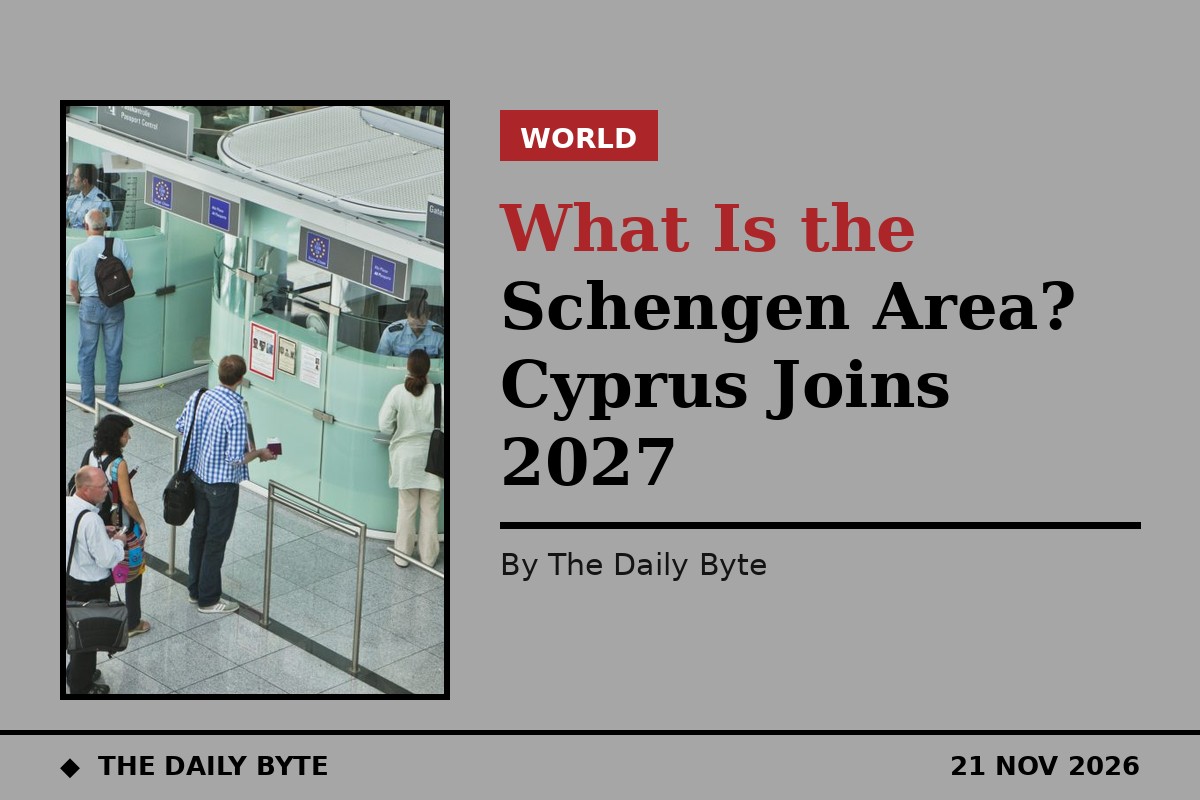
Europe has a border that most travellers never notice. Drive from France into Germany, take a train from Belgium into the Netherlands, or fly from Spain to Italy, and in most cases nobody will ask to see your passport. That is the Schengen Area at work: 29 European countries that have agreed to abolish checks at their shared borders and to run one common set of rules at their outer edge instead. It is one of the most searched travel questions in Europe, and it is back in the news this week because Cyprus is now expected to join it on 1 July 2027.
The announcement came at the fourth Greece-Cyprus intergovernmental summit in Nicosia on 18 November 2026, where Greek Prime Minister Kyriakos Mitsotakis said he looked forward to Cyprus formally joining the Schengen Area on 1 July, the first major decision of the Greek presidency of the Council of the European Union. The summit also backed the Greece-Cyprus electricity interconnector, known as the Great Sea Interconnector, and called for Cyprus reunification talks to resume from where they stopped at Crans-Montana in 2017. For travellers, the Schengen part of the story is the one with the most practical consequences, because it changes how millions of people cross borders.
What is the Schengen Area?
The Schengen Area is a zone of 29 European countries that have abolished passport and other border controls at their common borders. Inside the area, people can generally cross from one member country to another without stopping at a checkpoint, in much the same way as travelling between counties in the United Kingdom or states in the United States. The area is named after Schengen, a village in Luxembourg close to the point where Luxembourg, France and Germany meet. The original Schengen Agreement was signed there in 1985 by Belgium, France, Germany, Luxembourg and the Netherlands, and the area itself opened in 1995.
The deal works because the checks have not disappeared altogether. They have moved. Instead of each country guarding every border with its neighbours, the member states share one external border. A traveller arriving from outside the area is checked once, at the point of entry, under a common visa policy. After that, movement inside the area is normally free. The member states also share police and security cooperation, and a common information system, so that removing internal checks does not mean removing all controls.
Which countries are in the Schengen Area?
There are 29 countries in the Schengen Area in 2026: 25 member states of the European Union plus Iceland, Liechtenstein, Norway and Switzerland. The EU members in the area are Austria, Belgium, Bulgaria, Croatia, the Czech Republic, Denmark, Estonia, Finland, France, Germany, Greece, Hungary, Italy, Latvia, Lithuania, Luxembourg, Malta, the Netherlands, Poland, Portugal, Romania, Slovakia, Slovenia, Spain and Sweden. The four non-EU members are all part of the European Free Trade Association and have signed association agreements with the EU.
The newest members are Croatia, which joined in 2023, and Bulgaria and Romania, which became full members on 1 January 2025. Those two joined in two steps: checks on flights and sea crossings with the rest of the area ended on 31 March 2024, and checks at land borders ended on 1 January 2025. Two EU countries sit outside the area: Cyprus, which is committed by treaty to join and is now expected to do so in 2027, and Ireland, which has an opt-out under EU law so that it can keep the Common Travel Area with the United Kingdom. The United Kingdom is in neither the EU nor Schengen, which is why British travellers are checked at the Schengen external border.
Some smaller states sit in a grey area. Monaco is treated as part of the area in practice, because its borders are administered through France. San Marino and Vatican City have open borders with their Schengen neighbours and can be entered with a Schengen visa, while Andorra is not formally in the area but has open borders with Spain and France and can be visited with a Schengen visa. Gibraltar has secured a separate arrangement that moves Schengen external controls to its airport and seaport, removing checks at its land border with Spain.
How did Schengen start?
Schengen began as a small experiment. In 1985, five countries signed an agreement to gradually abolish checks at their common borders. A follow-up convention in 1990 set out how the system would work in practice, including the common visa rules and police cooperation. The area opened in 1995 with seven countries, and it has grown in stages ever since, as new EU members met the conditions for joining. Each new member has to show that it can guard the external border, run the shared information systems, and apply the common visa rules before the internal checks come down.
That test is why Cyprus has taken so long. Joining is not a matter of signing a declaration. A country must pass an evaluation of its border management, its visa system, its data protection and its police cooperation, and the EU Council must then vote to lift the checks. Cyprus already takes part in Schengen cooperation, and the European Commission describes its integration as under way. The date now put on it by the Greek prime minister, 1 July 2027, would make it the first big decision of the Greek EU presidency.
What does passport-free travel actually mean?
Inside the Schengen Area, there are normally no routine passport checks when you cross an internal border. You can drive, walk or take a train across without stopping. That does not mean you should travel without identification. Police in any member state can still ask for ID, and spot checks can take place near borders. Airlines and hotels may also ask for a passport or identity card, and travellers should always carry one.
Nor does passport-free travel mean the borders have vanished. The Schengen Borders Code, the rulebook for the area, has always allowed a country to bring back checks at its internal borders if it faces a serious threat to public order or internal security, and only as a last resort. Those checks are time-limited: they run for up to six months and can be renewed, up to two years in total under the version of the code rewritten in 2024. As of 14 November 2026, eight countries were running such checks, including Germany at its land borders with all nine of its neighbours until 15 March 2027, and Austria at its borders with Slovakia, Czechia, Hungary and Slovenia until the same date. Travellers may therefore still be stopped, even on a route that is normally open.
The 90-day rule for visitors
For visitors from outside the area, the most important rule is the 90-day limit. A short-stay Schengen visa, or a visa-free stay, lets you travel within all 29 countries for up to 90 days in any 180-day period. The 180 days are counted on a rolling basis, so the clock does not reset at the start of a calendar year. Staying beyond 90 days without a long-stay visa or residence permit can mean a fine, a ban on returning, or refusal of entry next time.
The count is now done automatically. Since 10 April 2026, the EU Entry/Exit System, known as EES, has been fully operational at the external borders of the 29 EES countries. Non-EU visitors on a short stay have their passport scanned, a facial image taken and, for those aged 12 and over, four fingerprints scanned on their first crossing. The record is kept for three years, so later trips are quicker. There is no application to complete in advance and no fee for EES. Registration happens at the border, including at St Pancras, Dover and Folkestone, where French border checks take place before travellers leave the UK.
A separate system, ETIAS, is often confused with EES. ETIAS will be an online travel authorisation for visa-exempt visitors, expected to cost 20 euros and to be valid for three years. As of late October 2026 it is not in operation, no applications are being collected, and the EU has not announced a start date. Any website charging for an ETIAS authorisation today is not selling a real EU document.
Schengen, the EU and the euro: not the same thing
One of the most common points of confusion is that Schengen, the European Union and the eurozone are three different clubs with overlapping but different memberships. The EU has 27 members. Schengen has 29 countries, including four that are not in the EU. The eurozone has 20 countries that use the euro. Ireland is in the EU and the eurozone but not in Schengen. Norway is in Schengen but not in the EU and does not use the euro. Denmark is in the EU and Schengen but keeps its own currency. Cyprus is in the EU and the eurozone but is not yet in Schengen, which is exactly what the 2027 date would change.
The distinction matters for travellers. Being in the EU does not by itself give a country passport-free borders with its neighbours, and being in Schengen does not mean a country uses the euro or follows all EU laws. Customs is another separate question: Schengen covers immigration controls, not customs. Travelling between a Schengen country and a non-Schengen EU country, such as Ireland, means passing through immigration controls but not customs, while travelling between an EU country and a non-EU Schengen country, such as Switzerland, means the reverse.
Why the Cyprus decision matters now
Cyprus joining Schengen would complete a process that has been under way for years. For Cypriots, it would mean passport-free travel to the rest of the area and the removal of checks at the island's airports and seaports for intra-Schengen travel. For visitors, it would mean that a trip combining Cyprus with Greece or another Schengen country would no longer involve a separate border check. For the EU, it would leave Ireland as the only member state outside the area, by its own choice.
The timing is also political. Greece takes over the presidency of the Council of the EU in the second half of 2027, and Mitsotakis said he wanted Cyprus joining Schengen to be the first major decision of that presidency. The summit's joint communique also covered the electricity cable, artificial intelligence and civil protection, and the two governments agreed to cooperate closely at technical level as the handover of the presidency approaches. Cyprus held the presidency in the first half of 2026, so the two countries are in effect passing the baton to each other.
None of this is final until the EU Council votes to lift the checks, and that vote follows the technical evaluation. But a public date from a prime minister, attached to a presidency timetable, is a strong signal. For anyone planning a European trip in 2027, the practical advice is simple: Cyprus is still outside Schengen today, so the current rules apply, and travellers should check the position again before booking if they are travelling after 1 July 2027.


