What Is the Schengen Area? Europe Explained
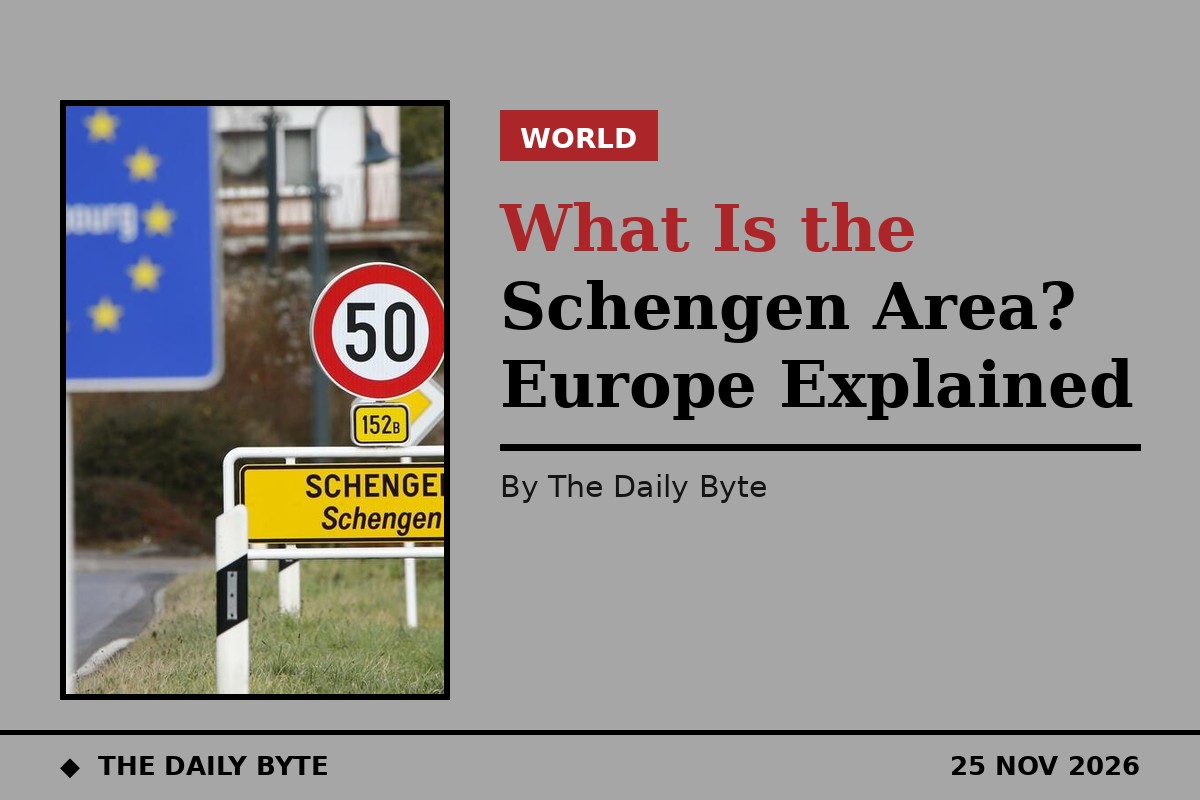
The Schengen Area is Europe's passport-free travel zone, a group of 29 countries that have abolished border controls at their shared borders. More than 450 million people live inside it, and they can travel from one member country to another without being stopped at a border post. It is named after Schengen, a small village in Luxembourg where the original agreement was signed in 1985. For travellers, the practical question it answers is simple: once you are inside the area, you can cross internal borders as freely as you would cross between counties in a single country.
The area matters again in late 2026 because its newest border system has just gone live. The European Union's Entry/Exit System, which electronically records non-EU visitors arriving and leaving, began operating on 12 October 2025 and will be fully operational on 10 April 2026. This explainer sets out what the Schengen Area is, which countries are in it, how it works for travellers, and what has changed at its borders.
What is the Schengen Area?
The Schengen Area is a system of open borders that covers 29 European countries which have officially abolished border controls at their common borders. It mostly functions as a single jurisdiction under a common visa policy for international travel. The area is named after the Schengen Agreement, signed on 14 June 1985 by five countries, France, Germany, Belgium, the Netherlands and Luxembourg, and the Schengen Convention of 1990, which set out the abolition of internal border controls and a common visa policy in detail.
Being part of the area means that countries do not carry out checks at their internal borders, except in cases of specific threats, and that they carry out harmonised controls at their external borders, based on clearly defined criteria. The set of rules governing the area is called the Schengen Borders Code. The Council of the European Union describes Schengen as one of the main achievements of the European project, and says it has gradually expanded to become the largest free travel area in the world.
| Fact | Detail |
|---|---|
| Member countries | 29 |
| EU members in Schengen | 25 of the 27 EU member states |
| Non-EU members | Iceland, Liechtenstein, Norway and Switzerland |
| EU states outside Schengen | Ireland (opt-out) and Cyprus (controls not yet lifted) |
| Population | More than 450 million people |
| Area | More than 4 million square kilometres |
| First agreement | Schengen Agreement, 14 June 1985, five countries |
| Schengen Convention | 1990 |
| Bulgaria and Romania fully in | 1 January 2025 |
| Entry/Exit System went live | 12 October 2025 |
| Entry/Exit System fully operational | 10 April 2026 |
Which countries are in the Schengen Area?
Today the Schengen Area includes 29 countries: 25 of the 27 European Union member states, plus all four members of the European Free Trade Association, Iceland, Liechtenstein, Norway and Switzerland. The full list is Austria, Belgium, Bulgaria, Croatia, Czech Republic, Denmark, Estonia, Finland, France, Germany, Greece, Hungary, Iceland, Italy, Latvia, Liechtenstein, Lithuania, Luxembourg, Malta, Netherlands, Norway, Poland, Portugal, Romania, Slovakia, Slovenia, Spain, Sweden and Switzerland.
Two EU member states are not in the area. Ireland has an opt-out and is not part of Schengen, and controls at the internal borders with Cyprus have not yet been lifted, although Cyprus is committed by treaty to join. The most recent members to join fully were Bulgaria and Romania. The Council agreed on 30 December 2023 to lift air and sea internal border controls with the two countries, and on 12 December 2024 it decided to remove checks on people at the internal land borders as well, so that from 1 January 2025 Bulgaria and Romania are fully part of the Schengen Area. The United Kingdom is not a member of the Schengen Area.
How does travel inside the Schengen Area work?
Once inside the area, people can travel from one member country to another without being subjected to border checks. National authorities may still check people at or close to internal borders if police information warrants stepping up surveillance temporarily, but there are no routine passport controls at internal borders. European Union citizens can stay in another EU country as a tourist for up to three months with a valid passport or identity card, and can also live in another EU country for work, with the right to be treated in the same way as nationals of that country.
For visitors from outside the area, Schengen operates a common visa policy. A Schengen visa is valid for travel across all member states, and citizens of around 60 visa-exempt nations can enter without a visa for short stays of up to 90 days within any 180-day period. That 90-days-in-180 rule is the key limit for tourists and business visitors: it counts all days spent anywhere in the area, not per country. In 2024 Schengen member states processed 11.7 million visa applications and issued approximately 9.7 million visas.
What is the Entry/Exit System?
The Entry/Exit System, known as the EES, is the European Union's new digital border system. It went live on 12 October 2025 at the external borders of 29 European countries, and it is being rolled out progressively over six months. It electronically registers the data of non-EU nationals crossing the external borders for short stays of up to 90 days in any 180-day period, including their biometric data and information from their travel document, as well as refusals of entry.
When the system is fully operational, from 10 April 2026, it will replace passport stamping at all external border crossing points. The European Commission says the system gives national authorities real-time information on who enters the EU and when, and describes it as a significant step in modernising and strengthening the security of the EU's borders. It applies to non-EU nationals, whether they need a visa or are visa-exempt. EU citizens are not registered in the system.
Can border checks come back inside the Schengen Area?
Yes, temporarily. The Schengen rules allow countries to reintroduce controls at internal borders in response to crises, and many have done so at various points for reasons including terrorism, large-scale unauthorised migration and public health emergencies. In April 2024 the EU updated the Schengen Borders Code to allow countries to temporarily reintroduce border controls for up to two years in response to serious threats. These are meant to be exceptional and time-limited: the default position is no routine checks at internal borders.
Security inside the area also relies on cooperation rather than border posts. The Schengen Information System, in operation since 1995, is the most widely used and largest information-sharing system for security and border management in Europe, and it was reinforced in March 2023 with new features including additional biometric data and access for EU agencies such as Europol. Operational coordination and surveillance at the area's external borders are managed by Frontex, the European Border and Coast Guard Agency.
Is the Schengen Area the same as the EU or the eurozone?
No, and the differences matter. The Schengen Area, the European Union and the eurozone are three overlapping but different groups of countries. Ireland is in the EU but not in Schengen. Iceland, Liechtenstein, Norway and Switzerland are in Schengen but not in the EU. And several EU and Schengen members, including Sweden, Denmark, Poland and the Czech Republic, do not use the euro. Membership of one does not automatically mean membership of the others, and each has its own rules for joining: a country that wants to join Schengen must apply the common set of Schengen rules, known as the Schengen acquis, covering border controls, visa issuance, police cooperation and protection of personal data.
Frequently asked questions
Do I need a passport to travel inside the Schengen Area? EU citizens can travel with a valid passport or identity card, and can stay in another EU country as a tourist for up to three months. Non-EU visitors should carry their passport and, where required, their visa, and should be aware that the Entry/Exit System now records their entries and exits electronically.
How many countries are in the Schengen Area? Twenty-nine: 25 EU member states plus Iceland, Liechtenstein, Norway and Switzerland. Ireland and Cyprus are the two EU member states outside the area.
What is the 90-days-in-180-days rule? It is the limit on short stays for non-EU visitors. You may spend up to 90 days in the Schengen Area within any 180-day period, counting all days spent anywhere in the area together, not 90 days per country.
Is the UK in the Schengen Area? No. The United Kingdom is not a member of the Schengen Area, so travellers going from the UK to a Schengen country cross an external border and are subject to the area's entry rules, including the Entry/Exit System for non-EU nationals.
Can internal border checks return? Yes, temporarily. Schengen rules allow member states to reintroduce internal border controls in response to serious threats, and the updated Schengen Borders Code allows this for up to two years. The checks are intended to be exceptional and time-limited.
Sources: Council of the European Union, "The Schengen area explained"; European Parliament, "Schengen: a guide to the European border-free zone"; European Commission, "The new Entry/Exit System went live on 12 October".


