What Is the Speed of Light?
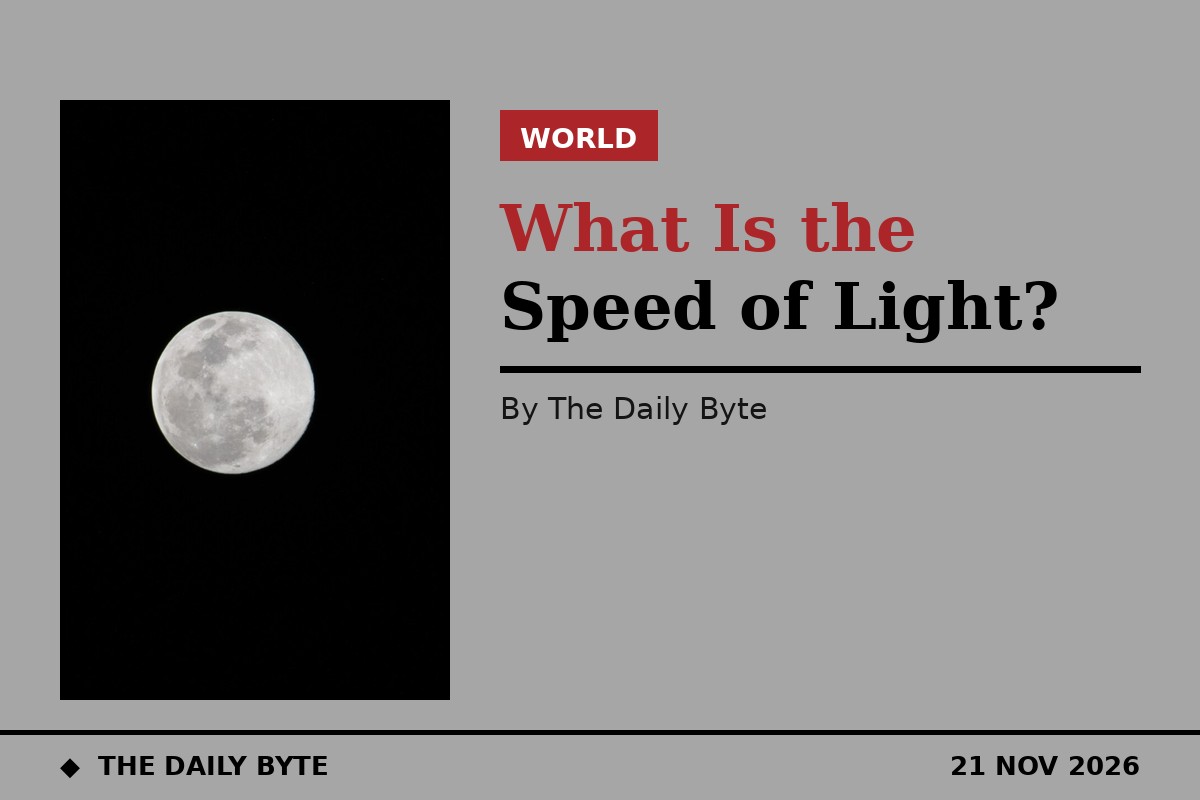
The speed of light is exactly 299,792,458 metres per second. That is about 300,000 kilometres per second, or about 186,282 miles per second, fast enough to circle the Earth about seven and a half times in a single second. Light from the Sun takes about eight minutes and nineteen seconds to reach us, and light from the Moon takes about 1.3 seconds. The number is not just a measurement: since 1983 it has been exact by definition, because the metre itself is defined as the distance light travels in a vacuum in one 299,792,458th of a second. And it is also a limit. Nothing carrying matter, energy or information can travel through space faster than light, a rule that shapes everything from satellite navigation to the way we see the stars.
This explainer explains what the speed of light is, why the number is exact rather than approximate, how scientists measured it over three centuries, how long light takes to cross the distances that matter to us, and why nothing can go faster. It also explains the difference between light's speed in empty space and its speed inside glass or water, and what a light-year really measures.
What is the speed of light, exactly?
The speed of light in a vacuum, usually written as a lowercase c, is exactly 299,792,458 metres per second. It is exact because, by international agreement, a metre is defined as the length of the path travelled by light in vacuum during a time interval of one 299,792,458th of a second. The definition was adopted in 1983 by the General Conference on Weights and Measures, and the 2019 revision of the metric system kept the arrangement. Since the definition fixes c, a better experiment today refines the length of the metre, not the speed of light, and the National Institute of Standards and Technology lists the value with zero uncertainty. In everyday units the figure is roughly one billion kilometres per hour, or about 671 million miles per hour. The letter c comes from the Latin word celeritas, meaning swiftness.
That exactness is a recent state of affairs. For most of history, the speed of light was a quantity to be measured, and each generation measured it better than the last. In 1729, the astronomer James Bradley used the apparent shift in the position of stars as the Earth moved around its orbit to calculate that light took about eight minutes and twelve seconds to travel from the Sun to the Earth; the modern figure is eight minutes and nineteen seconds on average, so Bradley was remarkably close. In 1972, a team led by Ken Evenson measured a laser's frequency times its wavelength and obtained 299,792.4562 kilometres per second, with an uncertainty of only 0.0011 kilometres per second. The measurements had become so good that the length of the metre, then defined by the wavelength of light from krypton atoms, was the limiting factor, so the 1983 conference turned the problem around and defined the metre using the speed of light instead.
How long does light take to get here?
Because light has a finite speed, everything you see is slightly in the past. The delay is far too small to notice over everyday distances: light crosses one metre in about 3.3 nanoseconds, and one foot in about 1.0 nanosecond. But over astronomical distances the delay becomes real, and it is the reason astronomers measure distance in light travel time. The table below gives the light travel time for a few journeys, all taken from the standard figures published for the speed of light.
| Journey | Distance | Time for light |
|---|---|---|
| One metre | 1 metre | 3.3 nanoseconds |
| Once around the Earth's equator | About 40,000 km | 134 milliseconds |
| Geostationary orbit to Earth | About 36,000 km | 119 milliseconds |
| Earth to the Moon | 384,400 km | 1.3 seconds |
| Earth to the Sun | 149.6 million km | 8 minutes 19 seconds |
| Earth to Mars | About 55 to 400 million km | About 3 to 22 minutes |
| Earth to the nearest star | About 4.2 light-years | 4.2 years |
The sunlight reaching your eyes right now left the Sun about eight minutes and nineteen seconds ago, and the exact time varies between eight minutes and ten seconds and eight minutes and twenty-seven seconds depending on the time of year, because the Earth's orbit is not a perfect circle. The moonlight you see at night left the Moon about 1.3 seconds ago, or 1.255 seconds measured surface to surface at the Moon's mean distance. A radio signal to a satellite in geostationary orbit takes about 119 milliseconds each way, which is part of why satellite phone calls have a noticeable pause. A signal to Mars takes between about three and twenty-two minutes each way depending on where the planets are in their orbits, so nobody can drive a Mars rover in real time: every command is sent in advance, and the rover waits. The Voyager 1 spacecraft, the most distant human-made object, is now nearly a light-day away from us, which means its signals take almost a full day to reach Earth.
What is a light-year?
A light-year is a unit of distance, not of time, and it is exactly what it sounds like: the distance light travels in one year. Multiply the speed of light by the number of seconds in a year and you get about 9.46 trillion kilometres. The nearest star to the Sun, Proxima Centauri, is about 4.2 light-years away, so its light takes 4.2 years to reach us, and when astronomers look at it they see it as it was 4.2 years ago. The same logic applies on the largest scales: the light from galaxies millions of light-years distant left them millions of years ago, so looking far away really is looking back in time. The principle holds at any distance: divide the distance by the speed of light and you get the age of the view.
Why can nothing go faster than light?
The speed limit comes from Einstein's special theory of relativity. The speed of light in a vacuum is the same for every observer, no matter how fast that observer is moving, and it is the upper limit for the speed at which information, matter or energy can travel through space. As an object with mass moves faster, it takes more and more energy to speed it up further, and reaching the speed of light itself would take infinite energy, so it cannot be done. Only things with no mass, such as light itself and gravitational waves, travel at exactly c. The famous equation E equals m c squared is part of the same theory: it says that mass and energy are two forms of the same thing, and the speed of light squared is the conversion factor between them.
That limit has practical consequences. It means no signal can ever be truly instant over a long distance, which is why mission controllers talk to Mars rovers with a delay of minutes, and why financial traders care about the milliseconds light takes to travel through fibre-optic cables. It also means the universe has a horizon: because the universe has a finite age, there are galaxies whose light has not had time to reach us yet, and some of it never will, because the expansion of space is carrying them away faster than their light can close the gap. There are apparent exceptions, but they are not real violations. Sweep a laser pointer across the face of the Moon and the bright dot can cross it faster than light, but nothing travels from one side to the other: each part of the dot is new light arriving from the pointer. The dot is a pattern, not a thing, and patterns are not bound by the speed limit.
Does light always travel at the same speed?
Light travels at its maximum speed only in a vacuum. Inside materials such as glass or water it travels more slowly, because it interacts with the atoms of the material as it passes through. That slowing is what makes lenses work: light bends, or refracts, when it enters glass at an angle, because one side of the light wave slows down before the other. The speed of light in a vacuum is the figure that is exact and universal; the speed in any material depends on the material. This is also why the shorter form, speed of light, is understood to mean the speed in a vacuum whenever the context implies it.
The history of measuring light's speed is also a history of improving the metre. Once the 1983 definition fixed c exactly, the metre became the quantity that experiments refine, and modern length measurements are effectively measurements of light travel time. The Global Positioning System depends on the same physics: its satellites carry atomic clocks, and the system calculates your position from the time their radio signals, travelling at the speed of light, take to reach your receiver. A timing error of a millionth of a second would put you hundreds of metres from your real position, so the speed of light is not an abstract number. It is wired into the navigation of every phone on Earth.
Frequently asked questions
How fast is light in miles per hour? About 671 million miles per hour in a vacuum, or about 186,282 miles per second. Can anything travel faster than light? No object, signal or piece of information can travel through space faster than light in a vacuum, according to special relativity. Apparent faster-than-light patterns, such as a laser dot sweeping across a surface, do not carry anything from one place to another. Why is the speed of light exact? Because since 1983 the metre has been defined as the distance light travels in a vacuum in one 299,792,458th of a second, which fixes the value of c by definition. How long does sunlight take to reach Earth? About eight minutes and nineteen seconds on average, varying between about eight minutes and ten seconds and eight minutes and twenty-seven seconds over the year.


