What Is the Strait of Hormuz and Why Does It Matter?
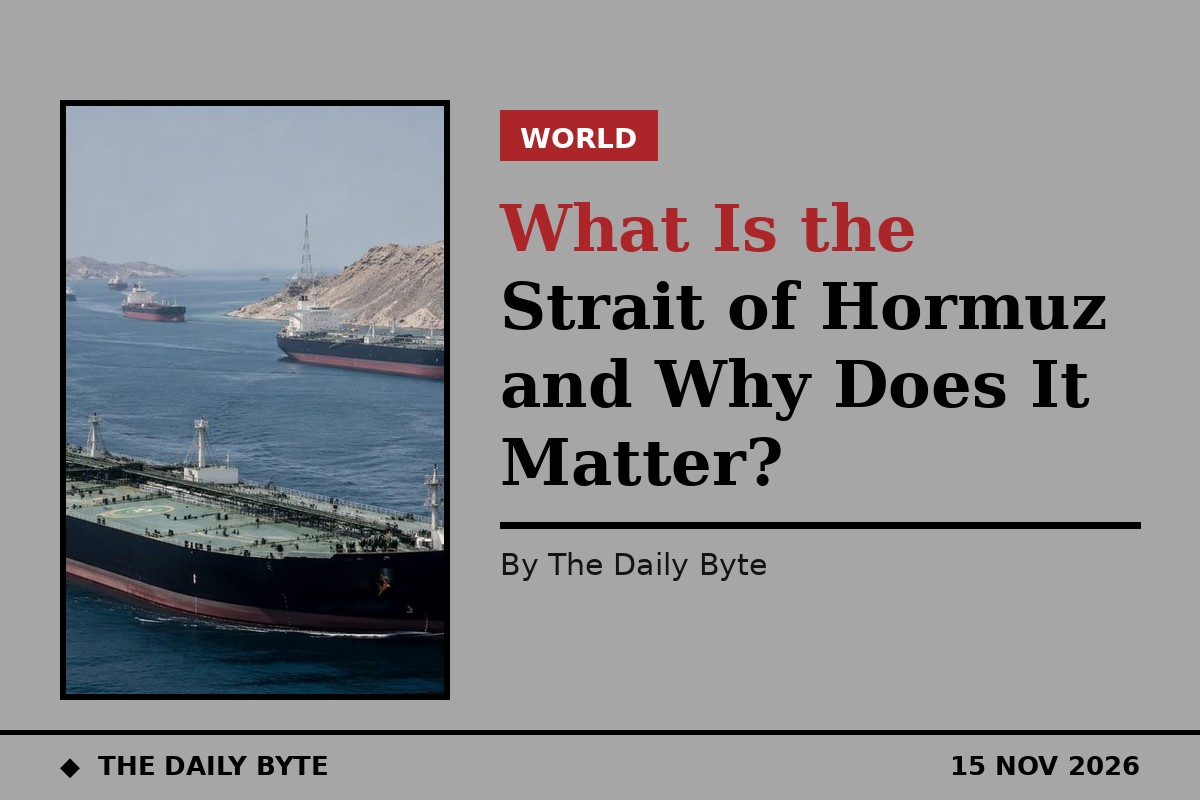
The Strait of Hormuz is the narrow sea passage between Iran and Oman that links the Persian Gulf with the Gulf of Oman and the Arabian Sea. At its narrowest point it is only 21 nautical miles (39 km) wide, and through it passes about 20 million barrels of oil a day — roughly a quarter of all the oil traded by sea in the world and about a fifth of total world oil consumption. It matters because it is the only sea route out of the Persian Gulf: if it closes, the world’s biggest oil exporters cannot get their oil to market, and global fuel prices spike within hours.
As of mid-November 2026 the strait is at the centre of a live crisis. Conflict between Iran and the United States has driven tanker traffic through the passage down to a fraction of normal levels, and oil markets have been pricing in the disruption for months. This guide explains where the strait is, how much oil and gas moves through it, who depends on it, whether it can be closed, and what a closure would mean for petrol prices, energy bills and the world economy.
Where is the Strait of Hormuz?
The strait runs between Iran to the north and the Musandam peninsula of Oman to the south, at the south-eastern end of the Persian Gulf. It is about 104 miles (167 km) long. At its widest it stretches roughly 60 miles across, but at its narrowest point — between Iran and Oman — it tightens to 21 nautical miles, or about 39 km, according to the International Energy Agency’s factsheet of February 2026.
Ships do not use the full width. Inbound and outbound traffic each has a navigable channel about two miles (3.7 km) wide, separated by a two-mile buffer zone. The working width of the busiest oil route on the planet is therefore only about six miles: two miles in, two miles out, and two miles of empty water in between. The strait is deep enough for the world’s largest crude oil tankers, which is why so much trade is squeezed through such a narrow corridor.
How much oil passes through the Strait of Hormuz?
The figures are among the most quoted in energy markets. The US Energy Information Administration (EIA) estimated that total oil flows through the strait averaged 20.9 million barrels a day in the first half of 2025 — about 20 per cent of global petroleum liquids consumption and more than a quarter of global seaborne oil trade. The International Energy Agency (IEA) reaches a similar picture from tanker-tracking data for the full year 2025: nearly 20 million barrels a day of oil was exported via the strait, of which almost 15 million barrels a day was crude oil and condensate and about 5 million barrels a day was refined oil products.
Nearly 15 million barrels a day of crude oil passed through the strait in 2025 — almost 34 per cent of all crude oil traded in the world. About 80 per cent of the oil leaving the strait is destined for Asia, with China and India together receiving 44 per cent of the crude exports. Japan and South Korea are also heavily reliant on the route, and IEA member countries import about 29 per cent of the crude that comes through it. Only about 4 per cent of the crude is routed into Europe.
The biggest single exporter through the strait is Saudi Arabia, at about 6.2 million barrels a day of crude and products in 2025, followed by Iraq at 3.6 million, the United Arab Emirates at 3.2 million, Iran at 2.4 million, Kuwait at 2.4 million, Qatar at 1.4 million and Bahrain at about 0.2 million, according to IEA analysis based on Kpler tanker data.
How much gas passes through it?
Almost as important as the oil is the liquefied natural gas. About 93 per cent of Qatar’s and 96 per cent of the UAE’s LNG exports transit the strait, representing almost 20 per cent of global LNG trade. Qatar is the world’s second-largest LNG exporter, with total exports of over 112 billion cubic metres in 2025, and the total volume of LNG transiting the strait in 2025 was just over 112 billion cubic metres — almost a fifth of all the LNG traded in the world.
The EIA put LNG flows through the strait at 11.4 billion cubic feet a day in the first half of 2025, more than a fifth of global LNG trade. Almost 90 per cent of that LNG goes to Asian markets, and it accounts for around 27 per cent of Asia’s total LNG imports. Bangladesh, India and Pakistan imported almost two-thirds of their total LNG supplies via the strait in 2025, and natural gas dominates the power sector in Bangladesh and Pakistan, providing 50 per cent and 25 per cent of their electricity respectively. A closure would therefore hit electricity supplies in South Asia as directly as it hit petrol prices in the West.
Why can’t ships just go another way?
They largely cannot. The strait is the only sea passage from the Persian Gulf to the open ocean, and only two countries have pipelines that can move crude around it. Saudi Arabia’s East-West pipeline system, known as Petroline, runs from Abqaiq to Yanbu on the Red Sea, with a design capacity of 5 million barrels a day — Aramco reported in March 2025 that capacity had been raised to 7 million, though flows at that level have never been tested. The UAE’s Abu Dhabi Crude Oil Pipeline runs 400 km from Habshan to Fujairah on the Gulf of Oman, with capacity of about 1.8 million barrels a day, of which roughly 1.1 million is already used.
The IEA estimates total available bypass capacity at only 3.5 to 5.5 million barrels a day — well below the roughly 20 million barrels a day that normally passes through the strait. Iran’s own bypass, the Goreh-Jask pipeline to the Jask terminal on the Gulf of Oman, has a reported capacity of 1 million barrels a day but effectively remains non-operational: a test load was exported in late 2024 and no further oil has moved through it since. For gas there is no bypass at all. Qatar and the UAE have no alternative route to get their LNG to world markets, other than the small volumes of piped gas Qatar sends to the UAE and Oman through the Dolphin pipeline.
Who depends on the Strait of Hormuz most?
On the export side, the Gulf producers have no choice: Iran, Iraq, Kuwait, Qatar and Bahrain rely on the strait to deliver the vast majority of their oil exports, and Saudi Arabia and the UAE rely on it for most of theirs despite their pipelines. On the import side, Asia is the most exposed. China and India are the two biggest buyers of crude through the strait, and Japan and South Korea depend on it for a large share of their oil and LNG. The IEA notes that about 80 per cent of the oil and almost 90 per cent of the LNG leaving the strait is destined for Asia.
Europe is less directly exposed — only about 4 per cent of the crude and just over 10 per cent of the LNG transiting the strait reaches Europe — but a closure would still hit European consumers hard, because oil is priced globally. The IEA is blunt about the consequences: a significant spike in oil prices would be inevitable, and physical shortages would quickly develop if a disruption were prolonged. The impact would be worse still because most of the world’s spare crude production capacity, held mainly by Saudi Arabia, sits inside the Gulf and would be stranded behind any closure.
Can Iran close the Strait of Hormuz?
Physically, yes — and that is the point. The strait is narrow, the shipping lanes are only two miles wide, and Iran controls the northern shore, with islands and coastal missile batteries overlooking the traffic. Legally, the position is contested. Under the United Nations Convention on the Law of the Sea, ships enjoy a right of transit passage through straits used for international navigation, but Iran has signed the convention without ratifying it and has long argued for a narrower reading of passage rights. The dispute has never been settled in court, and in a crisis the legal argument matters far less than the military facts.
History shows how the threat has been used. Iran has threatened to close the strait many times — during the Tanker War of the 1980s, in 2011–12 amid sanctions, and after tanker attacks in 2019 — but until 2026 it never did so fully, because closing it would also cut off Iran’s own oil exports, its main source of revenue. The conflict that began with US and Israeli strikes on Iran in February 2026 changed that calculation. EIA tanker-tracking data showed total oil flows falling from 20.9 million barrels a day in the first quarter of 2025 to 14.9 million in the first quarter of 2026 and 4.9 million in the second quarter of 2026, and the IEA reported 10.9 million barrels a day crossing the strait in September 2026 — roughly half the normal level. As of 15 November 2026, the strait remains effectively shut to normal commercial traffic amid the fighting, with Iranian drones reported targeting US radar in Bahrain and oil prices holding near multi-month highs.
What happens to oil prices if the strait closes?
The short answer is that they rise sharply, and quickly. The IEA’s assessment is that any disruption would have huge consequences for world oil markets, with a significant price spike inevitable and physical shortages developing fast if the disruption lasted. In 2026 that is what happened: Brent crude, the global benchmark, rose by more than a third from its levels before the conflict, and has held near $96 a barrel in November.
Three things make the price effect so severe. First, the volume is enormous — a fifth of the world’s oil and a fifth of its LNG cannot be replaced from elsewhere at short notice, because liquefaction plants and spare production elsewhere are already running close to capacity. Second, the world’s spare production capacity is mostly inside the Gulf, so a closure removes the very cushion that normally steadies prices. Third, insurance and shipping costs soar: war-risk premiums for tankers in the Gulf rise, some owners refuse the route, and the ships that do sail move more slowly and in convoy. For consumers, the chain runs from crude prices to petrol and diesel at the pump, to heating and electricity bills, and then to the price of almost everything transported by road, sea or air.
Has the strait ever been closed before?
Never fully, and never for long — until 2026. During the Iran–Iraq war of the 1980s, the so-called Tanker War saw hundreds of merchant ships attacked in the Gulf, but oil kept flowing. In 2011 and 2012, Iran threatened closure in response to sanctions and the US moved aircraft carriers through the strait to signal that it would stay open. In 2019, a series of attacks on tankers near the strait pushed oil prices up and brought the US and Iran close to direct conflict, but transit continued. Each episode followed the same pattern: threats, a price spike, and then a return to normal traffic.
The 2026 closure broke that pattern. It is the first time flows have fallen by more than half and stayed down for months, and it is the reason the strait dominates the news again in November 2026. The episode has also exposed how little slack exists in the system: bypass pipelines can carry at most a quarter of normal flows, LNG has no bypass at all, and the countries most dependent on the route — China, India, Japan, South Korea, Pakistan and Bangladesh — have no quick alternative source of supply.
Frequently asked questions
Where is the Strait of Hormuz? Between Iran to the north and Oman’s Musandam peninsula to the south, linking the Persian Gulf to the Gulf of Oman and the Arabian Sea. At its narrowest it is 21 nautical miles (39 km) wide.
How much oil goes through the Strait of Hormuz? About 20 million barrels a day in 2025, according to the IEA — around a quarter of the world’s seaborne oil trade and about a fifth of total world oil consumption. The EIA’s figure for the first half of 2025 was 20.9 million barrels a day.
Why is the Strait of Hormuz important? Because it is the only sea route out of the Persian Gulf, and there is almost no way around it. Bypass pipelines can carry only 3.5 to 5.5 million barrels a day, and the LNG that Qatar and the UAE export — almost a fifth of global LNG trade — has no alternative route at all.
Can Iran close the Strait of Hormuz? Physically it can, and in 2026 flows fell to a fraction of normal levels during the conflict with the United States. Iran had threatened closure many times before but never fully carried it out, partly because it would also block Iran’s own oil exports.
What happens if the Strait of Hormuz closes? Oil and gas prices spike, physical shortages develop if the closure lasts, and the impact is global even though most of the oil goes to Asia — because oil is priced on world markets and the Gulf holds most of the world’s spare production capacity.
Sources: International Energy Agency — Strait of Hormuz factsheet, February 2026; US Energy Information Administration — World Oil Transit Chokepoints, updated March 2026.


