What Is the Two-State Solution? Explained
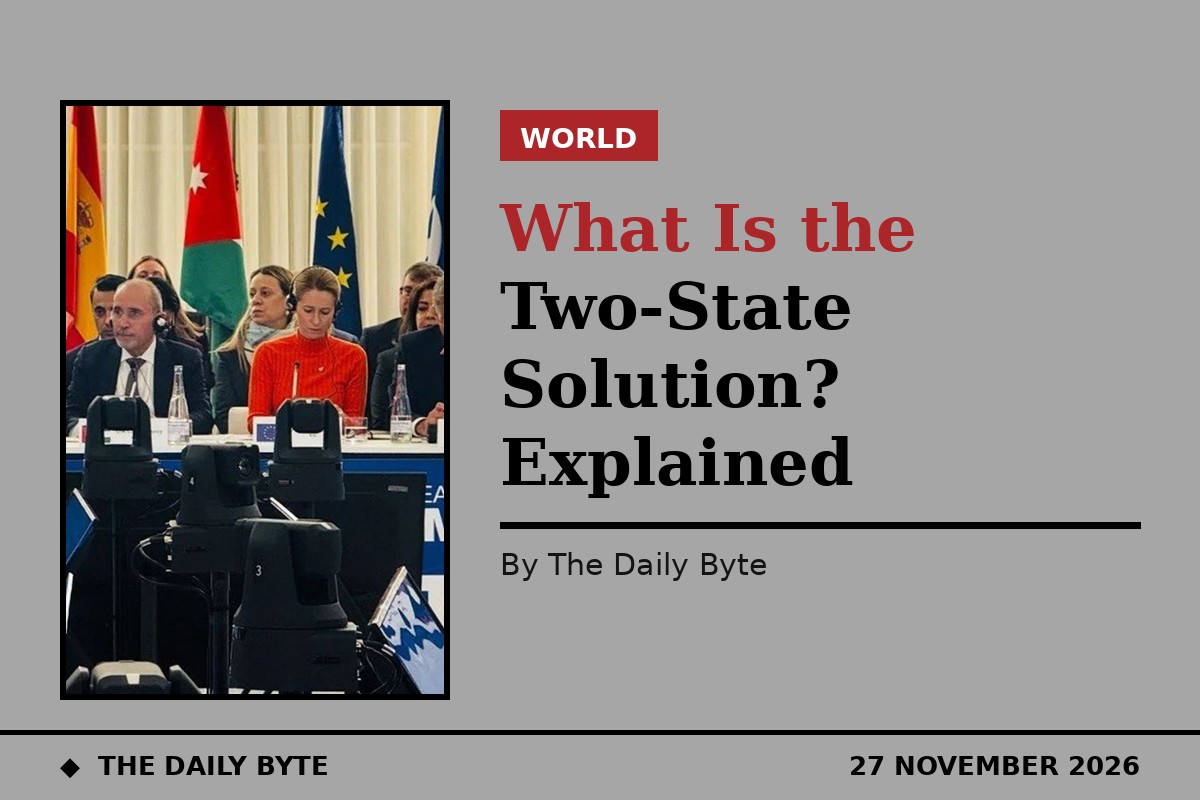
What is the two-state solution? It is the plan for two states, Israel and an independent Palestine, to exist side by side in peace and security. Under the formula backed by the United Nations and most of the world's governments, a Palestinian state would be established in the West Bank and the Gaza Strip, with East Jerusalem as its capital, alongside Israel, with the precise borders settled by negotiation rather than imposed by either side.
The idea was back at the centre of diplomacy on 26 November 2026, when foreign ministers from the Union for the Mediterranean (UfM) reaffirmed their commitment to a just, comprehensive and lasting peace based on the two-state solution in a joint statement issued after their 11th Regional Forum in Barcelona. The forum brought together representatives of the UfM's 43 member states, co-chaired by Jordan's foreign minister Ayman Safadi and the EU's foreign policy chief Kaja Kallas, and the statement also backed unhindered humanitarian aid to Gaza and the West Bank and support for the Global Alliance for the Implementation of the Two-State Solution.
What would the two states look like?
The broad shape of the plan is set out in decades of UN resolutions and peace plans, but the details have never been agreed. In the standard version, Israel would continue as a state within secure and recognised borders, and a sovereign, independent and viable Palestinian state would be established in the West Bank and Gaza, with East Jerusalem as its capital. The 1967 lines, the armistice lines in place before the Six-Day War of June 1967, are the usual starting point for the border, with land swaps to reflect the reality that large Israeli settlements now stand beyond those lines. The plan also assumes a negotiated answer on the status of Jerusalem, on Palestinian refugees, on security arrangements and on who governs Gaza. None of those questions has an agreed answer today, which is why the two-state solution is usually described as a framework for negotiations rather than a finished map.
Where did the idea come from?
The idea is almost as old as the conflict itself. In 1947 the UN General Assembly adopted Resolution 181, a partition plan that would have created separate Jewish and Arab states in Palestine. Arab leaders rejected the plan, war followed in 1948, and Israel was established while the West Bank came under Jordanian control and Gaza under Egyptian control. No Palestinian state emerged. The phrase two-state solution came into common use after Israel captured the West Bank, Gaza, East Jerusalem, the Golan Heights and Sinai in the Six-Day War of June 1967. UN Security Council Resolution 242, adopted that November, called for the withdrawal of Israeli armed forces from territories occupied in the conflict and affirmed the right of every state in the area to live in peace within secure and recognised boundaries. Resolution 338, adopted during the 1973 war, called on the parties to carry out Resolution 242 and start negotiations. The decisive breakthrough came with the Oslo Accords of 1993, when Israel and the Palestine Liberation Organisation recognised each other and agreed to a five-year interim period of Palestinian self-government leading to a permanent settlement based on Resolutions 242 and 338. The interim period was meant to end in 1999. It never did, and no final-status agreement has been reached since.
What do the UN resolutions say?
Resolution 242 remains the legal anchor of the plan, and it is the resolution every later negotiation has referred back to. Resolution 2334, adopted by the Security Council in December 2016, reaffirmed that Israeli settlements in the West Bank and East Jerusalem have no legal validity and constitute a flagrant violation of international law, and called for an immediate halt to settlement activity. The 2003 roadmap, drawn up by the United States, the European Union, Russia and the United Nations, set out a vision of two states, Israel and a sovereign, independent, democratic and viable Palestine, living side by side in peace and security. In 2012 the UN General Assembly voted to accord Palestine non-member observer state status at the United Nations, a step that gave it access to international bodies including the International Criminal Court. Each of these steps kept the two-state formula as the stated goal of the international community, even as the facts on the ground moved further away from it.
Who recognises a Palestinian state?
Recognition is one of the most concrete measures of where the plan stands. Around 147 of the UN's 193 member states recognised a Palestinian state before September 2025, according to the House of Commons Library, including China and Russia, the two permanent members of the Security Council that recognised it decades ago. In July 2025 the governments of the UK, France and Canada announced that they would recognise a Palestinian state at the UN General Assembly in September 2025, which would make them the first G7 countries to do so. The United States, Germany, Italy and Japan are among the countries that have not recognised it. Palestine is not a full member of the United Nations, and admission as a full member would need the approval of the Security Council, where the United States holds a veto. That gap, between wide recognition and full UN membership, is one reason the Barcelona statement put its emphasis on practical steps rather than on declarations alone.
Why has it not happened?
Four obstacles are cited most often by diplomats and analysts. First, Israeli settlements: the settler population in the West Bank and East Jerusalem has grown steadily for decades, and the UN Security Council has said the settlements have no legal validity, which makes drawing a workable border harder with every year that passes. Second, Jerusalem: both sides claim the city as a capital, and its holy sites carry religious significance far beyond the two parties, which is why the Barcelona statement stressed respect for the historical and legal status quo at the holy sites and the Hashemite Custodianship over them. Third, the Palestinian national movement is divided: Fatah governs in the West Bank, Hamas has governed Gaza since 2007, and there has been no agreed answer to the question of who would govern a Palestinian state. Fourth, violence and mistrust: no final-status negotiations have taken place since the US-led talks collapsed in 2014, and the Hamas attacks of 7 October 2023 and the war in Gaza that followed have made the politics of compromise harder on both sides. The Barcelona ministers condemned settlement expansion and annexation and called for a halt to all actions undermining the two-state solution, a recognition that the plan's opponents include facts on the ground as well as politics.
What was agreed in Barcelona on 26 November 2026?
The 11th Regional Forum of the Union for the Mediterranean met in Barcelona on 25 November 2026, co-chaired by Jordan and the European Union, with ministers and representatives from the forum's 43 member states. The joint statement issued on 26 November renewed their shared commitment to peace based on the two-state solution, in accordance with international law and relevant UN Security Council resolutions, with an independent Palestinian state living in peace and security alongside Israel. The ministers called for support for the Global Alliance for the Implementation of the Two-State Solution, an initiative that works on practical steps towards two states, and for the unhindered delivery of humanitarian aid to the Gaza Strip and the West Bank. They also voiced grave concern over the situation in the West Bank, rejected annexation, settler violence, settlement expansion and the displacement of Palestinians from Gaza or the West Bank, and affirmed support for Lebanon's sovereignty and for Syria's reconstruction. A joint statement of this kind does not change any policy on its own: it records a shared diplomatic position rather than a binding commitment. Its value is as a measure of where the region's governments stand, and on 26 November they stood, publicly and unanimously, behind two states.
What are the alternatives?
The main alternative is a one-state outcome, in which Israelis and Palestinians live in a single state between the Mediterranean and the Jordan river. Supporters of that idea argue that the settlements have made separation impractical, but it raises questions neither side has answered: what the state's character would be, and how equal rights would be guaranteed. A second idea is a confederation, in which two states would share institutions and open borders while remaining separate. A third outcome is the status quo continuing indefinitely: no Palestinian state, no annexation of the whole territory, and the conflict managed rather than resolved. None of the alternatives commands the international consensus that the two-state solution does, which is why, for all its difficulties, it remains the plan that governments keep returning to, as they did in Barcelona on 26 November 2026.
Two-state solution at a glance
| Item | Detail |
|---|---|
| What it is | Israel and an independent Palestinian state living side by side in peace and security |
| Legal basis | UN Security Council Resolutions 242 (1967), 338 (1973) and 2334 (2016) |
| Key agreement | Oslo Accords (1993): mutual recognition and interim self-government |
| Recognition | About 147 of 193 UN member states recognise a Palestinian state (August 2025) |
| Latest restatement | Union for the Mediterranean joint statement, Barcelona, 26 November 2026 |
Frequently asked questions
Q: Is Palestine already a country? It is recognised as a state by about 147 of the UN's 193 member states, and it has been a non-member observer state at the United Nations since 2012, but it is not a full member of the UN.
Q: What are the 1967 lines? The armistice lines in place before the Six-Day War of June 1967, when Israel captured the West Bank, Gaza and East Jerusalem. They are the usual starting point for a negotiated border, with land swaps.
Q: Does the two-state solution have a deadline? No. There is no agreed timetable, and no final-status negotiations have taken place since the US-led talks collapsed in 2014.
Q: What is the Global Alliance for the Implementation of the Two-State Solution? A diplomatic initiative that brings together countries working on practical steps towards two states. The Barcelona statement of 26 November 2026 called for support for it.


