What Is the UK State Pension? Explained
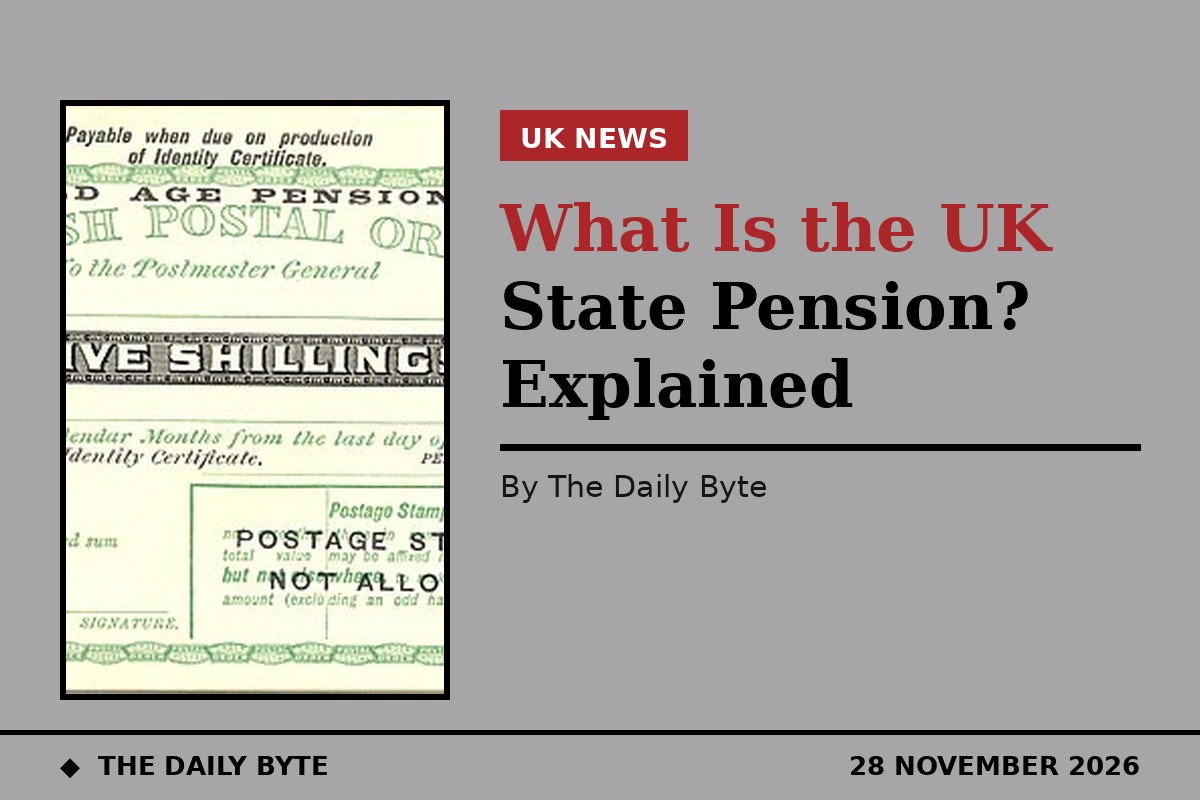
The UK State Pension is a regular payment from the government to people who have reached State Pension age, based on their National Insurance record rather than on their income or savings. It is one part of the UK pension system, sitting alongside workplace and personal pensions, and it is paid for life once you start claiming it. For 2026-27, the full new State Pension is £241.30 a week, and how much you get depends mainly on when you reached State Pension age and how many qualifying years of National Insurance you built up.
That short answer hides a lot of detail, because the UK currently runs two State Pension systems side by side. Which one applies to you depends on a single date: 6 April 2016. This guide explains both systems, the qualifying years, the State Pension age, the triple lock that sets the annual increase, how to claim, and what happens if you delay claiming or move abroad.
How much is the State Pension in 2026-27?
If you reached State Pension age on or after 6 April 2016, you are on the new State Pension. The full rate for 2026-27 is £241.30 a week, which works out at about £12,548 a year. That figure applies from 6 April 2026, after a 4.8 per cent increase under the triple lock. You only get the full rate if you have the full 35 qualifying years; fewer years means a proportionally smaller amount, as explained below.
If you reached State Pension age before 6 April 2016, you are on the old system, which closed to new pensioners in April 2016 but continues to be paid to those already on it. It has two parts: a flat-rate basic State Pension, worth £184.90 a week in full for 2026-27, and an earnings-related additional State Pension built up through schemes such as SERPS and the State Second Pension. The new State Pension began on 6 April 2016 at £155.65 a week, so it has risen substantially since it was introduced.
The October 2026 Budget announced the next increase: from April 2027 the full new State Pension rises by 3.9 per cent to £250.70 a week, worth £13,036.40 a year. The Budget also said the triple lock will be adjusted from the next Parliament, so that after that point the pension tracks earnings over time rather than ratcheting ever higher against them. Those are announced figures, and the annual uprating order confirms the final rates each year.
Who gets the new State Pension and who stays on the old one?
The dividing line is the date you reach State Pension age. The new State Pension applies to men born on or after 6 April 1951 and women born on or after 6 April 1953, who reached State Pension age on or after 6 April 2016. Everyone who reached State Pension age before that date stays on the pre-2016 scheme.
The new system is based entirely on your own National Insurance record. There is no general equivalent of the old Category B pension, which let some people claim on a spouse's record, although limited transitional rules protect some existing rights. A surviving spouse or civil partner may still be able to inherit part of a partner's protected payment or additional pension where the marriage or civil partnership began before 6 April 2016.
Most people now reaching State Pension age have National Insurance records from before April 2016. For them, the Department for Work and Pensions calculated a starting amount at April 2016 under both the old rules and the new rules and used whichever was higher, after a deduction for any periods when they were contracted out of the additional State Pension. If that starting amount was below the full rate, each qualifying year added after April 2016 adds about one thirty-fifth of the full rate until the full rate is reached. If it was above the full rate, the excess is paid as a protected payment on top, and that protected payment rises with price inflation rather than with the triple lock.
How many National Insurance years do you need?
For the new State Pension you normally need at least 10 qualifying years on your National Insurance record to get anything at all, and 35 qualifying years to get the full amount. The 10 years do not have to be in a row, and they can come from before or after 6 April 2016. If you have between 10 and 34 years and no National Insurance record before April 2016, you get a proportion of the full rate: 20 years, for example, gives you roughly 20 thirty-fifths of £241.30, or about £137.89 a week. Years beyond 35 do not increase the amount.
A tax year counts as a qualifying year if you pay, are treated as having paid, or are credited with enough National Insurance contributions. For 2026-27, an employee needs earnings of at least £6,708 a year, the lower earnings limit, and a self-employed person needs profits of at least £7,105, the small profits threshold. GOV.UK explains that in 2026-27 you build a qualifying year if you are employed and earning over £242 a week from one employer and paying National Insurance, or earning between £129 and £242 a week and treated as having paid. You can also qualify through National Insurance credits, for example if you claim Child Benefit for a child under 12, care for someone, or claim certain benefits, or by paying voluntary Class 3 contributions at £18.40 a week.
If you have gaps in your record, you can usually fill them by paying voluntary Class 3 contributions, normally for the previous six tax years. Before paying anything, check your State Pension forecast on GOV.UK, because not every top-up increases your pension: if you already have 35 years, or if a gap year would not raise your starting amount, the money may be wasted. The forecast service is free and shows how much you could get, when you can get it, and whether you can increase it.
What is the State Pension age?
State Pension age is the earliest age at which you can start claiming the State Pension, and it has been rising for years. It was historically 60 for women and 65 for men, was equalised at 66 in 2020, and is now rising to 67. For people born between 6 October 1954 and 5 April 1960, State Pension age is 66. The phased rise to 67 began on 6 May 2026 and will be complete by March 2028, so anyone born on or after 6 March 1961 has a State Pension age of 67, while people born between 6 April 1960 and 5 March 1961 have an age between 66 and 67 depending on their exact date of birth.
A further rise to 68 is already written into law for 2044 to 2046, although its timing is under review. The Pensions Act 2014 requires the government to review State Pension age regularly, and the third such review was launched in July 2025. Any change to the timetable for 68 must give at least ten years' notice. Because the age depends on your exact date of birth, the reliable way to find yours is the State Pension age checker on GOV.UK.
The increases in women's State Pension age, and the way they were communicated, have been the subject of sustained debate, with campaign groups including Women Against State Pension Inequality arguing that some women born in the 1950s faced a significant and unexpected increase. That history is part of why the government now gives long notice of changes.
How does the triple lock work?
The triple lock is the government's commitment to increase the State Pension each April by the highest of three measures: average earnings growth, consumer prices index inflation, or 2.5 per cent. It has been in place since 2011, with one exception: in 2022-23 the earnings element was temporarily suspended because post-pandemic wage figures were distorted, and the pension rose by inflation of 3.1 per cent instead.
The 4.8 per cent increase in April 2026 took the full new rate to £241.30 a week. The basic State Pension rises under the same triple lock, but the additional State Pension on the old system rises by price inflation only. The triple lock is expensive, and it is reviewed by governments precisely because it pushes the pension higher relative to earnings over time, which is why the October 2026 Budget announced an adjusted version from the next Parliament.
One practical consequence matters for tax. The State Pension counts as taxable income, although it is paid without tax deducted and HM Revenue and Customs collects any tax due through your tax code. The full new State Pension of about £12,548 a year sits just below the £12,570 personal allowance, so almost any other income on top of it, from a workplace pension, an annuity or part-time work, is taxed from the first pound.
How do you claim the State Pension?
You do not get the State Pension automatically. You have to claim it, and you can put in your claim up to four months before you reach State Pension age. The quickest way is online through GOV.UK, and the Pension Service will write to you before your State Pension age with information about claiming. Payments are normally made every four weeks in arrears, into a bank account of your choice.
Before you claim, it is worth checking your forecast at GOV.UK. It estimates how much you will get based on your National Insurance record so far, gives the date you reach State Pension age, and shows how many qualifying years you have. Anyone over 18 can get an estimate online, and people over 50 can also request a paper forecast from the Future Pension Centre.
If your income is low, the State Pension may not be the whole story. The full new State Pension is set above the basic level of means-tested support, the Pension Credit standard minimum guarantee, but people with little or no other income may still be entitled to Pension Credit to top their income up. People aged 80 or over with little or no contributory pension may qualify for a non-contributory over-80 pension, paid at 60 per cent of the full basic State Pension, and everyone over 80 gets a 25p a week age addition that has stayed at that level since 1971.
What happens if you delay claiming?
You do not have to claim your State Pension at State Pension age. If you delay, your pension is deferred, and when you do claim it is higher: it increases by about 1 per cent for every nine weeks you put it off, equivalent to roughly 5.8 per cent for each year of deferral. There is no maximum deferral period, and the extra amount is added to your weekly pension permanently and is also protected by the triple lock.
Deferring only pays off if you live long enough to collect the higher amount for many years, so it is a judgement about your health, your other income and whether you need the money now. The extra may also be taxed, and if you claim benefits while deferring, the rules interact in ways that are worth checking on GOV.UK before you decide.
What if you live abroad?
The State Pension can be paid abroad, but whether it goes up each year depends on where you live. Increases are paid to pensioners living in the UK and in countries with which the UK has a reciprocal agreement. Pensions paid to people living elsewhere, including Australia and Canada, are frozen at the rate first paid, which means their real value falls over time. The rules for people who have lived or worked abroad, and for filling gaps from abroad, changed in April 2026, so anyone in that position should check the current GOV.UK guidance rather than relying on older advice.
Frequently asked questions
How much is the UK State Pension? The full new State Pension is £241.30 a week in 2026-27, about £12,548 a year. The full basic State Pension on the old system is £184.90 a week. What you personally get depends on your National Insurance record.
How many years do I need for the full State Pension? You need 35 qualifying years for the full new State Pension and at least 10 years to get anything at all. Between 10 and 34 years you get a proportion of the full rate.
When can I claim my State Pension? At your State Pension age, which is 66 for most people reaching it now and is rising to 67 between May 2026 and March 2028. Check your exact date on GOV.UK.
Is the State Pension taxed? Yes, it counts as taxable income. The full new State Pension sits just below the £12,570 personal allowance, so other income on top of it is usually taxed from the first pound.
Can I increase my State Pension? You may be able to fill gaps in your National Insurance record with voluntary Class 3 contributions, or increase it by deferring your claim. Check your free forecast on GOV.UK first, because not every payment increases your pension.
Sources: GOV.UK, Your State Pension explained, accessed 28 November 2026; Age UK factsheet 19, State Pension, April 2026 edition; State Pension (United Kingdom), Wikipedia, accessed 28 November 2026. Rates are for 2026-27 and change each April, so check GOV.UK for the current figures. This is general information, not personal financial advice.


