What Is the UK Terror Threat Level? Levels Explained
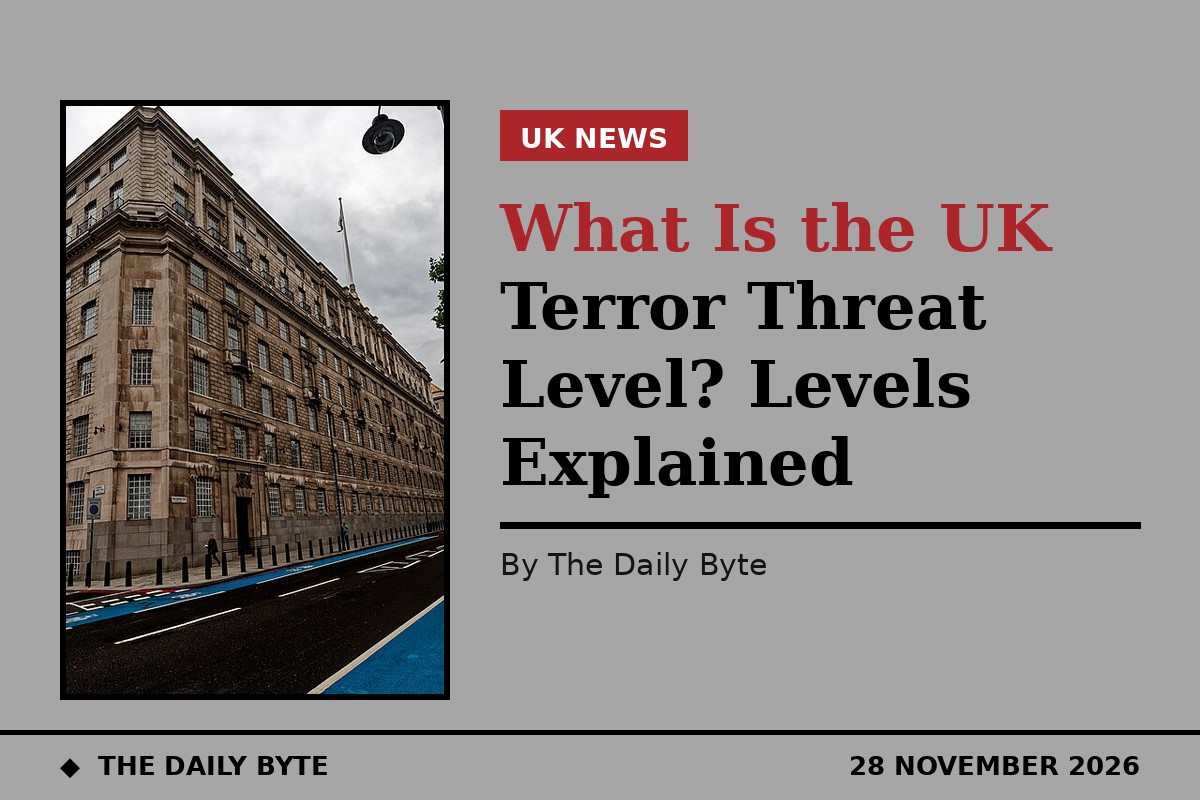
The UK terror threat level is the official assessment of how likely a terrorist attack is in the United Kingdom. As of 28 November 2026, the national threat level is SEVERE, which in MI5's words means an attack is highly likely, while the separate level for Northern Ireland-related terrorism in Northern Ireland is SUBSTANTIAL, meaning an attack is likely.
The level is set by the Joint Terrorism Analysis Centre (JTAC), which is based at MI5's Thames House headquarters in London, and it is published by MI5. It is a national judgement about likelihood, not a prediction of a specific attack, a warning about a particular town or place, or a set of instructions for the public, and it can change at any time as the intelligence picture changes.
What are the five UK terror threat levels?
There are five levels, and MI5 publishes a short meaning for each. The level also guides the protective security response expected of public bodies, the police and the transport sector, from routine measures at the lower levels to exceptional measures at the highest.
| Level | What it means (MI5 wording) | Protective security response |
|---|---|---|
| LOW | An attack is highly unlikely | Normal |
| MODERATE | An attack is possible, but not likely | Normal |
| SUBSTANTIAL | An attack is likely | Heightened |
| SEVERE | An attack is highly likely | Heightened |
| CRITICAL | An attack is highly likely in the near future | Exceptional |
SEVERE is the second-highest level. CRITICAL, the highest, means an attack is highly likely in the near future and triggers maximum protective security measures.
Who sets the threat level, and how is it decided?
The Joint Terrorism Analysis Centre is responsible for setting the threat level for the UK from terrorism, and the threat level from Northern Ireland-related terrorism in Northern Ireland. JTAC was established in June 2003, is based at MI5's London headquarters, and brings together representatives from 16 government departments and agencies.
In reaching an assessment, JTAC considers four factors: the available intelligence, including the level and nature of current terrorist activity; terrorist capability, meaning what a terrorist could do based on previous attacks or intelligence; terrorist intentions, including the aims of the terrorists and the targets they might consider; and timescale, because the threat level expresses the likelihood of an attack in the near term.
Threat levels have no expiry date and are kept under regular review. They can be revised at any time as the information available to the security services changes, and a change is announced by MI5 when it happens. The public can also sign up for threat level change alerts through an RSS feed on the MI5 website.
What is the current threat level?
MI5's threat levels page, checked on 28 November 2026, states that the threat to the UK, covering England, Wales, Scotland and Northern Ireland, from all forms of terrorism is SEVERE. The threat to Northern Ireland from Northern Ireland-related terrorism is SUBSTANTIAL.
The national level was raised from SUBSTANTIAL to SEVERE on 30 April 2026, and the change was announced on 1 May 2026. It followed the stabbing of two Jewish men in Golders Green, north London, on 29 April 2026. MI5 said the attack was not the only reason for the change, and the rise reflected a broader increase in the Islamist and extreme right-wing terrorist threat from individuals and small groups based in the UK. Before the rise, the national level had been SUBSTANTIAL since 9 February 2022.
The Northern Ireland level was lowered from SEVERE to SUBSTANTIAL on 6 March 2024. It had been SEVERE since 28 March 2023.
| Date | National threat level |
|---|---|
| 30 April 2026 | SEVERE |
| 9 February 2022 | SUBSTANTIAL |
| 15 November 2021 | SEVERE |
| 4 February 2021 | SUBSTANTIAL |
| 3 November 2020 | SEVERE |
| 4 November 2019 | SUBSTANTIAL |
| 23 July 2019 | SEVERE |
When has the threat level been CRITICAL?
CRITICAL is the highest level, and it has been used only four times since the system was first published in 2006. On each occasion it lasted only a matter of days, and the level was lowered once suspects had been arrested or the authorities were confident there was no immediate risk of another attack.
| Date | Why the level was raised to CRITICAL |
|---|---|
| 10 August 2006 | Plot to detonate explosives on transatlantic flights |
| 30 June 2007 | Attempted car bomb attack and attack at Glasgow Airport |
| 23 May 2017 | Manchester Arena bombing; lowered after four days |
| 15 September 2017 | Parsons Green District line attack; lowered after two days |
The Manchester Arena bombing on 22 May 2017 and the Parsons Green attack on 15 September 2017 were the third and fourth occasions on which the level reached CRITICAL.
How the threat level system began
The current system was first published on 1 August 2006, when the national level was set at SEVERE. It was introduced after the 7 July 2005 London bombings prompted the Government to replace a colour-based alert scheme known as BIKINI state with a simpler five-level system that the public could understand.
Threat levels for Northern Ireland-related terrorism were first published in September 2010, with separate levels for Northern Ireland and for Great Britain. In July 2019, the system was changed so that the national level reflects the threat from all forms of terrorism, irrespective of ideology, rather than international terrorism alone.
What does the threat level mean for you?
The threat level is a national assessment. It is not a forecast for any particular town, sector or venue, and a change in the level does not by itself require a specific response from the public. MI5 says changes to threat levels do not necessarily require specific responses from members of the public, and that the levels are a tool for security practitioners and the police to use in deciding what protective security response is required. The level does, however, explain the context for security measures the public may encounter, such as airport security or bag searches.
Vigilance matters whatever the current level. Members of the public should remain alert and report suspicious activity to the police on 999 if there is an emergency, or to the Anti-Terrorist Hotline on 0800 789 321, which is confidential. Information that does not relate to an imminent threat can also be passed to MI5. Counter Terrorism Policing's ACT campaign gives the public advice on what to look out for, including its Run, Hide, Tell guidance for an attack in progress.
Businesses and venues also plan around the level. The Terrorism (Protection of Premises) Act 2025, known as Martyn's Law, will require some venues to plan how they would respond to an attack, but its duties are not yet in force. The Security Industry Authority expects them to come into force in spring 2027, and not before.
The two threat levels, explained
There are two published threat levels, and they should not be confused. The national threat level covers all forms of terrorism across the whole of the UK, except for Northern Ireland-related terrorism in Northern Ireland. The second level covers only the threat to Northern Ireland from Northern Ireland-related terrorism. Quoting the Northern Ireland figure as the threat to London or to Great Britain would be wrong: as of 28 November 2026, the national level is SEVERE and the Northern Ireland level is SUBSTANTIAL.
Frequently asked questions
Is SEVERE the highest UK terror threat level?
No. SEVERE is the second-highest of the five levels. CRITICAL is the highest, meaning an attack is highly likely in the near future. CRITICAL has been used only four times since 2006, most recently in September 2017 after the Parsons Green attack.
Who decides the UK terror threat level?
The Joint Terrorism Analysis Centre (JTAC), based at MI5's Thames House headquarters in London, sets the national threat level and the Northern Ireland-related terrorism level. JTAC was established in June 2003 and brings together representatives from 16 government departments and agencies.
Does SEVERE mean an attack will definitely happen?
No. SEVERE means that, in JTAC's assessment, an attack is highly likely. It is a judgement about likelihood based on intelligence, terrorist capability and intentions, not a prediction that a specific attack will take place at a particular time or place.
How often does the terror threat level change?
There is no fixed timetable. The levels have no expiry date and are kept under regular review, and they can change at any time when the assessment changes. Between February 2022 and April 2026, for example, the national level stayed at SUBSTANTIAL for more than four years.
Where can I check the current threat level?
The current levels are published on the MI5 website, at mi5.gov.uk/threat-levels, which also carries the full history of changes since 2006 and an RSS feed for threat level change alerts.
What should I do if I see something suspicious?
Call 999 if there is an emergency or an imminent threat. Otherwise, call the Anti-Terrorist Hotline confidentially on 0800 789 321. Counter Terrorism Policing's advice is to remain vigilant, trust your instincts and report anything that does not feel right.


