What Is the Ukraine Peace Plan? 20 Points Explained
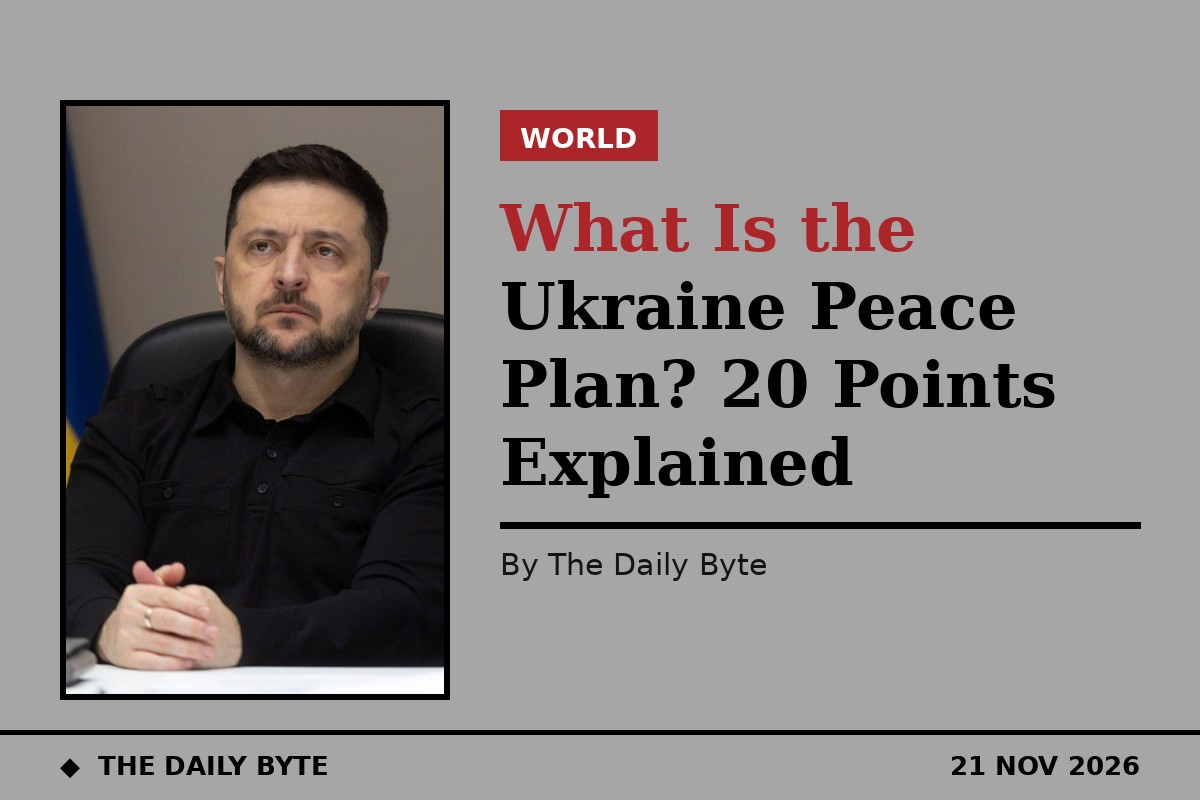
There is now a written framework for ending the war in Ukraine, but it is not yet a peace deal. President Volodymyr Zelenskyy has set out a 20-point draft framework for a political agreement, worked on with the United States and European partners, while American envoys shuttle between Moscow, Kyiv and European capitals. The framework is described by Kyiv as close to final on most points, with territory and the Zaporizhzhia nuclear power plant still unresolved. This explainer sets out what the plan contains, where it came from, what happened at the latest round of talks in Abu Dhabi, and what would still have to happen before any ceasefire takes effect.
What is the Ukraine peace plan?
The plan most often meant by the phrase today is the 20-point framework presented by President Zelenskyy in November 2026. It is a draft political framework, not a signed treaty. As Zelenskyy himself stressed when presenting it, the provisions may still change during negotiations, and the document involves four parties: Ukraine, the United States, Europe and Russia. Its purpose is to set out, in one document, the terms under which the war could end: a reaffirmation of Ukrainian sovereignty, a non-aggression pact, security guarantees modelled on NATO's Article 5, limits and guarantees around Ukraine's armed forces, a path into the European Union, a large reconstruction package, and arrangements for territory, elections and a ceasefire. The framework is deliberately structured so that the hardest questions, territory and the nuclear plant, are left to leader-level talks, while the points on which there is already broad agreement are nailed down first.
It is important not to confuse this framework with an earlier American draft. A 28-point plan drafted by the US special envoy Steve Witkoff and the head of Russia's sovereign wealth fund, Kirill Dmitriev, circulated last year and called for Ukraine to cede land to Moscow and renounce its ambitions to join NATO, according to The Times. That draft was rejected by Kyiv. The 20-point framework is the successor document, built around Ukrainian proposals, and it takes a different approach: it reaffirms sovereignty, keeps Ukraine's army large, and ties security to Western guarantees rather than to territorial surrender.
What the 20 points cover
The first points deal with sovereignty and security, which Kyiv treats as non-negotiable. Point one would have all signatories formally recognise Ukraine as a sovereign state. Point two would create a full and unconditional non-aggression pact between Ukraine and Russia, monitored over the long term using space-based surveillance, early-warning systems and conflict-prevention tools. Point three promises Ukraine strong, enforceable security guarantees, and point five spells out what that means in practice: the United States, NATO and European signatories would provide guarantees modelled on NATO's Article 5, the alliance's collective-defence clause. Point six would require Russia to codify a policy of non-aggression towards Ukraine and Europe in its own law, including ratification by an overwhelming majority in the State Duma.
On the military side, point four would keep Ukraine's armed forces at a peacetime level of 800,000 troops. That figure matters because earlier American suggestions had envisaged a much smaller Ukrainian army, and Kyiv has insisted that a large standing force is itself a security guarantee. The framework also envisages a monitoring mechanism along the line of contact, so that any future violation would be detected and attributed rather than disputed.
The economic points are ambitious. Point seven would see Ukraine join the European Union within a clearly defined timeframe, with short-term preferential access to EU markets in the meantime. Point eight promises a comprehensive global development package, set out in a separate investment and prosperity agreement. Point nine would establish several international funds for economic recovery, reconstruction and humanitarian needs, with a target of raising 800 billion dollars through equity, grants, debt instruments and private-sector contributions. Point ten would have Ukraine accelerate negotiations on a free trade agreement with the United States once a peace deal is signed, with similar terms offered to Russia.
The unresolved points: territory and the nuclear plant
Two issues remain open, and Zelenskyy has said openly that Kyiv and Washington have not yet reached consensus on either. The first is territory, covered by point 14. Russia demands that Ukraine withdraw from the parts of the Donetsk region it still controls, and claims the whole of Donetsk, Luhansk, Zaporizhzhia and Kherson. Kyiv's position is that fighting should freeze along the current lines, monitored by international forces. The framework records both options: a de facto freeze along current lines in the four regions, or the creation of a demilitarised free economic zone in parts of Donbas, requiring mirrored troop withdrawals and ratification through a nationwide Ukrainian referendum. Point 15 would then commit both sides not to alter whatever territorial arrangements are agreed by force. Zelenskyy has said that if talks collapse over the formula of standing where the two sides stand, Ukraine would face only two options: continuing the war, or asking citizens to decide how the disputed territories should be resolved.
The second unresolved issue is the Zaporizhzhia nuclear power plant, Europe's largest, which has been under Russian control since the early weeks of the invasion. Point 12 proposes that the plant be jointly operated by Ukraine, the United States and Russia, with operational details still under discussion and Kyiv reluctant to engage directly with Russia on the plant. The American proposal has been for a joint venture with equal stakes for the three parties, while Ukraine has advocated a joint operation with the United States alone. The plant's future matters far beyond the battlefield: it supplied a large share of Ukraine's electricity before the war, and its safe operation is a concern for the whole region.
The remaining points cover the aftermath of any deal. Point 11 would have Ukraine reaffirm its status as a non-nuclear state under the Nuclear Non-Proliferation Treaty. Point 13 would introduce education programmes promoting cultural understanding and tolerance, with Ukraine applying EU standards on religious freedom and minority language protections. Point 16 would bar Russia from obstructing Ukraine's commercial use of the Dnipro River or the Black Sea, with separate maritime agreements guaranteeing freedom of navigation, including demilitarisation of the Kinburn Spit. Point 17 would create a humanitarian committee to oversee the exchange of all remaining prisoners of war and the return of detained civilians, political prisoners and forcibly deported children. Point 18 would require Ukraine to hold elections as soon as possible after the agreement enters into force. Point 19 would make the agreement legally binding, supervised by a Peace Council chaired by US President Donald Trump, with sanctions for violations. Point 20 provides that a full and immediate ceasefire would take effect once all parties formally approve the agreement.
What happened at the Abu Dhabi talks?
The framework was discussed against the background of the first direct talks between Russia and Ukraine in nine months. On 10 and 11 November 2026, the United States, Russia and Ukraine held a round of trilateral talks in Abu Dhabi, mediated by Washington. The American delegation was led by Steve Witkoff and Jared Kushner, accompanied by General Alexus Grynkewich, the commander of US European Command and NATO's Supreme Allied Commander Europe. The Russian delegation was headed by Vladimir Medinsky, an adviser to President Vladimir Putin, and the Ukrainian delegation by Rustem Umerov, head of the Foreign Intelligence Service, and Kyrylo Budanov, head of the Office of the President. Ahead of the trilateral sessions, the American and Ukrainian delegations met representatives of Germany, France, Italy and the United Kingdom, as well as officials from the European Commission, the European Council and NATO.
The talks produced little progress on the substance. President Zelenskyy described them as constructive and fairly substantive, and said the parties had discussed the substance of security guarantees and the broader framework for further negotiations. But the Ukrainian delegation stressed that differences remained wide, and the only outcome was a preliminary agreement on a prisoner-of-war exchange, although its precise terms were not announced. Reporting after the talks put the possible exchange at more than 1,000 prisoners, a figure that has not yet been finalised. Russia, for its part, used the talks to press its wider demands: Medinsky said European security was the central issue and that a new, comprehensive and fair European security system should be built on Russia's proposals from December 2021, and he made clear Russia had no intention of scaling back its claims to Ukrainian territory or of involving Europeans in the negotiations.
On 12 November, Witkoff and Kushner travelled to Moscow for talks with President Putin, before heading to Dublin to meet Zelenskyy and European leaders on the sidelines of the European Political Community summit and an informal meeting of the European Council. The envoys initially said Putin had accepted European participation in the next round of talks, but Kremlin aide Yuri Ushakov said on 16 November that Moscow had made no such agreement and that several more US-Russia-Ukraine rounds might be necessary first. No date for the next round has been confirmed.
What Russia wants, and what Ukraine will not accept
The gap between the two sides remains wide, and the Abu Dhabi round showed why. Moscow's demands go beyond Ukraine itself: it wants NATO to recognise its right to have a say in security arrangements in Central and Eastern Europe, and has demanded that the alliance withdraw or substantially reduce its military presence on its eastern flank. It also wants Ukraine to withdraw from the parts of Donbas it controls, to drop any ambition of NATO membership, and to accept limits on its armed forces. Washington has agreed to discuss a future European security architecture with Russia, but has most likely rejected the scenario in Russia's 2021 ultimatum, according to the Centre for Eastern Studies, and has asked Moscow to put forward its own proposal for a new European security agreement.
Kyiv's red lines are the mirror image. Ukraine refuses to make any de jure territorial concessions, will not accept restrictions on its sovereignty, and has no intention of withdrawing from the parts of Donbas it controls. It wants a ceasefire first, then security guarantees to prevent any new Russian aggression, and it insists that decisions on Europe's security architecture can only be made once the war has ended and Ukraine's security has been guaranteed. That is why Kyiv is pushing for the inclusion of European representatives in the talks and for credible guarantees, primarily from the United States. As Zelenskyy put it after presenting the framework, the guarantee documents should deliver a strong Ukraine, with the support of the Coalition of the Willing, a mechanism for monitoring compliance, and specific responses to any renewal of aggression.
What happens next?
Nothing in the framework takes effect until all parties formally approve it, and point 20 is explicit: the full ceasefire would begin only once that approval exists. The next steps are further rounds of talks, with the venue and date still to be confirmed, and continued work on the guarantee documents with the Coalition of the Willing, the group of more than 30 countries planning Ukraine's post-ceasefire security guarantees. The United States is pressing for an agreement by the end of the year, according to the Wall Street Journal, but is reported to be demanding Ukrainian withdrawal from parts of Donbas while Kyiv insists on ironclad guarantees against any Russian violation. Until the territory and nuclear plant questions are settled at leader level, the framework remains what Zelenskyy called it: a non-final draft, close to agreement on most points, with the hardest parts still open.


