What Is the UN Security Council? Powers Explained
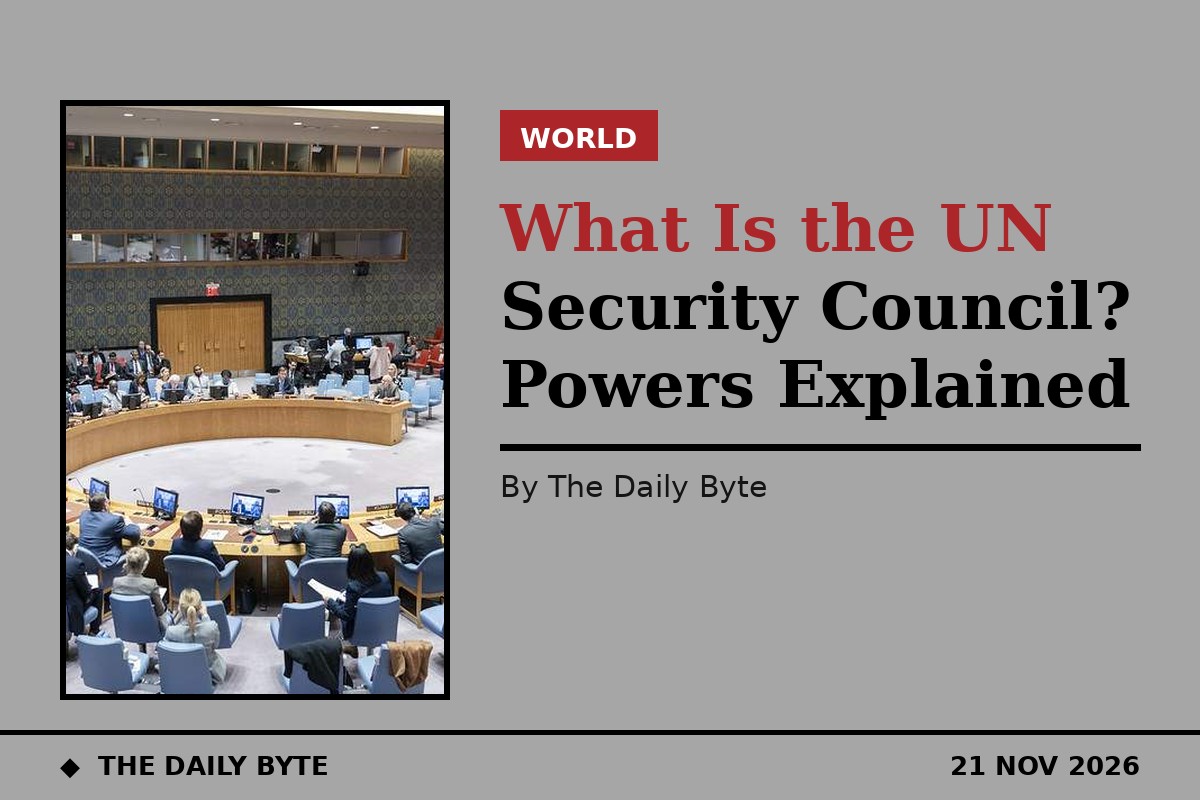
The United Nations Security Council is the most powerful body in the UN system, and also one of the most criticised. It is the only UN organ whose decisions can legally bind every member state, it can impose sanctions and authorise military force, and yet a single one of its five permanent members can block almost anything it tries to do. In November 2026 it is back in the headlines: its Gaza resolution is being tested a year after adoption, and the General Assembly has just voted overwhelmingly on the future of the UN's Palestine refugee agency. This explainer sets out what the Council is, who sits on it, how its voting works, what it can actually do, and why reform is so hard.
What is the UN Security Council?
The Security Council is one of the six principal organs of the United Nations, created by the UN Charter in 1945. Under the Charter it has primary responsibility for the maintenance of international peace and security. That phrase is the key to everything it does: the Council is the body that decides whether a situation threatens peace, what should be done about it, and whether force may be used. Unlike the General Assembly, whose resolutions are generally recommendations, the Council's decisions are binding on all 193 UN member states, which are obliged to comply with them. The Council does not meet seasonally but stands ready to convene at any time, and it has met almost continuously since 1946.
The Council's work falls into three broad kinds of action. Under Chapter VI of the Charter it calls on parties to a dispute to settle it by peaceful means and recommends methods of adjustment. Under Chapter VII it can determine the existence of a threat to the peace or an act of aggression, impose sanctions, and authorise the use of force to maintain or restore international peace and security. And it performs institutional roles: it recommends to the General Assembly the appointment of the Secretary-General and the admission of new members to the United Nations, and together with the Assembly it elects the judges of the International Court of Justice.
Who sits on the Council?
The Council has 15 members. Five are permanent members with veto power: China, France, the Russian Federation, the United Kingdom and the United States. These are the countries the Charter's drafters considered to have played the key roles in establishing the United Nations, and they were granted a special status that has never changed. The other ten are non-permanent members, elected by the General Assembly for two-year terms, with five elected each year. Their seats are distributed by region: five from African and Asian states, one from Eastern European states, two from Latin American states and two from Western European and other states.
The Council originally had 11 members, five permanent and six non-permanent. In 1963 the General Assembly recommended an amendment to the Charter increasing the membership to 15, which entered into force on 31 August 1965. The 2026 membership illustrates the rotation: alongside the five permanent members sit Bahrain, Colombia, the Democratic Republic of the Congo, Denmark, Greece, Latvia, Liberia, Pakistan, Panama and Somalia. Pakistan's presence on the Council in 2026 is one reason the Council's Gaza and Middle East debates are followed so closely in Islamabad.
How does voting work, and what is the veto?
Each member of the Council has one vote. Under Article 27 of the Charter, decisions on procedural matters require an affirmative vote of nine members. Decisions on all other matters require an affirmative vote of nine members including the concurring votes of the permanent members. In practice that means a resolution needs nine votes in favour and no negative vote from any of the five permanent members. If any one permanent member casts a negative vote, the resolution or decision is not approved. That is the veto.
Abstention is the escape valve. If a permanent member does not fully agree with a proposed resolution but does not wish to cast a veto, it may choose to abstain, allowing the resolution to be adopted if it obtains the required nine favourable votes. All five permanent members have exercised the veto at one time or another, and the veto is the single most criticised feature of the Council: it can paralyse the body precisely when the stakes are highest, as it has repeatedly done over Syria, Ukraine and Gaza. The veto does not apply to procedural matters, so a permanent member cannot block a vote on whether to hold a meeting or to invite a speaker.
What can the Council actually do?
The Council's powers are broad on paper. It can call on the parties to a dispute to settle it peacefully, and it can recommend terms of settlement. If it determines that there is a threat to the peace, a breach of the peace or an act of aggression, it can impose measures that do not involve force, such as economic sanctions, arms embargoes and travel bans. If it considers those measures inadequate, it can authorise member states to take military action, as it did in Korea in 1950, in Kuwait in 1990 and in Libya in 2011. It also establishes and extends peacekeeping missions, sets up international tribunals and commissions of inquiry, and authorises stabilisation forces.
In practice, what the Council can do is limited by politics. A resolution needs nine votes and no veto, so the Council can only act when the great powers agree, or at least when none of them cares enough to block it. That is why so much of its work is negotiation before the vote: draft resolutions are revised repeatedly to win over abstentions and avoid vetoes, and the public vote is usually the end of a long process of private bargaining. When the Council cannot agree, the action moves elsewhere, to the General Assembly, to regional organisations, or to coalitions of the willing acting without a Council mandate.
The Gaza vote: Resolution 2803
The most consequential recent example is Resolution 2803, adopted on 17 November 2025. The Council voted 13 in favour, with Russia and China abstaining and no vetoes cast, to endorse the United States' 20-point plan for Gaza and authorise an international stabilisation force for the territory. The resolution also authorised the formation of a Board of Peace, a transitional governing body for Gaza with a mandate running until the end of 2027, and held out a conditional pathway to Palestinian statehood once the Palestinian Authority had carried out reforms and reconstruction was under way. It explicitly excluded Hamas from any future governance role, and called for the resumption of humanitarian aid at scale through the UN, the Red Cross and the Red Crescent.
The vote showed the Council's machinery working as designed: the text was revised several times during high-stakes negotiations, Russia circulated a competing draft and argued the American plan was rushed, and several Arab and Muslim-majority nations, including Qatar, Egypt, Saudi Arabia, Indonesia, Pakistan, Jordan and Turkey, published a joint statement of support for the text. Russia and China chose to abstain rather than veto, allowing the resolution to pass with the required nine votes. A year on, the Board of Peace has reported back to the Council, warning that ceasefire violations, aid blockages and stalled reconstruction threaten the fragile agreement, and the Council is again the forum where those warnings are heard and, if the members can agree, acted on.
Security Council versus General Assembly
The distinction between the Council and the General Assembly confuses many people, and the events of November 2026 illustrate it well. The Assembly includes all 193 member states, each with one vote, and its resolutions are generally recommendations rather than binding law. It can discuss any matter within the scope of the Charter, and it can act when the Council is deadlocked, but it cannot impose sanctions or authorise force. On 19 November 2026 the Assembly's Fourth Committee voted 143 to 9 to back the operations of UNRWA, the UN agency for Palestine refugees, a large majority that expresses the will of the membership but does not create the binding obligations a Council resolution would. The Council, by contrast, has only 15 members and can bind all 193, but can be blocked by a single veto. The two bodies are complementary by design: the Assembly is representative, the Council is powerful, and the tension between representation and power is the central problem of the UN system.
Why is reform so difficult?
Calls to reform the Council have run for decades, and the intergovernmental negotiations on reform have been taking place for more than twenty years. The issues under discussion are the category of membership, the question of the veto, regional representation, the size of an enlarged Council, and the Council's working methods and its relationship with the General Assembly. Proposals range from adding permanent seats for Africa, Asia and Latin America to limiting the use of the veto in cases involving mass atrocities. None has succeeded, for a structural reason: amending the Charter requires the agreement of the permanent members themselves, including ratification by all five, so the countries whose power would be diluted hold a veto over the change. The Council's defenders argue that the veto is what keeps the great powers inside the system at all, and that a Council without it would be ignored. Its critics argue that a body designed in 1945 no longer reflects the world of 2026, and that the veto has become a shield for impunity. Until the permanent members agree to change the rules, the Council will go on working exactly as it was designed to work: powerful when its members agree, and paralysed when they do not.


