What Is the United Nations? Members and Powers
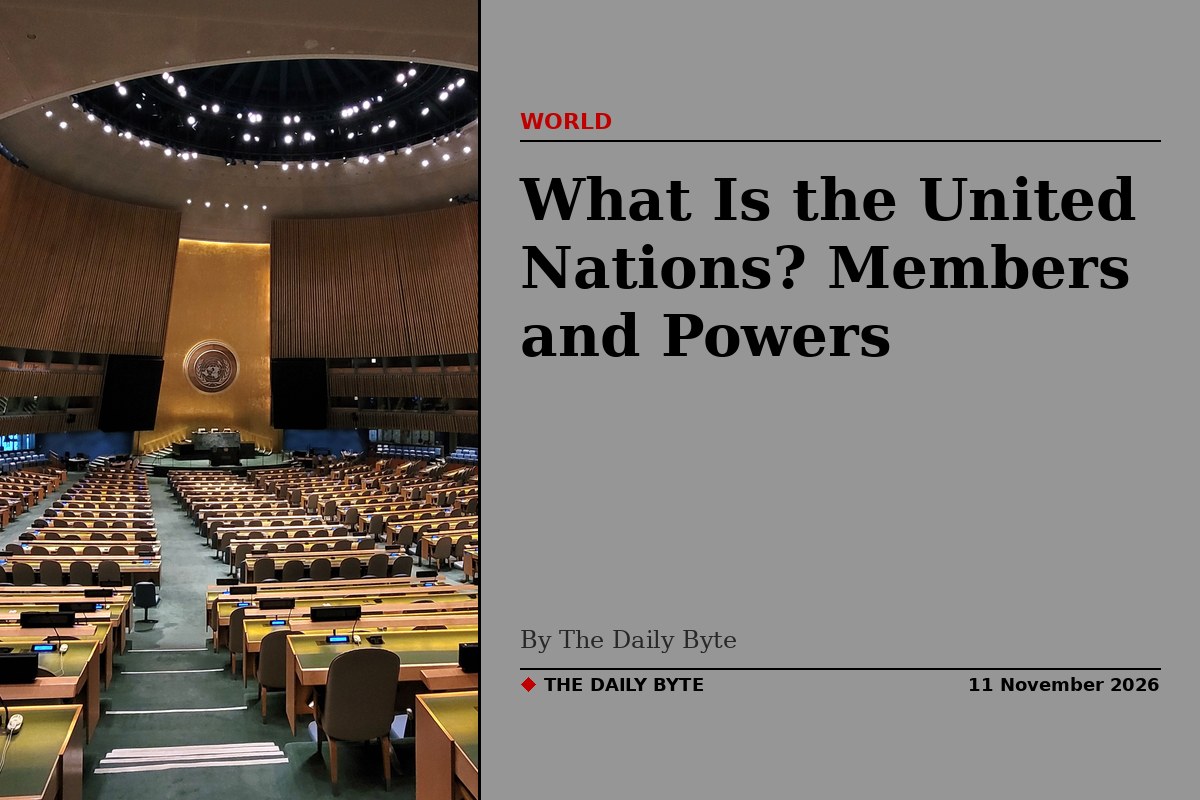
The United Nations (UN) is an international organisation founded in 1945, after the Second World War, to give the world's countries a place to settle disputes without war. It now has 193 member states, almost every country in the world, and works on peace and security, human rights, humanitarian aid and sustainable development.
The UN is not a world government. It has no army of its own and cannot force a country to obey it, except in limited circumstances through the Security Council. Its power comes from the agreement of its members, set out in its founding treaty, the UN Charter, and from the agencies, funds and peacekeeping missions that carry out its work around the world.
When and why was the United Nations founded?
The UN was created in the aftermath of the Second World War, which had killed tens of millions of people and shown that the League of Nations, founded after the First World War, had failed to keep the peace. Representatives of 50 countries met in San Francisco in 1945 and signed the UN Charter on 26 June 1945. The Charter entered into force on 24 October 1945, a date marked as United Nations Day, and the organisation began with 51 original members.
The Charter sets out four purposes: to maintain international peace and security; to develop friendly relations among nations; to solve economic, social, cultural and humanitarian problems; and to promote respect for human rights. Those purposes still guide the organisation today, and the Charter remains its founding document. The UN's headquarters are in New York, on the East River in Manhattan, with other major offices in Geneva, Vienna and Nairobi.
Who belongs to the United Nations?
There are 193 member states. A country joins when the Security Council recommends it and the General Assembly approves it by a two-thirds majority. The newest member is South Sudan, admitted on 14 July 2011. A handful of states are not members, most notably the Vatican City, which holds observer status, while Palestine also holds non-member observer status.
Every member state, large or small, has one vote in the General Assembly.
How is the United Nations organised?
The Charter establishes six principal organs. The General Assembly is the main deliberative body, where all 193 members meet. The Security Council has primary responsibility for peace and security. The Economic and Social Council coordinates work on economic, social and related issues. The Secretariat, headed by the Secretary-General, runs the organisation day to day. The International Court of Justice, based in The Hague, settles legal disputes between states. The sixth, the Trusteeship Council, has been inactive since 1994, when the last trust territory became independent.
The Secretary-General is the UN's chief administrative officer and its public face. The current Secretary-General, and the ninth person to hold the post, is António Guterres of Portugal, who took office on 1 January 2017 and was re-appointed to a second term in June 2021. The Secretary-General is appointed by the General Assembly on the recommendation of the Security Council for a five-year, renewable term.
Beyond the six organs sits the wider UN system: programmes, funds and specialised agencies with their own leadership and budgets, including the World Food Programme, the UN refugee agency UNHCR, the children's fund UNICEF, the World Health Organization and the World Bank. The UN coordinates its work with these bodies to help achieve its goals.
What does the General Assembly do?
The General Assembly is the UN's main forum for debate. Each year it holds a general debate in September in New York, where heads of state and government address the world, and it discusses questions ranging from armed conflict and climate change to poverty, hunger and migration. It sets the UN's budget, appoints the Secretary-General, elects members to the Security Council and other bodies, and admits new members.
General Assembly resolutions are recommendations rather than binding law, but they carry political weight because they express the view of nearly every country in the world. Important questions, including peace and security, the admission of new members and budgetary matters, need a two-thirds majority of members present and voting.
What does the Security Council do?
The Security Council is the UN's most powerful body. It has 15 members: five permanent members, the United States, the United Kingdom, France, Russia and China, and ten members elected by the General Assembly for two-year terms. Pakistan is among the elected members serving in 2026. Decisions on substantive matters need nine votes in favour, and any one of the five permanent members can block a decision with a veto.
Unlike the General Assembly, the Security Council's decisions are legally binding on all member states. It can impose sanctions, authorise peacekeeping missions, and, as a last resort, authorise the use of force. That is why the veto matters so much: a single permanent member can stop the Council from acting, even when most other members agree.
What does the UN actually do day to day?
The UN's work falls into three broad areas. The first is peace and security: mediating conflicts, sending peacekeeping missions to monitor ceasefires and protect civilians, and supporting disarmament. The second is human rights, built on the Universal Declaration of Human Rights adopted in 1948 and a series of treaties and monitoring bodies that followed. The third is development, now guided by the 2030 Agenda for Sustainable Development and its 17 Sustainable Development Goals, covering poverty, hunger, health, education, gender equality and climate action.
Much of the work people see is humanitarian. The World Food Programme delivers food to people facing hunger, UNHCR protects and assists refugees, UNICEF works for children, and the World Health Organization coordinates responses to disease outbreaks. When a disaster strikes, UN agencies are often among the first responders, and the UN also coordinates the relief efforts of governments and charities.
What are the limits of the UN's power?
The UN's greatest strength, that it includes almost every country, is also its greatest weakness. Because it depends on the agreement of its members, it can be slow to act, and the veto can paralyse the Security Council on the most serious crises. Member states also fund the organisation, and when they pay late or withhold contributions, its work suffers.
Even so, the UN remains the one place where all the world's nations can gather, discuss common problems and find shared solutions, and that role is the heart of what the United Nations is for.
Frequently asked questions
How many countries are in the United Nations? There are 193 member states, almost every country in the world. South Sudan, admitted on 14 July 2011, is the newest member.
Who leads the United Nations? The Secretary-General, currently António Guterres of Portugal, who took office on 1 January 2017. He is the organisation's chief administrative officer and is appointed for a five-year, renewable term.
Can the United Nations force a country to do something? Only through the Security Council, whose decisions are legally binding. General Assembly resolutions are recommendations, and a single permanent member of the Security Council can veto a decision.
Sources: United Nations, About Us and Congressional Research Service, The United Nations System: Frequently Asked Questions.


