What Is the US Government Shutdown?
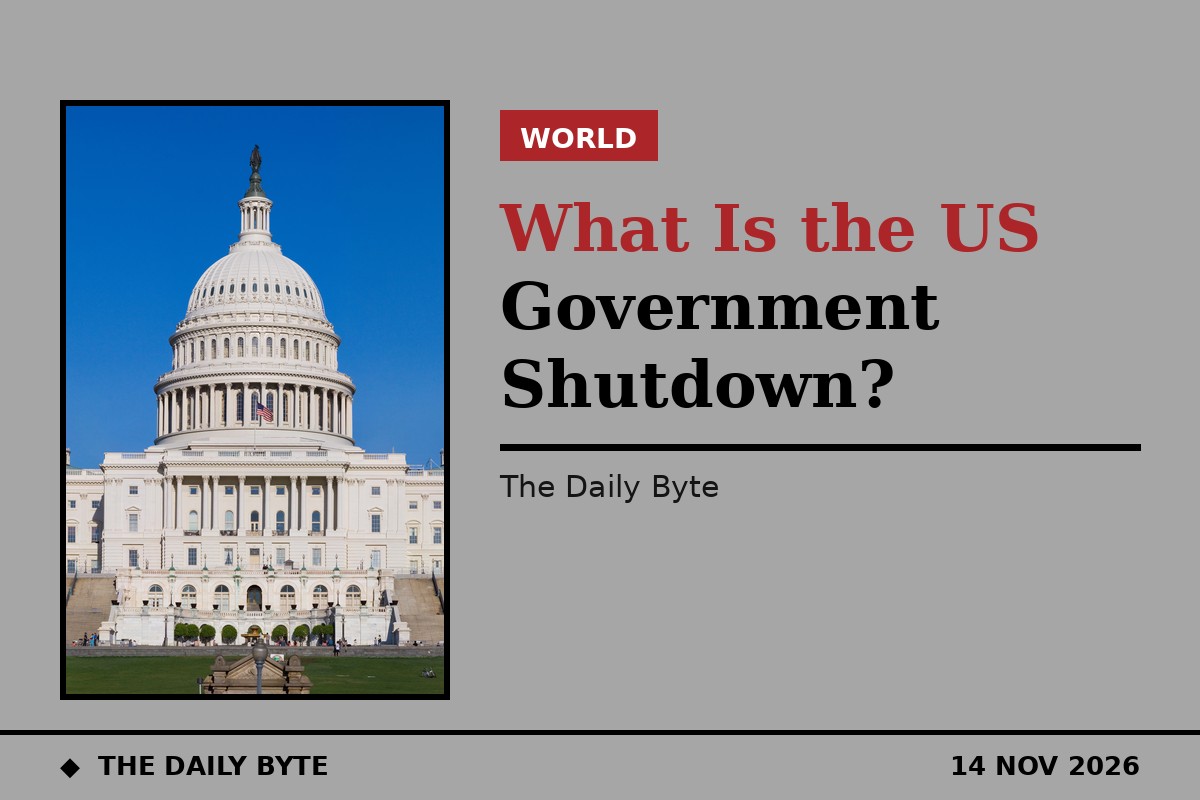
A United States government shutdown happens when Congress fails to pass the laws that fund federal agencies, leaving them without legal authority to spend money. Non-essential services stop, hundreds of thousands of federal workers are sent home without pay, and the parts of government that must keep running do so with staff working unpaid until Congress restores funding.
The latest example ended this week. The shutdown that began on 1 October 2026 lasted 43 days on the count used by the news wires, making it the longest in American history. The House of Representatives passed a funding package by 222 votes to 209 on Wednesday evening, and President Donald Trump signed it into law in the Oval Office at about 9.45pm Eastern Time that night. The Senate had cleared the package on Monday by 60 votes to 40. The previous record was the 35-day shutdown of December 2018 to January 2019.
Why does the US government shut down?
The answer lies in the Constitution. Article I gives Congress exclusive control over federal spending, stating that no money shall be drawn from the Treasury except under an appropriation made by law. Each year Congress is supposed to pass 12 appropriations bills covering every department before the fiscal year begins on 1 October. If those bills are not passed, and no temporary funding law is agreed, the money legally runs out.
A 19th-century law, the Antideficiency Act, puts teeth behind that rule. It prohibits federal officials from spending money that has not been appropriated, and legal opinions issued by Attorney General Benjamin Civiletti in 1980 and 1981 concluded that agencies must generally stop work during a lapse in funding, except in narrow emergencies involving the safety of human life or the protection of property. In practice, that is what forces a shutdown: it is not a policy choice by agencies, but a legal requirement.
When Congress cannot agree on full-year bills, it often passes a continuing resolution, a short-term measure that keeps funding at existing levels while talks continue. A shutdown happens when even that stopgap cannot be agreed in time.
What stops and what keeps running?
When funding lapses, every agency sorts its workforce into two groups. Excepted employees perform work tied to the safety of human life or the protection of property, and they must keep reporting for duty even though their pay is delayed. That group includes active-duty military personnel, air traffic controllers, airport security staff, federal law enforcement officers and border agents. Everyone else is furloughed: sent home on temporary unpaid leave and legally barred from working, even voluntarily.
Some services are protected by law regardless of the shutdown. The Department of Veterans Affairs keeps most of its hospitals running because its healthcare funding is approved in advance, and mandatory spending such as Social Security payments continues because it does not depend on the annual appropriations bills. National parks, museums and many public-facing offices close, passport and visa processing slows, and loan approvals and inspections are delayed.
The 2026 shutdown showed the scale of the disruption. Around 670,000 federal civil servants were furloughed, and a similar number kept working without pay, including more than 60,000 air traffic controllers and airport security staff. Thousands of flights were cancelled, food assistance for millions of households was thrown into doubt, and food banks reported long lines as unpaid workers sought help.
Do federal workers get paid?
Yes, eventually. The Government Employee Fair Treatment Act of 2019 guarantees that all federal employees, both furloughed and excepted, receive their full back pay once a shutdown ends. The 2026 funding package also reversed the administration's firing of furloughed workers during the shutdown and protected federal workers against further lay-offs through January. Federal contractors, such as cleaners and catering staff, have no such guarantee and are generally not repaid for lost work.
What ended the 43-day shutdown?
The legislation that ended the shutdown was a 394-page package, the Continuing Appropriations, Agriculture, Legislative Branch, Military Construction and Veterans Affairs, and Extensions Act of 2026. Its core is a continuing resolution that funds most of the federal government at existing levels through 30 January 2027, giving Congress about eleven more weeks to complete the full-year spending bills. Wrapped inside it are three full-year appropriations bills covering the Agriculture Department, veterans affairs and military construction, and the legislative branch.
The package also fully funds the Supplemental Nutrition Assistance Programme, the food assistance programme used by about 42 million lower-income Americans, through the end of the fiscal year. It includes 203.5 million dollars to boost security for lawmakers and a further 28 million dollars for the security of Supreme Court justices.
What the bill does not contain is the issue that caused the shutdown. It does not extend the enhanced Affordable Care Act tax credits that lower the cost of health insurance bought through the marketplaces, the demand Democrats made the condition of their support for six weeks. Those credits expire on 31 December. The promise Democrats extracted in return is a Senate vote on extending them, no later than the second week of December, rather than the extension itself.
Could it happen again?
Yes. The stopgap runs out on 30 January 2027, when Congress must have passed the nine remaining annual appropriations bills or agreed another funding law. If it does not, federal agencies will face another lapse in funding and another shutdown. The argument that caused the 2026 shutdown, over the health insurance tax credits, has not been settled, so the same fight is likely to return before the deadline.
Frequently asked questions
Is a government shutdown the same as the government running out of money? No. A shutdown is a lapse in the legal authority to spend, caused by Congress not passing funding laws. It is separate from the national debt and from the debt ceiling, which limits how much the government can borrow.
Do federal workers lose pay during a shutdown? No. The Government Employee Fair Treatment Act of 2019 guarantees full back pay for furloughed and excepted federal employees once funding is restored, though the money arrives late and many workers face weeks without a pay cheque.
Does a shutdown close everything? No. The military, law enforcement, air traffic control and other services tied to the safety of human life keep running, and mandatory programmes such as Social Security continue. But national parks, museums and many routine services close, and backlogs can take days or weeks to clear after reopening.
Sources: Associated Press report on the 43-day shutdown ending and GovFacts step-by-step guide to government shutdowns.


