What Is Thunder?
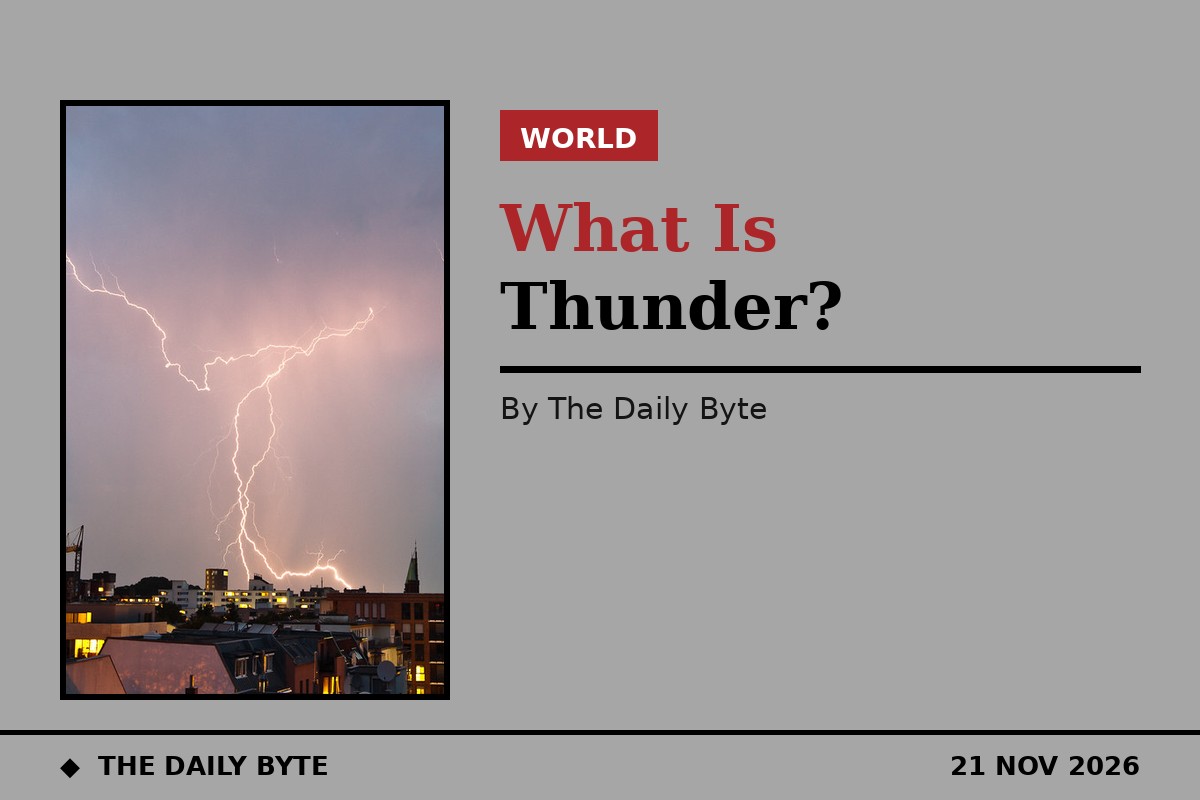
Thunder is the sound a lightning bolt makes as it heats the air around it so violently that the air explodes outward. A lightning bolt is a giant spark, and the narrow channel of air it travels through is heated to about 30,000 degrees Celsius in a fraction of a second — around five times hotter than the surface of the Sun. The air has no time to move aside gently, so it bursts outward as a shock wave, and that shock wave is what we hear as thunder.
Every lightning bolt makes thunder, even when we cannot hear it. Light travels so much faster than sound that we see the flash first and hear the boom later, and the gap between the two tells us roughly how far away the storm is. Thunder is not a separate event from lightning: it is the sound of the same event, arriving late because sound is slow.
What exactly is thunder?
When lightning strikes, it forces a huge electric current through a channel of air only a few centimetres wide, about as wide as a thumb. All of that energy turns into heat in a tiny space, and the air in the channel reaches about 30,000 degrees Celsius almost instantly, according to the UK Met Office. The pressure inside the channel jumps to many times normal air pressure, and the heated air slams outward into the cooler air around it. That outward rush is a shock wave, and as it spreads it slows down to the ordinary speed of sound and becomes the sound we call thunder.
Close to the bolt, within a few metres, the shock wave is still travelling faster than sound, and it is strong enough to split tree bark and shatter glass. As it moves away it loses energy quickly and softens into an ordinary sound wave. The air in the channel then cools and contracts, and the column of air vibrates as it settles, which adds to the noise. The whole process takes only a fraction of a second, but the sound it makes can roll on for much longer.
| Fact | Figure |
|---|---|
| Temperature inside a lightning channel | About 30,000 degrees Celsius |
| Speed of light | 299,792,458 metres per second |
| Speed of sound in air at 20 degrees Celsius | About 343 metres per second |
| Lightning strikes worldwide | About 44 every second, nearly 1.4 billion a year |
| How far thunder is usually heard | Rarely more than 20 kilometres away |
The figures in the table come from the Met Office, which also notes that a lightning flash is often made up of several individual strokes, pulses of current only hundredths of a second apart. Each stroke heats its own stretch of air, so a single flash can produce several overlapping shock waves, and that is one reason thunder so rarely sounds like a single clean bang.
Why do we see the lightning first?
We see the flash first because light is enormously faster than sound. Light from a lightning bolt covers 10 kilometres in about 33 millionths of a second, effectively instantly, while sound in air at 20 degrees Celsius travels at only about 343 metres per second. The flash and the thunder are made at the same moment and in the same place; only the difference in speed pulls them apart for us.
That delay is useful. Sound takes roughly three seconds to travel one kilometre, or about five seconds to travel one mile, so the gap between flash and thunder is a rough measure of distance. If you count three seconds between the flash and the first rumble, the nearest part of the bolt was about one kilometre away. A fifteen-second gap puts it about five kilometres away, and a thirty-second gap about ten kilometres away.
How far away is the storm? Count the seconds
The Met Office gives the rule plainly: count the seconds between seeing the flash and hearing the start of the thunder, then divide by three for kilometres or by five for miles. The count measures the distance to the nearest part of the lightning channel, not to the edge of the storm, and a channel can run for kilometres sideways through a cloud, so treat the answer as a rough guide rather than an exact measurement.
| Seconds between flash and thunder | Distance in kilometres | Distance in miles |
|---|---|---|
| 3 seconds | About 1 km | About 0.6 miles |
| 6 seconds | About 2 km | About 1.2 miles |
| 15 seconds | About 5 km | About 3 miles |
| 30 seconds | About 10 km | About 6 miles |
The speed of sound changes a little with the temperature of the air — faster in warm air, slower in cold — but never enough to change the rule. At freezing point sound travels at about 331 metres per second, and at 30 degrees Celsius about 349 metres per second, so the three-seconds-per-kilometre rule stays within a few per cent in any weather you are likely to be standing in.
Why does thunder rumble instead of bang?
A lightning channel can be several kilometres long, and every part of it makes sound at the same instant. The sound from the part nearest you arrives first, as a sharp crack, and the sound from parts further along the channel arrives later, stretched out into a long, low rumble that can last for many seconds. A single sharp bang means the whole channel was close to you. A long rumble with no crack means the strike was distant, or the sound came from a channel high in the cloud.
Echoes add to the rumble. The sound bounces off clouds, hills and the ground, and each reflection arrives a little later than the last, smearing the noise out further. The atmosphere itself bends sound: under some conditions the air higher up is warmer, and the sound is bent back down towards the ground, which can carry thunder further than usual, while under other conditions it is bent upwards and away, and a storm that looks close can sound strangely quiet.
Snow changes the sound too. In a thundersnow storm, the snow in the air dampens the thunder, and the Met Office notes that it is then usually heard only within two to three miles of the lightning. That is why winter thunder, rare as it is, often sounds muffled compared with a summer storm.
Why can you see lightning but hear no thunder?
Lightning that flashes on the horizon on a summer evening with no sound at all is often called heat lightning, but it is ordinary lightning from a thunderstorm too far away for its thunder to reach you. Thunder is rarely heard more than 20 kilometres from the strike, according to the Met Office, and under the best conditions, on a still night, it can sometimes be heard as far as 25 kilometres. Beyond that, the sound has faded into the background noise, while the light, which travels so much further, is still plainly visible.
The same thing can happen closer in, when the atmosphere bends the sound upwards and away from the surface. The flash is there to be seen, but the sound never reaches the ground where you are standing. In both cases the thunder was made — every bolt makes it — it simply never arrived.
Is thunder dangerous?
Thunder itself is only sound, and it cannot hurt you. But if you can hear it, the lightning that made it is close enough to hurt you, and that is what the safety advice is really about. The US National Weather Service puts it in one line: when thunder roars, go indoors. Lightning can strike well away from the rain, so there is no safe distance to watch a storm from outdoors.
The widely used 30-30 rule follows from the counting rule above. If the gap between flash and thunder is 30 seconds or less, the strike was within about ten kilometres, and you should seek shelter in a substantial building or a hard-topped vehicle. You should then stay inside until 30 minutes after the last clap of thunder, so that distant strikes at the start of the storm, or trailing storm clouds at the back of it, do not catch you outside.
Lightning is not rare. The Met Office estimates that a strike hits somewhere on the Earth about 44 times every second, nearly 1.4 billion strikes a year. In the United States, where records are kept in detail, lightning kills about 20 people a year on a recent ten-year average, and injures more than 500. Thunder is the warning that the storm is already within range.
Frequently asked questions
Can there be thunder without lightning? No. Thunder is always caused by lightning heating the air. If you hear thunder, lightning happened, even if the flash was hidden behind a cloud or over the horizon.
Can there be lightning without thunder? The thunder is always made, but it is not always heard. If the storm is more than about 20 kilometres away, or the sound is bent away from the ground, you will see the flash and hear nothing.
Why does thunder sound different every time? Because every bolt is a different shape and at a different distance, and the sound reaches you through different air. A close bolt gives a sharp crack, a distant one a long low rumble, and echoes off clouds and hills change the sound further.
What is heat lightning? Ordinary lightning from a distant thunderstorm, too far away for its thunder to be heard. It is not a different kind of lightning, and it is not caused by heat: the name comes from the warm summer evenings when it is most often seen.
Sources: the UK Met Office’s guide to thunder and lightning; Scientific American’s explainer on what causes thunder; the University of Arizona’s severe-weather course notes on lightning and thunder; and the US National Weather Service’s lightning safety guidance. Thunder is lightning you can hear — the sound of air heated to 30,000 degrees in an instant.


