What Is Trident? The UK's Nuclear Deterrent Explained
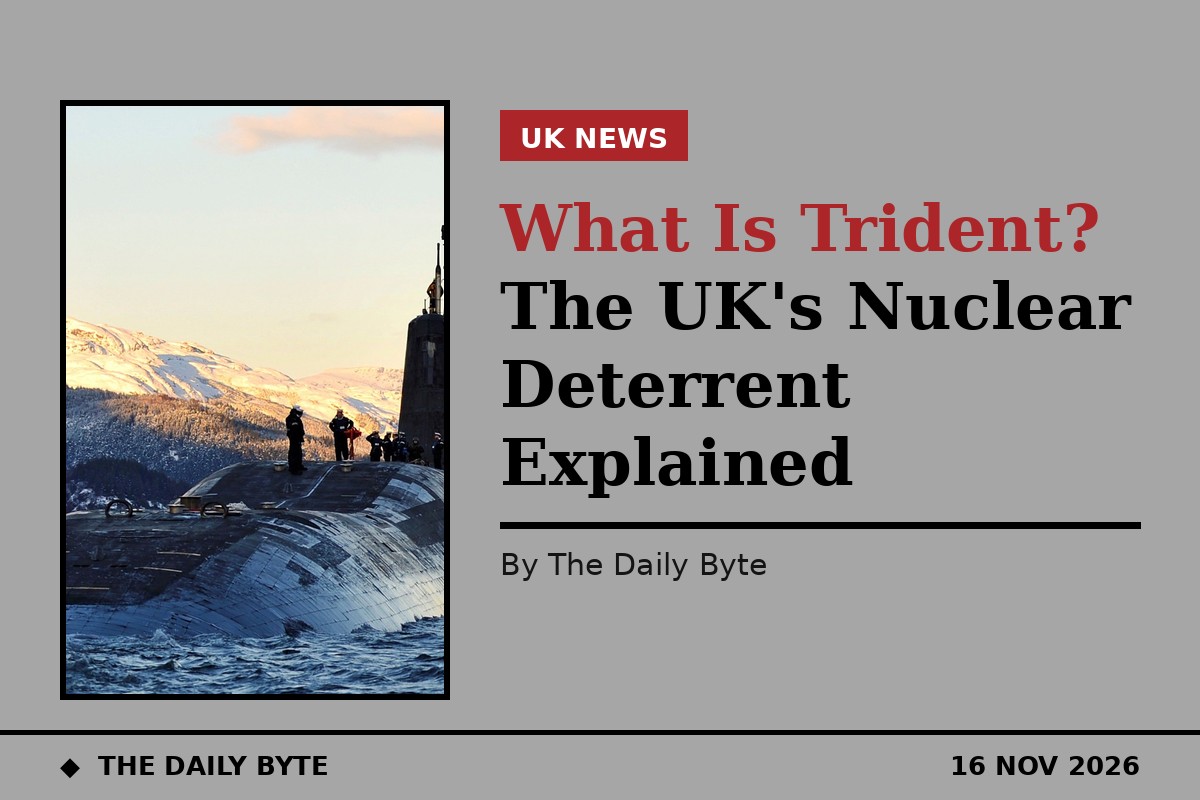
Trident is the United Kingdom's nuclear deterrent: a system of four Vanguard-class submarines armed with Trident II D5 ballistic missiles, which keeps at least one nuclear-armed submarine at sea at all times. It is the UK's only nuclear weapon system, and it has been in continuous operation since 1969. It is in the news because HMS Vengeance has just returned to Faslane after a record-breaking 217-day patrol — the longest continuous underwater deployment by a Royal Navy vessel.
Why is Trident in the news now?
HMS Vengeance returned to HM Naval Base Clyde at Faslane, on the River Clyde in Scotland, on Sunday 15 November 2026, after spending 217 days submerged on patrol. The submarine had sailed from Faslane on 12 April 2026 and remained underwater for the whole deployment, with its crew of around 140 largely cut off from home. Defence Secretary Wes Streeting was at the base to welcome the crew home.
The 217-day patrol beats the previous Royal Navy record of 205 days, set by HMS Vanguard when it returned to Faslane in April 2026. Vengeance's return had been expected the previous weekend but was reportedly delayed after the submarine due to relieve it on patrol had to return to base with a technical fault. The record is a sign of the strain on Britain's ageing deterrent fleet: patrols that were once around three months long are now routinely lasting six or seven months, because maintenance problems have left fewer submarines available.
What exactly is Trident?
Trident is not a single weapon. It is the name for the whole system that delivers the UK's nuclear deterrent, made up of three parts working together:
- The submarines — four Vanguard-class nuclear-powered ballistic missile submarines, known as SSBNs, built in the 1990s and based at HM Naval Base Clyde.
- The missiles — Trident II D5 submarine-launched ballistic missiles, manufactured in the United States and held in a shared missile pool with the US Navy. Each missile can carry multiple warheads.
- The warheads — nuclear warheads designed and built in the UK at the Atomic Weapons Establishment, fitted to the missiles before a submarine sails.
The Ministry of Defence describes the purpose of the system as deterring "the most extreme threats to our national security and way of life, which cannot be done by other means". Since the last RAF nuclear bomb, the WE.177, was retired in 1998, Trident has been the UK's only nuclear weapon system. The missiles are the delivery system; the submarines are what keep them hidden and survivable.
What does "continuous at-sea deterrence" mean?
Continuous at-sea deterrence — usually shortened to CASD — is the principle behind Trident. Since April 1969, there has always been at least one Royal Navy nuclear-armed ballistic missile submarine on patrol at sea. The Royal Navy calls the mission Operation Relentless, and it has run without a break for more than 50 years.
The logic is straightforward. A submarine hidden somewhere in the ocean cannot be found and destroyed in a first strike, so an attacker can never be sure of escaping retaliation. That uncertainty is what is meant to deter an attack in the first place. It is why only one submarine needs to be at sea at any given time: the other three are in maintenance, in training, or preparing for their next patrol. The system depends on having four boats, so that one is always available even while the others are out of service.
The deterrent is also part of NATO's nuclear posture. The UK's submarines are committed to the defence of the alliance, and the government has said the deterrent protects both the UK and its allies.
What are the Vanguard-class submarines?
The four Vanguard-class submarines are the largest submarines ever built for the Royal Navy. Each is around 150 metres long, is powered by a nuclear reactor, and carries a crew of about 135 to 140. They entered service in the 1990s — the first, HMS Vanguard, in 1994 — and were designed for a service life of 25 years, which they have now exceeded by more than a decade.
| Submarine | Pennant number | Role |
|---|---|---|
| HMS Vanguard | S28 | First of class; set the previous patrol record of 205 days in April 2026 |
| HMS Victorious | S29 | Currently in dry dock undergoing deep maintenance |
| HMS Vigilant | S30 | In service |
| HMS Vengeance | S31 | Returned 15 November 2026 after a record 217-day patrol |
Each submarine can carry up to 16 Trident missiles. The boats are based at Faslane, on the Gare Loch, while their missiles and warheads are handled at the Royal Naval Armaments Depot at Coulport, on nearby Loch Long. Life on board a deterrent patrol is demanding: the crew cannot be resupplied at sea, the boat stays submerged and largely in radio silence to avoid detection, and the submarines were designed to carry only three to four months of food — a limit that seven-month patrols have now pushed well beyond.
How does deterrence work in practice?
A deterrent patrol is, by design, uneventful. The submarine leaves Faslane, disappears into the Atlantic, and stays hidden. Its crew follows a routine of watches, maintenance, training and drills, with no contact with the outside world beyond tightly controlled communications. The boat's location is a closely guarded secret — even the government does not announce where it is.
The order to launch a nuclear weapon could only come from the Prime Minister. Each prime minister, on taking office, writes sealed orders — known as the letters of last resort — which are kept on board each submarine. They contain instructions for the commanding officer in the extreme scenario where the UK government has been destroyed and contact has been lost. The contents are destroyed, unread, when a prime minister leaves office.
The government no longer publishes figures for how many warheads are deployed on patrol. The 2021 Integrated Review raised the overall ceiling on the UK's nuclear stockpile to no more than 260 warheads, up from a planned 180, and said that deployed numbers would no longer be disclosed. What the government does say is that the UK will only maintain the minimum amount of destructive power needed for deterrence, and that it remains committed to the long-term goal of a world without nuclear weapons.
What is replacing the Vanguard class?
The Vanguard submarines are being replaced by four new Dreadnought-class submarines, currently being built by BAE Systems at Barrow-in-Furness in Cumbria. The four boats will be named HMS Dreadnought, HMS Valiant, HMS Warspite and HMS King George VI. They will be the largest submarines the Royal Navy has ever operated, at more than 150 metres long, with a crew of around 130.
The first Dreadnought boat is expected to enter service in the early 2030s, taking over the deterrent patrol from the Vanguard class. The new submarines will carry the same Trident II D5 missile system. The programme was approved by the House of Commons in July 2016, when MPs voted by 472 to 117 to renew the deterrent, and its overall budget was set at £31 billion, with a further £10 billion contingency fund. The keel of the first boat, HMS Dreadnought, was laid at Barrow in March 2025.
The replacement programme is delivered by the Dreadnought Alliance, a partnership between the Ministry of Defence's Submarine Delivery Agency, BAE Systems and Rolls-Royce, which builds the submarines' nuclear reactors. The government's Defence Nuclear Enterprise, the wider organisation behind the deterrent, supports tens of thousands of jobs across the UK, and the government says the workforce will grow to around 65,000 by 2030.
Why are patrols getting longer?
The record-breaking patrols of 2025 and 2026 are not a sign that the system is working as designed. They are a symptom of a fleet under strain. Vanguard-class submarines were designed for patrols of about three months. In recent years, six-month deployments have become routine, and HMS Vanguard's 205-day patrol in April 2026 and HMS Vengeance's 217-day patrol in November 2026 have pushed that further still.
The main reason is maintenance. HMS Victorious is currently in dry dock undergoing a deep maintenance period reported to cost £560 million, which began in 2023. With one of the four boats out of service for years at a time, the remaining three have to cover the continuous patrol between them, which means each patrol lasts longer. HMS Vengeance's return was delayed because the submarine meant to relieve it had to return to base with a technical fault, leaving Vengeance at sea for longer than planned.
Long patrols put pressure on crews as well as machines. Submariners spend months underwater with limited contact with their families, in confined conditions, with food and supplies that were planned for a shorter deployment. The First Sea Lord, General Sir Gwyn Jenkins, told a conference in Oslo in November 2026 that the UK must improve its maintenance of the fleet — a view echoed by independent experts, who say patrol lengths will only come down once more submarines are reliably available.
What do supporters and critics say?
Trident has been debated in British politics for decades, and the arguments on both sides are well established. Supporters say the deterrent is the ultimate insurance policy: it protects the UK against nuclear blackmail, underpins NATO's security, and cannot be replaced by conventional weapons. They point to the continuous patrol record since 1969 and argue that abandoning it would leave the UK exposed in an increasingly dangerous world. A YouGov poll in June 2025 found that 50% of British adults supported replacing Trident with an equally powerful system.
Critics question the cost, the morality of weapons designed to kill on a vast scale, and whether a system built for the Cold War is the right priority for today's security threats, such as cyber attacks and hybrid warfare. The Scottish National Party and the Green Party oppose Trident, and the basing of the submarines at Faslane — on the Clyde, near Glasgow — is a long-running issue in Scottish politics. The Labour government elected in 2024 supports the deterrent, and its 2025 Strategic Defence Review confirmed that a modernised nuclear deterrent would remain the cornerstone of UK defence.
Whatever the politics, the operational facts are not in dispute: four ageing submarines, one always at sea, a replacement class due in the early 2030s, and patrols that keep getting longer in the meantime. HMS Vengeance's 217 days underwater is a record for the Royal Navy — and a measure of how hard the current fleet is being worked.
Frequently asked questions
What is Trident?
Trident is the UK's submarine-based nuclear deterrent: four Vanguard-class submarines armed with Trident II D5 ballistic missiles, keeping at least one nuclear-armed submarine at sea at all times since 1969.
How many Trident submarines does the UK have?
Four: HMS Vanguard, HMS Victorious, HMS Vigilant and HMS Vengeance. They are being replaced by four Dreadnought-class submarines, the first of which is expected to enter service in the early 2030s.
Where are the Trident submarines based?
At HM Naval Base Clyde, which includes Faslane on the Gare Loch, where the submarines are based, and Coulport on Loch Long, where missiles and warheads are handled.
Has a Trident missile ever been fired in anger?
No. The UK's nuclear deterrent has never been used in conflict. Its purpose, as the government describes it, is to deter attack — and the system is judged by the fact that it has never had to be used.
What was the longest Trident patrol before HMS Vengeance?
HMS Vanguard's 205-day patrol, which ended in April 2026. Before that, HMS Vengeance itself held a notable record with a 201-day deployment completed in March 2024.
Sources: Ministry of Defence / Defence Nuclear Enterprise — The UK's Nuclear Deterrent: A National Endeavour; reporting on HMS Vengeance's return from Glasgow News and Internewscast. For related coverage, see our report UK and France deepen nuclear deterrent cooperation.