What Is the Tropical Forests Forever Facility?
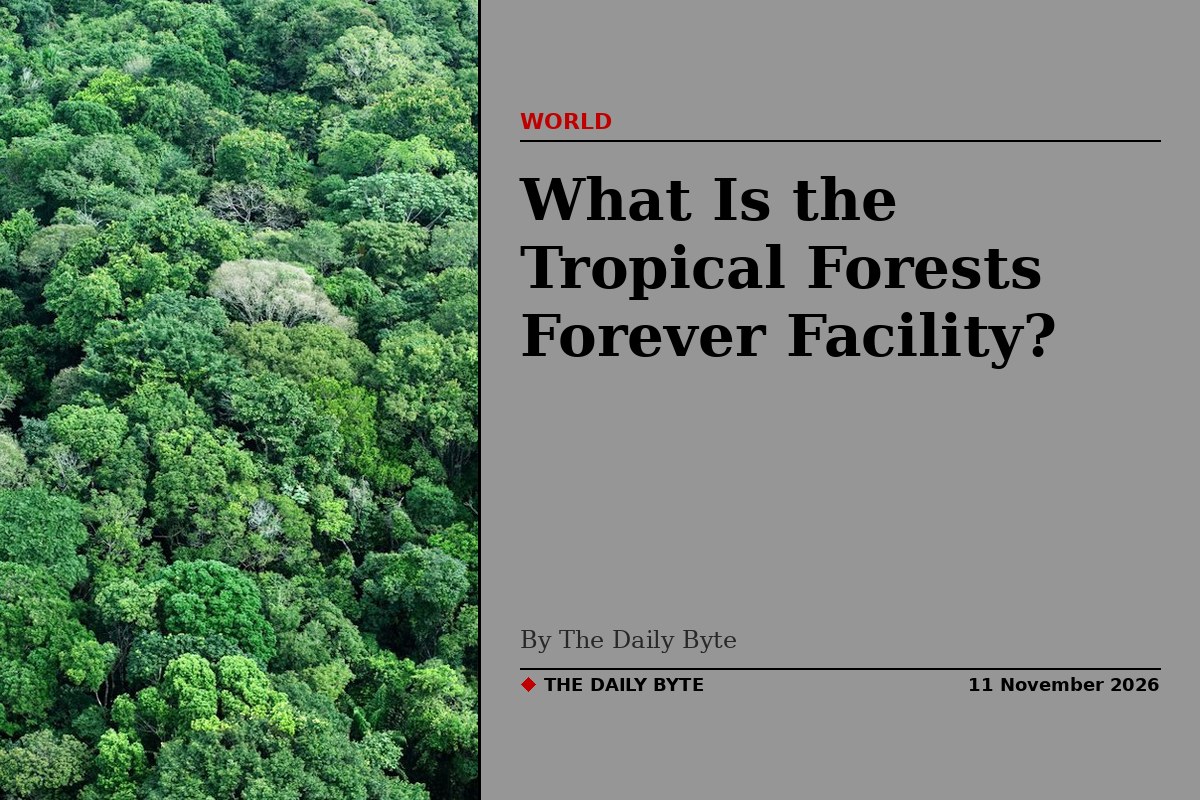
The Tropical Forests Forever Facility, known as the TFFF, is a Brazil-led investment fund worth a planned $125 billion that pays tropical forest countries for keeping their forests standing, rather than cutting them down. Launched at the COP30 climate summit in Belém, Brazil, in November 2025, it rewards countries with up to $4 a year for every hectare of forest they preserve, measured by satellite. As the COP31 climate conference opened in Antalya, Turkey, on 9 November 2026, the fund has reached a make-or-break moment: it has collected about $7.8 billion in pledges and must reach $10 billion by the end of the year to unlock a conditional $3 billion contribution from Norway.
The idea behind the facility is simple. Tropical forests store vast amounts of carbon, shelter extraordinary wildlife and regulate rainfall, yet the countries that host them often earn far more in the short term by clearing land for cattle, soy, palm oil, mining and timber. Traditional conservation funding, which depends on donor governments voting fresh grants every year, has never matched the scale of the problem. The TFFF tries a different approach: build a giant investment fund, earn returns on financial markets, and use the surplus to pay forest countries every year, predictably and indefinitely, for as long as the trees remain standing.
How does the Tropical Forests Forever Facility work?
The facility is designed to work like a sovereign wealth fund for forests. Money raised from governments, philanthropists and private investors is pooled into an investment fund, the Tropical Forest Investment Fund, which is based in Luxembourg. That fund invests in fixed-income assets such as emerging-market government and corporate bonds. If those investments earn more than the fund owes in interest to its lenders and bondholders, the surplus is distributed each year to eligible tropical forest countries. Countries are paid only if returns stay above the fund's own costs, and any shortfall in meeting those costs would be covered from the money loaned by governments.
What makes the scheme different from three decades of forest aid is that payments are intended to be predictable, results-based and free of project cycles. They are not tied to individual conservation projects, and they are not dependent on the annual budget decisions of donor parliaments. Instead, a country qualifies by keeping its forests standing, with the extent of its forest cover checked each year by satellite. At least 20 percent of every payment must go to Indigenous peoples and local communities, who protect much of the world's remaining tropical forest.
The facility operates through two linked entities. The Tropical Forest Investment Fund mobilises and manages the money, while the Tropical Forest Forever Facility itself oversees reporting and distributes the payments. The World Bank acts as trustee and host, and is hosting the facility's secretariat. Governance is still taking shape: an interim charter and board are in place, with donors and rainforest countries holding equal seats, and most future board decisions will require a two-thirds majority.
Where does the $125 billion come from?
The $125 billion target is split into two parts. Sponsor governments and philanthropic groups are expected to provide $25 billion in long-term loans, repaid over decades. That public money acts as junior capital, absorbing the first losses and supporting the issue of up to $100 billion in senior bonds to private investors, including pension funds, insurers and asset managers, which pay a fixed return.
The whole $125 billion would then be invested, and the gap between what the portfolio earns and what the fund owes in interest becomes the money paid to forest countries. The facility's concept note estimates that a portfolio earning between 247 and 325 basis points above United States Treasury bonds would be enough to fund payments in the early years, and suggests the facility could mobilise around $4 billion a year once fully funded. That is the scale its backers say is needed: according to the United Nations Environment Programme, tropical forest countries will need a total of $67 billion a year in investment by 2030, including $33 billion for reforestation, $18 billion for agroforestry and $16 billion for conservation.
Private investors are being courted on the grounds that the fund combines scale and impact with a financial return. A group of 34 financial institutions and organisations, including Allianz Global Investors and Deutsche Bank, signed a statement of support this year, although those statements are not commitments to invest. The expectation among the fund's backers is that private money will engage once the structure is fully in place and the first sponsor capital is secured.
How much do countries get paid, and what happens if they cut forest down?
Under the scheme, eligible tropical forest countries would receive up to $4 a year for every hectare of standing forest, measured by satellite. To qualify in the first place, a country must enter with a deforestation rate at or below 0.5 percent a year. The payment is then adjusted according to how much forest the country loses.
The penalty mechanism is deliberately tough. For a country with a deforestation rate below 0.3 percent, each hectare cleared cancels the payment for 100 hectares of standing forest, which works out at a $400 penalty per hectare lost. Above a 0.3 percent deforestation rate, the penalty doubles on the excess, so a single cleared hectare can forgo $800 of payment. Degraded forest carries a discount of one hectare in 35. Crucially, the mechanism can only reduce what a country receives; it cannot leave a country owing money.
The designers argue that the penalty, rather than the $4 payment, is the real incentive. As Felix Finkbeiner, founder of the non-governmental organisation Plant-for-the-Planet, put it, no one will stop deforestation for four dollars, but others will because of the penalty deduction: the incentive is the money they are not getting. The environmental group WWF has calculated that Suriname, for example, could receive an estimated $42 to $46 million a year if the fund reaches its full $125 billion, compared with about $2 million a year it currently receives in bilateral aid for biodiversity.
Countries must also meet conditions on how they use the money. They need adequate public financial management systems, assessed using World Bank methods; they must allocate at least 20 percent to Indigenous peoples and local communities; publish an annual allocation plan; and show that payments supplement rather than substitute for existing budgets. The Indigenous allocation carries real enforcement: a national steering committee must be operating, a dedicated account opened, and the transfer completed within a year, failing which a country becomes ineligible for payments the following year.
Who has pledged money so far?
More than 65 countries have endorsed the facility since it was unveiled, but only eight have actually pledged money, amounting to $7.8 billion. The pledging countries are Brazil, Indonesia, Norway, Germany, France, Luxembourg, the United Kingdom and the Netherlands. Brazil and Indonesia, two of the three largest tropical forest countries, have each committed $1 billion of sponsor capital. Norway has pledged $3 billion over ten years, but that pledge is contingent on the fund reaching its $10 billion target by the end of 2026. Germany has pledged one billion euros and France 500 million euros.
The most recent pledge came from the Netherlands, which announced on 26 October 2026 that it would contribute up to $500 million over the next decade. The facility left Belém with $6.7 billion of its junior target, and the co-chairs have expressed confidence in reaching $10 billion by the end of this year. Sources have suggested South Korea, Canada and Japan could be next to pledge. The fund is expected to become operational in 2027, but the first payments are not anticipated before 2028, and some of the rules that will determine how it works, including how forest degradation is monitored and penalised, are still being negotiated.
Why is COP31 in Antalya so important for the fund?
COP31, the 2026 United Nations climate conference, runs from 9 to 20 November in Antalya, Turkey. Turkey holds the COP31 presidency, while Australia leads the formal negotiations, with Turkey's environment minister Murat Kurum serving as COP31 president and his Australian counterpart Chris Bowen acting as president of negotiations. Pushing the TFFF across the $10 billion threshold is a key priority for Brazil at the conference, and the Global Forest Coalition has described COP31 as make or break for the fund, warning that it has until the end of the year to secure the initial funding or face key investors pulling out.
Brazil arrives in Antalya with fresh momentum. President Luiz Inácio Lula da Silva, who championed the facility, was re-elected in the presidential runoff on 25 October 2026, removing what backers saw as an immediate political threat to the Amazon and to the fund itself. Six days before COP31 opened, Brazil's COP30 presidency published a global roadmap for moving away from fossil fuels, alongside a second roadmap on ending deforestation, after last year's summit failed to agree either document. The deforestation roadmap cites UN Environment Programme figures showing annual forest funding was $84.5 billion in 2023 and must rise above $300 billion by 2030.
The stakes are high because the forests in question are irreplaceable. The Amazon basin, the Congo basin and Borneo alone hold about 78 percent of the world's remaining tropical forests. COP30 in Belém was widely viewed as a disappointment on forests and fossil fuels, although it did launch the TFFF and adopt a just transition mechanism and a gender action plan. Whether COP31 can turn the fund from a promising design into a fully financed reality is now one of the defining questions of the Antalya talks.
What are the criticisms and unanswered questions?
The facility has attracted serious criticism as well as praise, and several of its rules are still unwritten. One concern is measurement. As currently designed, the fund only penalises fire-based degradation, which is easier to monitor by satellite but accounts for only about a third of all forest loss. Critics say ignoring other causes of degradation creates a bad incentive, while supporters of the current design say no global methodology reliable enough to use right away exists, and waiting for one would cost years.
A second concern is where the money goes once it reaches a recipient country. Payments go to national treasuries, and the test that they supplement rather than substitute for existing spending is measured against national budgets. In federal states such as Brazil, much of the work that determines whether forest stays standing is carried out by state governments, whose budgets form no part of that national baseline. Environmental management accounts for between 0.17 and 0.55 percent of total planned spending across the four states of the Brazilian Legal Amazon that publish sufficient detail, and Amazonas, which holds more standing rainforest than any other state, budgets around $23 million for it.
A third concern is the role of Indigenous peoples and local communities. Although they are guaranteed at least 20 percent of payments, and Indigenous organisations helped design the fund, their role is advisory and their representatives hold no voting rights on the board. Campaigners have also questioned the investment rules, which are still being worked out. The broad principles are set, with no money to be invested in activities that lead to deforestation or the extraction of fossil fuels, but investors are pushing for social and environmental checks to apply to the whole company the fund buys bonds from, not just to the project the money pays for.
Despite these questions, backers argue the fund is built for exactly the kind of difficult politics it will face. As Mauricio Voivodic, executive director of WWF-Brazil, put it, the facility was launched without being bulletproof, and the vulnerabilities need to be recognised and improved as it goes along, or years could be lost. In his view, the fund has a real potential to change the game by making standing forest worth more than cleared land.
Frequently asked questions
Is the Tropical Forests Forever Facility the same as carbon credits? No. The facility does not sell carbon credits and it is not a carbon-offset market. Countries are paid from the investment returns of the fund for verified standing forest, measured by satellite, rather than for credits that a buyer can use to excuse its own emissions. It is designed to sit alongside existing mechanisms such as REDD+, which pays for verified reductions in deforestation.
Which countries can receive payments? The facility is aimed at developing tropical forest countries across Latin America, Africa and Asia-Pacific. To qualify, a country must have a deforestation rate at or below 0.5 percent a year, demonstrate adequate public financial management, publish an annual allocation plan, and pass at least 20 percent of payments to Indigenous peoples and local communities.
When will the first payments be made? The fund is expected to become operational in 2027, but the first payments are not anticipated before 2028. Several rules, including how forest degradation is monitored and what the fund may invest in, are still being negotiated before then.
Has the United Kingdom pledged money? Yes. The United Kingdom is one of the eight countries that have pledged money to the facility so far, alongside Brazil, Indonesia, Norway, Germany, France, Luxembourg and the Netherlands. The total pledged so far is about $7.8 billion.
What happens if the $10 billion target is missed? Norway's $3 billion pledge is contingent on the fund reaching $10 billion by the end of 2026, so missing the target would put that contribution at risk and make it harder to attract private investors. The fund's co-chairs have expressed confidence the target will be reached, with South Korea, Canada and Japan tipped as possible next pledgers.


