What Is the Trump-Xi-Putin Meeting in Shenzhen?
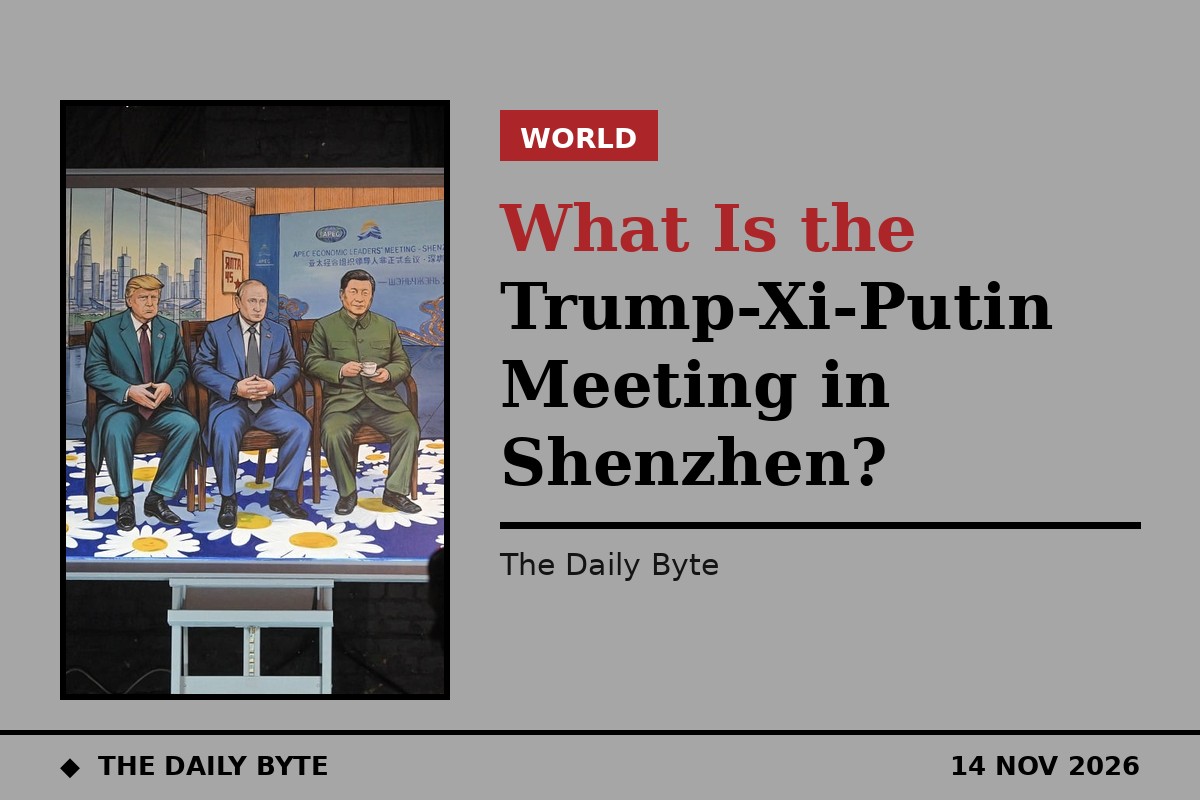
Donald Trump, Xi Jinping and Vladimir Putin may sit down together in Shenzhen, China, on 18 and 19 November 2026, on the sidelines of the Asia-Pacific Economic Cooperation (APEC) leaders' summit. It would be the first formal three-way meeting of the leaders of the United States, China and Russia, and the White House confirmed on Friday 13 November that the meeting is scheduled. But Beijing has not confirmed that it will happen, no agenda or format has been agreed, and a senior US official has said no agreements are expected to be announced. As of 14 November 2026, the Shenzhen meeting is best described as planned by Washington, discussed by Beijing and Moscow, and still capable of not happening.
The idea has dominated diplomatic coverage for two weeks because of who would be in the room and what is at stake: the war in Ukraine, the war in Iran, nuclear arms control after the expiry of the last US-Russia treaty, and the future shape of great-power politics. This explainer sets out what is actually agreed, what each leader wants, and why critics and supporters alike keep reaching for the same historical comparison: the Yalta Conference of 1945.
What is the Shenzhen meeting?
The proposed meeting is a trilateral summit, meaning a meeting of three heads of state, held on the sidelines of the APEC leaders' summit in Shenzhen on 18 and 19 November 2026. China is hosting the APEC summit, and Xi Jinping is hosting leaders and representatives from the forum's 21 member economies. All three presidents are expected to attend the summit itself. The three leaders have met separately but have never held formal talks together, so a three-way encounter would be a first of its kind.
The proposal is older than this week. The Wall Street Journal reported on 19 October that Mr Putin had proposed a summit with Mr Trump and Mr Xi to discuss ending the war in Ukraine, and Kremlin aide Yury Ushakov said Mr Putin and US special envoy Steve Witkoff discussed it in St Petersburg on 21 October. The Financial Times reported on 3 November that officials from the three countries had been holding undisclosed talks for two weeks about arranging the meeting. The Kremlin has also said Mr Putin and Mr Xi are expected to meet bilaterally in Shenzhen on 18 November.
What has actually been confirmed, and what has not?
The on-the-record facts are thin but specific. Chinese Foreign Ministry spokesperson Mao Ning told reporters in Beijing on Wednesday 4 November: "China is maintaining communication with relevant parties regarding a meeting of the heads of state of China, Russia and the United States." She gave no date, no agenda and no format, and Beijing has announced no final decision. A spokesperson for Beijing's embassy in Washington said on Friday: "China is in communication with relevant parties regarding a meeting between the three heads of state. We have nothing to share at the moment."
Kremlin spokesman Dmitry Peskov told the Financial Times on Tuesday 3 November: "Work is under way on organising such a meeting," adding that Moscow hopes the arrangements will be finalised in the coming days. On Monday 9 November he told reporters: "Suggestions are being exchanged regarding a possible agenda. In any case, the meeting will certainly be interesting. And, of course, it will capture the attention of people all over the world." Russia's embassy in Washington did not respond to a request for comment.
The White House position moved on Friday 13 November, when it confirmed that the meeting is scheduled, according to Press TV, which cited the Associated Press and a senior US official. That same official said Mr Trump did plan to discuss the war in Iran with Mr Xi and Mr Putin, and described the meeting as the beginning of hopefully a conversation on nuclear disarmament that could be productive going forward, while adding that no agreements were expected to be announced. Reuters, reporting on 14 November, said down-to-the-wire negotiations had not yet yielded an agenda or format for talks, according to two people familiar with the planning, but that a meeting is expected in Shenzhen.
What would each leader want from the room?
The three men come with very different goals. Mr Trump sees a moment for the history books, with possible movement towards a three-way agreement on nuclear arms control, and a foreign-policy win after midterm elections that cost his party control of Congress. He has said he is open to three-way talks focused on nuclear weapons, telling reporters last month: "If President Xi wants to have it, I'd have it." He has also named ending the war in Iran as a topic. A senior Trump administration official said: "We do not expect to get to any kind of agreement" on nuclear issues, but added that it was time for China to step up and talk about the topic.
Mr Putin sees a chance to secure an agreement to end the war in Ukraine on his terms. Moscow sought a conversation on the war in Ukraine, and Russian nationalists have described the meeting as a path towards a new Yalta. Just holding the meeting would elevate Russia to the status of a superpower alongside China and the United States in the eyes of his own public, and the photograph alone would do much of the work. Mr Peskov, however, asserted that any potential agreements in Shenzhen could not be imposed on other countries, and said the global order had to be based on mutual benefit and mutual respect.
For Mr Xi, the gathering is an unpredictable event full of risks. The Republican president's improvisational style clashes with Mr Xi's scripted approach to high-profile events, and Mr Trump's hope for arms control rubs against the reality that China, which has far fewer nuclear weapons than the United States or Russia, considers itself a nuclear underdog. Beijing has resisted putting the war in Ukraine on the agenda, according to one of the people briefed on the meeting and a European diplomat, and a US official said on Friday that Mr Trump was not likely to raise the war in Ukraine and that three-way talks were not the proper forum to do so. As host, Mr Xi decides whether the room exists at all, and China has not yet decided whether to proceed.
Why are people calling it a new Yalta?
The proposed meeting has drawn comparisons, particularly in Russia, with the 1945 Yalta Conference between the United States, Britain and the Soviet Union, which formalised spheres of influence, set the stage for the post-Second World War order and became shorthand for great-power deals imposed on smaller countries. For Russian nationalists, the prospect of an updated version of Yalta has generated excitement, potentially opening the door to an agreement to end the four-year-old Ukraine conflict in a manner that would favour Moscow. Russian nationalist ideologue Alexander Dugin told Radio Sputnik this week: "It shows who is important in the world: 'We are, China and the West'. It's deeply symbolic, a confirmation of a multi-polar world that the West denies."
But the possible meeting has generated anxiety from Kyiv to Tokyo, according to people briefed on those governments' reactions. Ukrainian President Volodymyr Zelensky said last month: "We really don't want this to turn into 'Yalta 2, 3, 4,' with a redistribution of influence." For smaller governments not at the table, including Ukraine and Taiwan, the idea of the big powers possibly cutting a private deal without them is a cause of deep unease. The optics are awkward for China, which was not invited in 1945 and tries to present itself as an advocate for smaller countries. The comparison is therefore doing political work on both sides: for Moscow it promises recognition, for Kyiv it warns of a settlement drawn up without Ukraine, and for Beijing it sits uneasily with its claim to speak for the developing world.
Nuclear arms and the end of New START
Nuclear arms control is the most concrete item on the table, and also the one on which agreement looks least likely. The meeting comes months after the expiration of the New START treaty in February 2026, ending restrictions on the United States and Russian nuclear arsenals for the first time in more than half a century. Mr Trump has rejected Moscow's proposal to extend the agreement for another year.
The numbers explain Beijing's reluctance. Russia and the United States each possess more than 5,000 nuclear warheads, while China has about 500, though Beijing is rapidly expanding its arsenal. "This is something the Chinese hate," said Edgard Kagan, a former senior Biden White House official for East Asia now with the Centre for Strategic and International Studies. "I think it's fair to say the Chinese do not want arms control discussions with the US. And they certainly don't want to do it with the US and Russia, because it suggests that they accept the framing that they are now a major nuclear power that should be subject to similar restrictions." Chinese academics interviewed by Reuters called Mr Trump's suggestion of nuclear talks a nonstarter for Beijing. A follow-up has already been floated at the G20 summit in Florida on 13 to 15 December, where a further meeting has been discussed, and whether Mr Putin will attend remains open.
What is APEC, and why Shenzhen?
APEC, the Asia-Pacific Economic Cooperation forum, groups 21 member economies around the Pacific, and its leaders' summit is the set-piece event of its year. China is hosting the 2026 summit in Shenzhen, the southern technology hub across the border from Hong Kong, and the choice of city is itself part of the story: a painting dubbed "Shenzhen 26" by Russian artist Alexey Sergienko, depicting Mr Trump, Mr Putin and Mr Xi, was unveiled in St Petersburg on 12 November 2026 ahead of the summit. The leaders' summit runs on 18 and 19 November, and a trilateral meeting would take place on its sidelines, meaning it is arranged around the main summit rather than as a standalone event.
Still, next week Mr Xi will play host. Beijing and Moscow have grown closer in recent years, trading oil and gas and military know-how. But they have taken different approaches to the potential trilateral meeting, and the format is the message: a free-standing meeting of the three would mark a clear break from the post-1945 pattern in which Washington coordinated closely with its allies before engaging with Moscow or Beijing, and treated those allies as secondary players.
What happens next?
Three signals will show whether the meeting happens. The first comes from Moscow, where Mr Peskov hopes the arrangements will be finalised in the coming days, so the next Kremlin briefing is the first deadline. The second comes from Washington, where the White House has now confirmed the meeting is scheduled, and any further detail on format will show how hard Mr Trump is pushing for it. The third comes from Beijing, where the Foreign Ministry's wording will be read word by word for any shift from "in communication" towards confirmation. Between now and Shenzhen, the APEC agenda will show whether a trilateral slot exists at all. If no confirmation comes from Beijing by the eve of the summit, the meeting will not happen, and the story will be Beijing's refusal. Either way, the diplomacy around the meeting is already doing work: the prospect alone has set the terms of debate about Ukraine, Iran, nuclear weapons and who gets to decide the future of the international order.
Frequently asked questions
Is the Trump-Xi-Putin meeting confirmed? Not by all three sides. The White House confirmed on Friday 13 November that the meeting is scheduled, and the Kremlin says work is under way to arrange it, but Beijing has said only that it is in communication with the relevant parties, and no agenda or format has been agreed.
When and where would the three leaders meet? On the sidelines of the APEC leaders' summit in Shenzhen, China, on 18 and 19 November 2026. The three leaders have never held formal talks together.
What would they discuss? Mr Trump has named the war in Iran and nuclear arms control. Mr Putin proposed the meeting to discuss ending the war in Ukraine, but Beijing has resisted putting Ukraine on the agenda, and a US official said Mr Trump was not likely to raise it.
Why is it compared to Yalta? The 1945 Yalta Conference between the United States, Britain and the Soviet Union formalised spheres of influence after the Second World War. Supporters of the Shenzhen meeting in Russia welcome the comparison; Ukraine's President Zelensky has warned against a "Yalta 2, 3, 4" that redistributes influence without Ukraine.
Will anything be agreed? A senior US official said no agreements were expected to be announced, and described the meeting as the beginning of hopefully a conversation on nuclear disarmament. The New START treaty expired in February 2026, and Mr Trump has rejected Moscow's proposal to extend it for another year.
Sources: Reuters via Sowetan, A new 'Yalta'? Trump and Putin push for a meeting that Xi is wary of hosting and Press TV, Trump, Xi and Putin prepare for unprecedented trilateral meeting in China. All facts checked on 14 November 2026.


