What Is Typoprompting? Fake AI Domains Explained
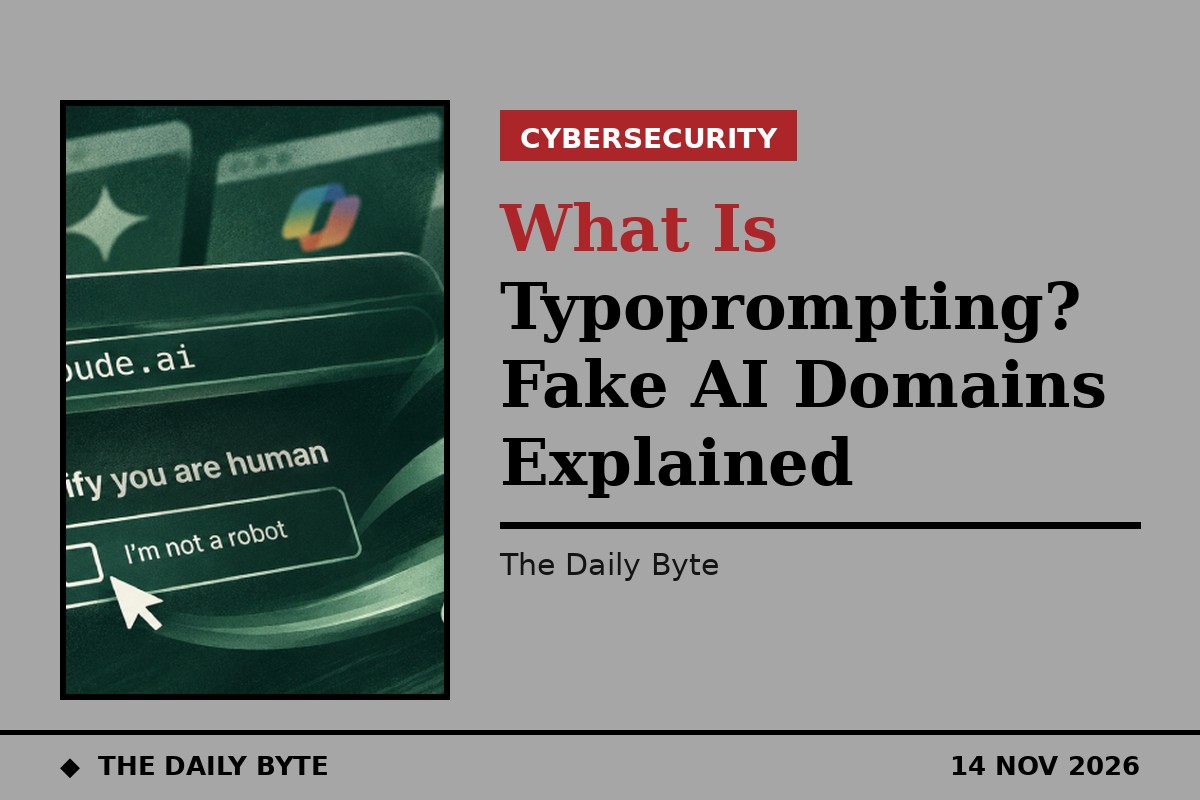
Typoprompting is a cyberattack in which a mistyped web address for a popular artificial intelligence tool leads to malware instead of the service the visitor wanted. Security researchers at Island, who coined the term, traced 186 lookalike domains across 27 AI brands, from Claude and ChatGPT to DeepSeek, Perplexity and Cursor, and found that an ordinary typing slip could end in a fake verification page, a browser hijacker or a search-hijacking extension. The research was published on 12 November 2026, and it matters because AI tools have become part of everyday work: the typo changes the destination, not the task.
The name is a blend of "typo" and "prompting". Island defines it as AI-app lookalikes that turn an attempt to reach a familiar tool into a prompt to verify, install or run something else. Nothing about the attack exploits a flaw in Claude, ChatGPT or any other AI service. It exploits the address bar, the trust people place in a familiar-looking page, and the habit of following on-screen instructions without checking where they came from.
What is typoprompting?
Typoprompting starts with a domain name that is one letter away from a real AI service. Type "cloude.ai" instead of "claude.ai", or "chatlgpt.com" instead of "chatgpt.com", and the browser still loads a page, because somebody else owns that almost-right address. What loads is not an error page. It is a parked domain that hands the visitor to a traffic distribution system, which chooses a destination based on the visitor's location, operating system and browser. One visitor may see a harmless parked page. Another, on a different device or in a different country, is sent towards malware.
The technique is not new in itself. In December 2025, the DNS security firm Infoblox documented how parked domains without a current web page can be monetised by redirecting visitors through profiling and malicious redirect chains. What Island found is that the same plumbing has been aimed squarely at AI tools, at a moment when millions of people type those addresses every day. Some of the lookalike domains are years old: registration records show that "cloude.ai" and "cluade.ai", both typos of Claude, were registered as early as 13 July 2023. That is more than three years of sitting on a typo, waiting for traffic to arrive.
Which AI tools are being imitated?
Island's inventory covers 186 bogus domains spanning 27 AI brands. ChatGPT draws the most lookalikes, with 25, from "chatgpy.com" to "chtgpt.com". Claude follows with 18 and DeepSeek with 16, among them "deepseel.com" and "deeepseek.com". The list also covers Google Gemini and NotebookLM, Microsoft Copilot, Grok, Mistral, Perplexity, Midjourney, ElevenLabs, Lovable and Cursor, as well as creative tools such as Runway, Leonardo, Kling, Hailuo, Suno and the agent platform Manus. Some lookalikes imitate the companies themselves, such as "opnai.com" and "anthropiv.com", for people who type the company name instead of the product.
The mistakes themselves are ordinary. In "clsude.ai", the finger hits S instead of A. In "cluade.ai", two letters swap places. In "caude.ai", the L goes missing. Other typos drop a letter, add one, or spell a name by ear, as in "purplexity.ai" for Perplexity. Each one is a separate address, and none of them belongs to the AI service the visitor meant to reach.
How does a typo become an attack?
What happens after the typo depends on who is visiting. A parking page hands the browser to a traffic distribution system, which picks a destination from the visitor's country, operating system and browser. The chain fingerprints the browser and collects the public IP address before showing anything malicious, so the same typo can look harmless to a security scanner and dangerous to a real user. Island pivoted on the fingerprint gate's script hash and found 550 matching scan records across 211 entry domains between April 2025 and November 2026, after excluding decoy redirects. Those entry domains reach well beyond AI, and include lookalikes of Scotiabank, Charles Schwab, Blue Cross Blue Shield, Verizon, ServiceNow and Microsoft Azure.
Each lure is then fitted to the visitor's platform. Windows visitors are told to run a clipboard command. Mac users see a fake Terminal or security update that asks them to run a command. Others are offered an archive with instructions to extract it and run the executable inside. The three main routes are set out below.
Route one: the ClickFix fake verification page
The best-documented route starts with the Claude typo "cloude.ai". Island followed a scan of that domain through its redirect chain, and it ended on a fake Cloudflare verification page that turns a familiar human check into instructions to run a Windows command. The page registers click and key handlers that copy a command to the clipboard, then walks the visitor through opening the Windows Run dialog, pasting and pressing Enter.
The recovered command uses the Windows curl tool to save a script named W901.ps1 to the temporary folder, then launches it in a hidden PowerShell window with no profile and the execution policy bypassed. The download address is written as a single decimal number, 3112851459, which is the IP address 185.138.88.3 written without dots, so a pattern-based filter looking for a dotted IP address will not catch it. A second scan reached the same command from a different gate subdomain, confirming the route was not a one-off. Other AI lookalikes have delivered malware directly: in October and November 2026, "chatlgpt.com" offered a file called Installer_ChatGPT.zip containing an executable that 9 of 16 MetaDefender engines detect as malicious. Earlier cases include "midj0urney.org", which served a Windows payload attributed to the Aurora stealer in 2023, and "deepsek.icu", which served an Android package attributed to OctoV2 in early 2025.
Route two: fake security checks and the Net Guard hijacker
The second route ends somewhere that looks far more trustworthy. Eight typos of Claude, DeepSeek, Copilot, ElevenLabs and Voice AI, among them "ckaude.ai", "deepceek.com", "copiot.com" and "vocie.ai", led through a redirector to fake "Security Check" pages. The pages delivered an app called Net Guard, sold as a Wi-Fi and DNS safety scanner. The file downloaded from the funnel matches the hash of the Net Guard listing in the Microsoft Store, published by "Myflixly App", and carries Microsoft's own Marketplace signature. Visitors were getting the real Store package, with a browser-control engine inside.
Island's lead security researcher, Oleg Zaytsev, told The Hacker News that the download from the Security Check pages is the Microsoft Store app itself, unmodified, and byte-for-byte identical to Net Guard as Microsoft distributes it. The hidden browser control comes with every copy, whether installed from the Store or from a typo site, and it switches itself on without asking. It waits until the user stops using the computer, then takes over Chrome's search settings and can run scripts inside the browser, following instructions from the operator's server.
Net Guard is a Tauri application built on a module called "buntai-sdk" and driven by remote configuration. Its native code can change the default search engine while the user is idle, using UI Automation and synthetic input in Chrome's settings, with a matching flow for Firefox. It can run remotely supplied JavaScript in the browser through the DevTools Runtime.evaluate function. And it can edit browser profiles and install extensions through Chrome's profile files, PowerShell and the registry. In the code Island analysed, these features are all enabled by default. The welcome screens count down 30 seconds and then submit browser synchronisation as enabled, without mentioning the browser changes. The app runs at startup with full trust and checks for a debugger and for enterprise browser management. Island analysed the Net Guard 1.0.9.0, Privacy Keeper 1.0.10.0 and MyFlixly Browser 1.0.10.0 packages one by one, and its static analysis classifies each as a malicious browser hijacker. The AI typos are only a slice of the installer funnel, which spans 191 related lander domains, about 45 product names and 1,437 source domains across AI tools, banks, insurers and telecoms.
Route three: search-hijacking browser extensions
The third route starts at the Perplexity typo "preplexity.ai". A related-search page passes the browser to an installation page for a Chrome Web Store extension that replaces the default search engine. The extension needs no executable JavaScript and no declared permissions to do its job. Its listing promises Bing search, but its manifest sets the default search provider to "find.flashysearches.com", so every address-bar search passes through a third party first. At work, those searches can include internal hostnames, customer names and project details.
The extension is one of 30 built from the same kit. They use the same minimal search-override template under separate developer accounts, and every listing Island checked is unlisted, so the only way in is an installation page. Since the kit's landing pages were first observed, 13 of the 30 extensions have been removed from the Chrome Web Store. The 17 still listed displayed 972,000 users in total on 3 November 2026, with GPT for Chrome alone showing 80,000 users. Socket documented the same search-hijacking technique at a larger scale in its Searchjacked research on 29 October 2026, and lists 22 of the 30 extensions among its malicious indicators.
Why is typoprompting so hard to spot?
Three features make the pattern unusually hard to defend against. First, the domains are old and the infrastructure is shared, so blocking a single address achieves little. Shared publisher keys and affiliate IDs tie an 81-domain portfolio, including about 23 AI lookalikes, to a single redirector, and three advertising keys replaced one another between March and October 2026 while the source domains stayed the same. Second, the delivery is selective: the traffic distribution system profiles each visitor, so a security scanner may see a parked page while a real user on Windows in a particular country is sent the lure. Third, the most alarming payload arrives with a genuine signature. A Microsoft Store signature means the package came from the Store, not that it is safe, and Island's finding is a reminder that signed software can still carry hidden browser-control code.
The campaign also shows how parked-domain economics and malware delivery overlap. When a domain owner opts into direct search, traffic to the domain is sold to advertisers who bid on keywords and traffic characteristics. In practice, the visitor is funnelled through a series of traffic distribution systems operated by third-party advertising platforms, creating a complex web in which a legitimate business model is weaponised for abuse. That is Infoblox's description of the same plumbing, and it explains why typos registered years ago can suddenly become active attack routes.
How to protect yourself
Island's advice is to give people a direct route to approved AI services rather than leaving the address bar as the test. Publish managed bookmarks or launcher entries for the tools your organisation sanctions, and monitor common lookalikes of those tools and block confirmed harmful destinations. For individual users, the practical rules are simple. Bookmark the AI services you use and open them from the bookmark, not from memory. Check the address bar before signing in or typing anything sensitive, and treat any page that asks you to paste a command into the Run dialog or a terminal as hostile: no legitimate human-verification check ever asks you to do that. Never install an app from a "security check" page, and be wary of browser extensions that change your search engine, especially ones reached through an installation page rather than the Chrome Web Store's own search. If a search engine you did not choose starts handling your address-bar searches, remove the extension, reset the search setting, and check installed programs for anything you do not recognise. At work, report the typo domain to your IT or security team so it can be blocked for everyone else.
Frequently asked questions
What is typoprompting? It is a name coined by the cybersecurity company Island for AI-app lookalike domains that turn an attempt to reach a familiar tool into a prompt to verify, install or run something else. Island traced 186 such domains across 27 AI brands.
Which AI tools are affected? The brands include Claude, ChatGPT, Google Gemini, Microsoft Copilot, Grok, DeepSeek, Mistral, Perplexity, Midjourney, ElevenLabs, Lovable and Cursor. ChatGPT has the most lookalikes, with 25, followed by Claude with 18 and DeepSeek with 16.
What happens if I mistype an AI website address? It depends on your device and location. You may see a parked page, or you may be sent to a fake verification page that tries to get you to run a command, a fake security check that installs the Net Guard browser hijacker, or an installation page for a search-hijacking browser extension.
Is Net Guard really signed by Microsoft? The file delivered through the typo funnel matches the hash of the Net Guard listing in the Microsoft Store and carries Microsoft's Marketplace signature. Island's analysis classifies the package as a malicious browser hijacker despite the signature.
How many people are affected by the search-hijacking extensions? The 17 extensions from the same kit that were still listed in the Chrome Web Store displayed 972,000 declared users in total on 3 November 2026, with GPT for Chrome alone showing 80,000 users.
How can I stay safe? Use bookmarks for AI services, check the address bar before signing in, never paste a command from a verification page into the Run dialog or a terminal, and do not install apps or extensions offered by pages you reached through a typo.
Sources: Island, TypoPrompting: From AI Typos to Malware and The Hacker News, 186 Fake AI Domains Redirect Users to ClickFix Lures, Browser Malware, and Search Hijackers. All facts checked on 14 November 2026.


