What Is UK Digital ID? BritCard Scrapped, Explained
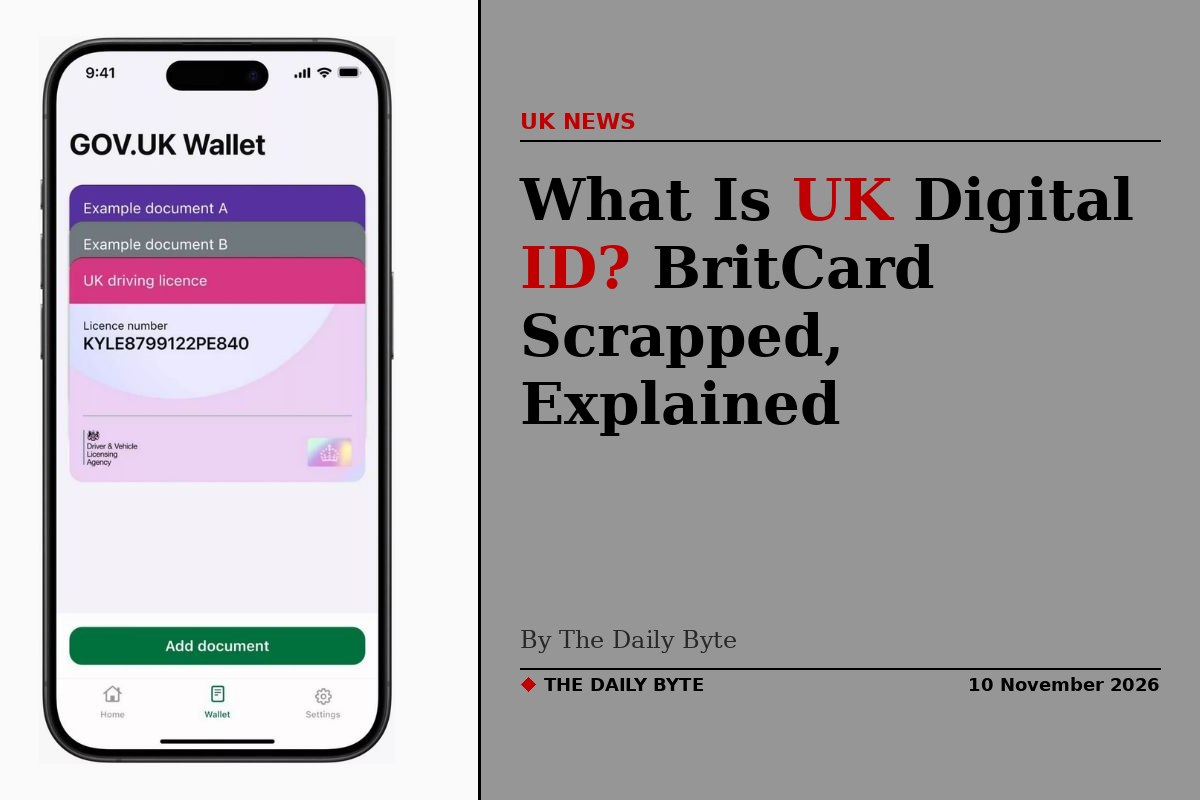
UK digital ID, widely known as BritCard, was a proposed national digital identity credential for adults in the United Kingdom. It was announced in September 2025, softened within months, and then scrapped in July 2026 by the incoming government of Prime Minister Andy Burnham. There is no BritCard to apply for, and no one is required to carry one. What has continued, however, is the digital identity infrastructure around it, including GOV.UK One Login and the GOV.UK Wallet, which is why the question still causes confusion.
This guide explains what BritCard was, what it would have contained, why it was cancelled, what is still going ahead, and what it means for you in practice.
What was UK digital ID, or BritCard?
BritCard was the widely used name for a proposed UK government digital ID scheme announced by Prime Minister Keir Starmer on 25 September 2025. The plan was for a free digital credential, held on a smartphone in a GOV.UK wallet, that adults could use to prove who they are and that they have the right to work in the UK.
The government presented it as a way to strengthen right-to-work checks and to make it harder for people without the right to work to find employment. Ministers also argued that a single digital credential would be more convenient than repeatedly producing paper documents, photocopies and utility bills when proving identity to an employer, a landlord or a public service.
The name BritCard was never the formal name of a finished product. It was the branding used in public discussion of the scheme, and it stuck in news coverage, in Parliament and in online searches. The underlying idea was a government-issued digital credential, rather than a plastic card.
What would BritCard have contained?
As described at the time of the announcement, the credential would have held a person's name, date of birth, nationality or residency status and a photograph for biometric verification. The government said it would use strong encryption and build on GOV.UK One Login and the GOV.UK Wallet.
The first and main use was to be right-to-work checks. The original plan was that, by the end of that Parliament, around 2029, employers would be required to use the digital ID when checking a new hire. The government said people would not be required to carry the ID routinely, and that non-smartphone options would be provided for people who do not use a smartphone.
Later uses were discussed but never fixed in law. Ministers suggested the credential could in time be extended to other checks, such as with landlords, banks, welfare and housing. Because those extensions were never legislated, they remained proposals rather than settled policy, and they ended with the scheme itself.
How was it supposed to work?
The design, as set out in government briefings and in the work of the technology industry body techUK, followed the pattern of a digital wallet. A person would be verified once, using identity documents and a biometric check such as facial recognition. A credential would then be issued to the wallet on their phone. When an employer or another organisation needed proof, the person would share only the fact that was needed, for example that they are over 18 or that they have the right to work, rather than handing over a full document with a name, address and document number.
That idea is known as selective disclosure. It is a standard feature of modern digital identity systems, and it was one of the arguments made in favour of the scheme: a digital check can in principle reveal less personal information than showing a driving licence or passport. Critics, including cybersecurity specialists, argued the other way, warning that a single national identity system would become a large target for hackers and that the safeguards, governance and breach-response plans had not been published in enough detail.
What changed before it was scrapped?
The compulsory element did not survive long. Within months of the announcement, ministers dropped the idea that every adult would have to hold the credential, and said the scheme would be voluntary. In January 2026 the government confirmed that other forms of identification would also be accepted to prove the right to work, and that right-to-work checks would still move online by 2029.
The scheme also faced sustained public and parliamentary opposition. A parliamentary petition against digital ID cards attracted nearly three million signatures. The Home Affairs Committee later concluded that the original announcement had been rushed and poorly thought through and had damaged public confidence. The cost was also contested. In November 2025 the Office for Budget Responsibility estimated that introducing a national digital ID would cost about £1.8 billion between 2026-27 and 2028-29.
When and why was it scrapped?
On 18 July 2026, Andy Burnham, on becoming Prime Minister, pledged to scrap the digital ID scheme as one of his first major policy decisions, saying he wanted to focus resources on helping with the cost of living. The government announced the cancellation on 21 July 2026, and the House of Commons Library confirmed in a briefing published on 4 September 2026 that the government had cancelled plans for a national digital ID scheme.
The official announcement put the projected cost at £1.8 billion over three years, and said the money earmarked for the programme would be redirected towards reducing household electricity costs. That link to energy bills was later reflected in the Autumn Budget, which extended the temporary cut in VAT on household electricity.
It is important to be precise about what was cancelled. The government cancelled the proposed national credential itself: the single, government-issued digital ID that would have been mandatory for right-to-work checks. It did not cancel the separate systems that the credential would have sat alongside, and it did not repeal the digital identity provisions in the Data (Use and Access) Act 2025.
What is still going ahead?
Several related programmes are continuing, and they are the reason many people still encounter the phrase digital ID in 2026.
- GOV.UK One Login. The single sign-on and identity verification system for government services. It is now used by more than 23 million people across more than 120 government services, and figures given to a Public Accounts Committee hearing in October 2026 put it at 264 services, with about 500 planned within two years.
- GOV.UK Wallet. The government app that holds digital credentials. A digital driving licence is being piloted in the wallet, with further testing planned for December and a national rollout targeted for 2027.
- Digital proof of age. From 15 September 2026, pubs, bars, restaurants, music venues and shops in England and Wales can accept digital proof that a customer is over 18, provided it comes through a service certified under the government's trust framework and listed on its statutory register.
- Digital Verification Services. The trust framework and register through which private companies can be certified to check identity digitally. More than 80 types of document are earmarked for the government wallet, including proof of benefits, driving test certificates and Disclosure and Barring Service certificates.
- UK CertifID. The government-owned trust mark that qualifying digital identity and verification services can display. It existed before the cancellation and is not the cancelled national credential under another name.
The House of Commons Library briefing of 4 September 2026 states explicitly that One Login and GOV.UK Wallet are separate from the cancelled national digital ID scheme, and that there is no indication their development has been affected.
What does the scrapping mean for you?
For most people, the practical effect is straightforward. You do not need to apply for a BritCard, download a new national ID app, or carry a digital ID. Employers still have to carry out right-to-work checks, but they do so using the existing documents and online checks, not a national digital ID credential.
If you already use GOV.UK One Login to access a government service, that continues unchanged. If you are offered a digital driving licence in the GOV.UK Wallet when the rollout reaches you, that is a separate credential, not a revival of BritCard. If a pub or shop asks for proof of age, it may accept a certified digital proof, but it is not required to, and a physical driving licence or passport remains accepted.
People without a smartphone are not excluded from government services by the cancellation, because no national digital ID is required to use them. The government has said non-smartphone options would be expected for any future digital identity service, but no new national scheme has been announced to replace BritCard.
What were the main arguments for and against it?
Supporters of the original scheme argued that digital right-to-work checks would be harder to forge than paper documents, would make illegal working more difficult, and would save time for employers and jobseekers. They also argued that a wallet-based credential, with selective disclosure, could reduce the amount of personal data shared in everyday checks.
Opponents argued that a national identity database would create a single point of failure and an attractive target for cyberattacks, that the cost was not justified, and that the public had not been consulted properly before the announcement. Privacy campaigners, including Big Brother Watch, welcomed the cancellation but warned that the continuing growth of One Login, the wallet and private verification services still needed clear governance, accountability and limits on data sharing.
Both sides of that debate continue. The difference now is that the debate is about the infrastructure that remains, rather than about a compulsory national card.
Frequently asked questions
Is UK digital ID compulsory? No. The national digital ID scheme was cancelled in July 2026. There is no requirement to hold a BritCard, and no law makes a national digital ID compulsory.
Do I need to apply for a BritCard? No. There is no application process, because the scheme was scrapped before it was launched. Anyone asking you to pay to apply for a BritCard is not acting for the government.
Will my employer still check my right to work? Yes. Right-to-work checks continue, using existing documents and online checks. The cancellation changed the proposed future method, not the existing legal duty on employers.
What is GOV.UK One Login? It is the government's single sign-on system for accessing public services online. It is separate from the cancelled BritCard scheme and continues to operate, with more than 23 million users.
What is the GOV.UK Wallet? It is the government app that stores digital credentials, such as a digital driving licence when that rollout reaches you. It is not a national ID card, and holding a credential in the wallet is not the same as holding BritCard.
Can I prove my age with my phone in a pub? In England and Wales, from 15 September 2026, licensed premises can accept digital proof of age through a certified service listed on the government's register. A physical document is still accepted, and a business is not obliged to accept a digital proof.
Sources: BBC News, Digital ID plan to be scrapped, 18 July 2026; Institute for Government, Digital ID cards explainer; State of Surveillance, UK scrapped its digital ID card, 2 November 2026.