What Is the UK State Pension Triple Lock?
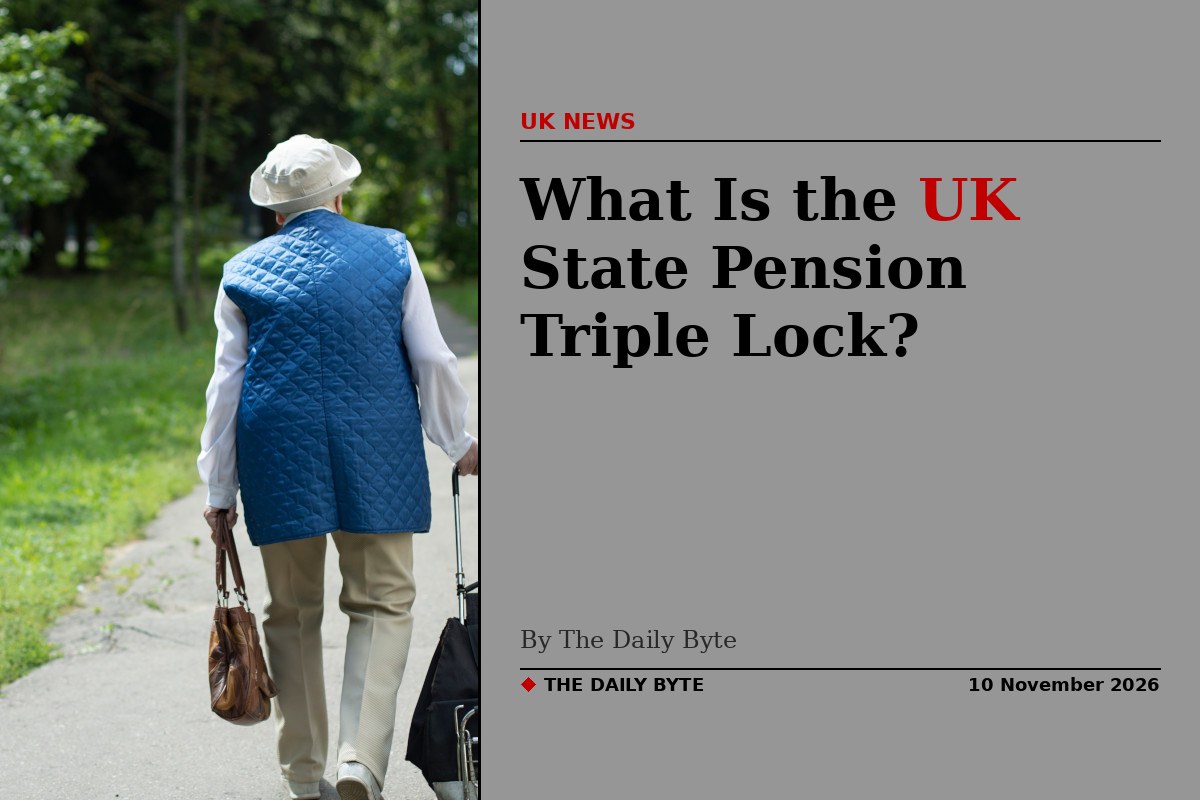
The triple lock is the rule that decides how much the UK State Pension goes up every April. It is one of the most searched questions in British personal finance, and it matters to more than 12 million pensioners. In simple terms, the government promises that the State Pension will rise each year by whichever is highest out of three measures: average earnings growth, inflation, or 2.5 per cent.
That promise has shaped retirement incomes for a decade and a half. It has also become one of the most expensive commitments in the public finances, and it is regularly debated in Parliament, in the Budget and in the press. This guide explains what the triple lock is, how the yearly figure is worked out, what pensioners are actually paid in 2026-27, and what is set to change in April 2027 and beyond.
What is the triple lock?
The triple lock is the government's policy for uprating the State Pension. Each year, the pension rises by the highest of three figures: growth in average earnings, the rate of inflation measured by the Consumer Prices Index (CPI), or a fixed minimum of 2.5 per cent. Because the highest of the three always wins, the State Pension can never fall behind both wages and prices in the same year, and in a year when both are low the 2.5 per cent floor still guarantees a rise.
The policy was introduced in 2011 by the coalition government. Before that, the State Pension was generally linked only to prices, which meant that over long periods it tended to fall behind what workers were earning. The triple lock was designed to stop that slow erosion and to protect pensioners' living standards in real terms.
It is important to be clear about what the triple lock is not. It is a policy commitment rather than a legal guarantee. Governments have kept it in place, and the current Labour government has confirmed it will be maintained for this Parliament, but a future government could change it. That is exactly what the Budget in October 2026 began to do for the years after 2029, as explained below.
The three measures explained
Average earnings growth. This is the annual growth in average weekly earnings across the UK economy, measured over the three months from May to July in the year before the April uprating. The figure comes from the Office for National Statistics (ONS) labour market release, published each September. It is based on total pay, including bonuses, and it is seasonally adjusted. For the April 2026 uprating, the relevant earnings figure was growth of 4.8 per cent in the year to May-July 2025.
CPI inflation. This is the year-on-year rate of Consumer Prices Index inflation for September in the year before the uprating. The September CPI figure is published by the ONS in October. For the April 2026 uprating, CPI inflation in the year to September 2025 was 3.8 per cent.
The 2.5 per cent floor. If both earnings growth and inflation come in below 2.5 per cent, the State Pension still rises by 2.5 per cent. The floor is the part of the lock that protects pensioners in years of weak wage growth and low inflation.
The government compares the three numbers, takes the highest, and applies that percentage to the State Pension from the following April. The decision is confirmed formally in the autumn, usually around the Budget, after the September CPI figure is known.
What the triple lock is worth in 2026-27
For the April 2026 uprating, earnings growth of 4.8 per cent was the highest of the three measures, ahead of CPI inflation at 3.8 per cent and the 2.5 per cent floor. The 4.8 per cent rise was confirmed by the Secretary of State for Work and Pensions, Pat McFadden, in a written statement to Parliament on 26 November 2025, following the statutory annual review of State Pension and benefit rates.
From 6 April 2026, the full rate of the new State Pension is £241.30 a week, or £12,547.60 over a full year. That is an increase of £11.05 a week, or around £575 a year, on the 2025-26 rate of £230.25 a week. The full rate of the basic State Pension is £184.90 a week, or £9,614.80 a year, up from £176.45 a week — an increase of around £440 a year.
The previous April, in 2025, the State Pension rose by 4.1 per cent, again driven by earnings growth. The 2026 rise of 4.8 per cent was the largest in three years. Other State Pension and benefit rates covered by the same annual review rose by 3.8 per cent, in line with CPI inflation, because the triple lock applies only to the basic and new State Pensions.
Who gets the triple lock — and who does not
The triple lock applies to the basic State Pension, paid to people who reached State Pension age before 6 April 2016, and to the new State Pension, paid to people who reached State Pension age on or after that date. It does not apply to the additional State Pension, which includes elements built up under the old SERPS and State Second Pension schemes, or to any protected payment above the full new State Pension rate. Those elements are generally uprated by CPI inflation only.
How much a person actually receives depends on their National Insurance record. To get the full new State Pension, a person needs 35 qualifying years of National Insurance contributions or credits. Someone with fewer than 35 years gets a proportionate amount, and someone with fewer than 10 qualifying years gets nothing under the new State Pension rules. People who reached State Pension age before April 2016 are under the older system, where the number of qualifying years needed for the full basic State Pension is 30 for men born on or after 6 April 1945 and women born on or after 6 April 1950.
The State Pension age itself is rising from 66 to 67 between 2026 and 2028, affecting people born after April 1960. The quickest way to find out what you will actually get, and when, is the Check your State Pension forecast service on GOV.UK, which shows your forecast, your National Insurance record and whether you have gaps you could fill.
What happens in April 2027
The triple lock cycle for April 2027 is already under way. The earnings figure landed first: on 15 September 2026 the ONS published average weekly earnings growth of 3.9 per cent for May to July 2026. The September 2026 CPI figure followed on 21 October 2026. Once all three numbers exist, the outcome is simple arithmetic — the highest of the three sets the rise.
HM Treasury's Budget documents, published on 28 October 2026, put the full new State Pension at £13,036.40 a year for 2027-28, which works out at about £250.70 a week. That figure reflects the 3.9 per cent earnings rise. The Department for Work and Pensions had not published the final weekly rates when the Budget documents appeared, so the weekly figure may differ by a few pence once DWP confirms the rounded rate.
There is a tax point worth noting. The personal allowance — the amount of income a person can receive before paying income tax — is frozen at £12,570 until 2031. The full new State Pension alone, at £13,036.40 a year, would exceed that allowance from April 2027, which means some pensioners whose State Pension is their only income could face income tax on part of it.
The Budget 2026 changes: triple lock kept, then adjusted
Budget 2026, delivered on 28 October 2026, kept the triple lock up to and including the April 2029 uprating. From April 2030, an adjusted lock will apply: the State Pension will rise by the highest of 2.5 per cent, inflation, or the amount needed to keep the pension's value relative to earnings at its April 2029 level. In practice, that is designed to stop the pension ratcheting ever further ahead of earnings over the long term, while still protecting it against inflation.
The change matters because the triple lock is expensive. The Office for Budget Responsibility has projected that maintaining it will add around £15.5 billion a year to costs by 2029-30, and State Pension spending was already around £138 billion in 2024-25 — the second-largest item in the UK budget after health. Supporters say the cost is the price of keeping pensioners out of poverty; critics say the mechanism is unpredictable and unaffordable as the population ages. Both sides of that argument are likely to be heard again before the adjusted lock takes effect.
Has the triple lock ever been suspended?
Yes, once. In 2022-23 the earnings element was temporarily suspended because the earnings data was distorted by the Covid-19 pandemic, when furlough and the return to work produced an unusually large jump in measured wage growth. That year the State Pension rose by 3.1 per cent, in line with CPI inflation, instead of the much higher earnings figure. The suspension was presented as a one-off, and the full triple lock was restored the following year.
How to check your own State Pension
Anyone can check their own position in a few minutes. The GOV.UK Check your State Pension service shows your forecast, your State Pension age, and your National Insurance record, including any gaps. Voluntary National Insurance contributions can sometimes fill gaps and increase the amount you will receive, but the rules and deadlines are specific to each person's record, so it is worth checking the official guidance or speaking to the Future Pension Centre before paying anything. Rates and rules change, so always confirm the current figures on GOV.UK before making a decision based on them.
The triple lock, in the end, is a simple idea with large consequences: whichever is highest — wages, prices or 2.5 per cent — is what pensioners get. For April 2026 that meant 4.8 per cent and a full new State Pension of £241.30 a week. For April 2027 the Treasury's figures point to about £250.70 a week. And from 2030, the lock itself will change, which is why the question of what the triple lock is will keep being asked for years to come.