What Is ULEZ? London Rules, Charges and Who Pays
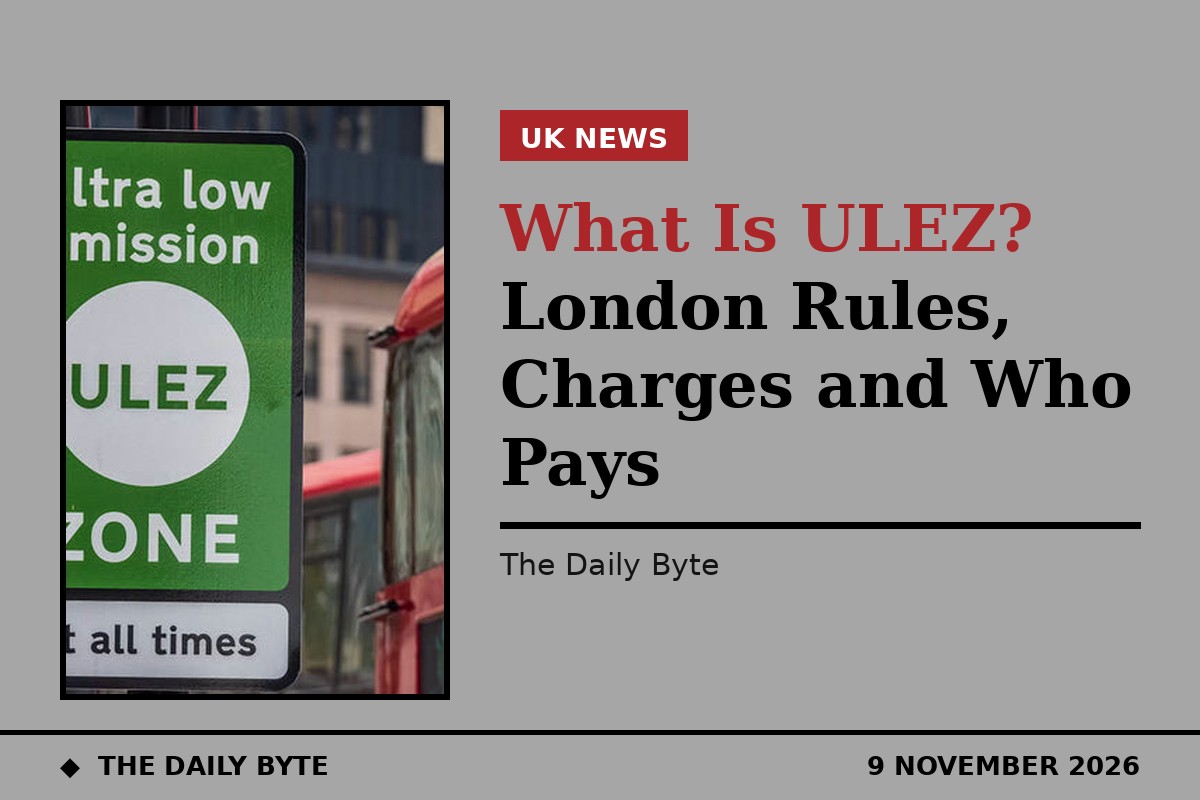
ULEZ stands for Ultra Low Emission Zone. It is a London-wide charging scheme run by Transport for London (TfL) that charges the drivers of older, more polluting vehicles £12.50 a day to drive anywhere in Greater London. If your car meets the emissions standard, you pay nothing. If it does not, you pay for every day you drive inside the zone.
The zone now covers all 32 London boroughs and the City of London, right out to the edge of Greater London. The M25 motorway itself is outside the zone, even where it clips the boundary. The scheme operates 24 hours a day, every day of the year except Christmas Day, and it is enforced by automatic number plate recognition cameras. There is nothing to display in your windscreen: the cameras read your number plate and check it against the emissions standard for your vehicle.
Where does ULEZ apply?
ULEZ began in central London in April 2019, covering the same area as the Congestion Charge zone. It expanded in October 2021 out to the North and South Circular roads, and then expanded again on 29 August 2023 to cover every London borough. The boundary has not moved since that 2023 expansion, and it covers roughly 1,500 square kilometres.
That means a non-compliant car driven on any road inside Greater London owes the charge for that day, whether the journey is in central London or in an outer borough such as Croydon, Enfield, Bromley or Harrow. Roads leading off the M25 into Greater London can fall inside the zone immediately, so drivers coming in from Surrey, Kent, Essex or Hertfordshire should check before they travel. TfL provides an online map and a postcode checker for exactly that purpose.
A vehicle that stays parked inside the zone and is not driven does not incur the charge for that day. The charge applies only on days the vehicle is actually driven within the zone, and the charging day runs from midnight to midnight, so a journey that crosses midnight counts as two days.
Which vehicles have to pay?
Whether you pay depends on your vehicle's emissions standard, not its age or its value. TfL judges each vehicle on its declared emissions, so some older cars comply and some newer ones do not. As a general guide, a petrol car needs to meet the Euro 4 standard, which generally means cars registered from 2006 onwards, while a diesel car needs to meet the stricter Euro 6 standard, which generally means diesels registered from September 2015 onwards. Motorcycles need to meet the Euro 3 standard.
The charge applies to cars, motorcycles, vans and specialist vehicles up to and including 3.5 tonnes, and minibuses up to and including 5 tonnes. Heavier vehicles, including lorries, buses and coaches, fall under London's separate Low Emission Zone (LEZ) instead, which has its own standards and charges.
Fully electric cars produce no exhaust emissions, so they meet the ULEZ standard and do not pay the charge. The same is true of most other zero-emission vehicles. City Hall has said that around 97 per cent of vehicles seen driving in London now meet the ULEZ standard, which means only a small minority of drivers are actually liable for the daily charge.
How much does ULEZ cost?
The standard ULEZ charge is £12.50 a day for a non-compliant vehicle. You pay it only for days you drive inside the zone. A compliant vehicle pays nothing for ULEZ, however often it is driven in London.
You can pay up to 90 days in advance, or by midnight on the third day after your journey. Payment is made through TfL's website, the free TfL Pay to Drive in London app, or by phone on 0343 222 2222. Drivers who use the zone regularly can register for Auto Pay, which bills them monthly so a payment cannot be forgotten. TfL warns drivers to pay only through its own channels, because copycat websites charge extra for the same service.
If you do not pay by the deadline, TfL can issue a Penalty Charge Notice of £180, reduced to £90 if it is paid within 14 days. A penalty can also follow if you pay for the wrong number plate or the wrong date, so it is worth double-checking both before you confirm a payment.
Exemptions and discounts
Some vehicles are exempt from the charge altogether. Historic vehicles, vehicles in the disabled tax class and certain specialist vehicles are among those that do not have to pay, although the rules differ by category. Vehicles registered in the disabled or disabled passenger vehicle tax class are exempt until 24 October 2027.
London's scrappage scheme, which paid grants to help drivers replace non-compliant vehicles, closed to new applications in September 2024. TfL and City Hall have said the scheme paid out more than £180 million in grants to almost 54,000 successful applicants before it closed.
There is no general discount on the ULEZ charge itself, and TfL has said it is committed to not increasing the £12.50 daily rate. Blue Badge holders are not automatically exempt: exemption depends on the vehicle's tax class, not on the badge.
ULEZ, the Congestion Charge and the LEZ: what is the difference?
London has several overlapping road charges, and they are easy to confuse. ULEZ covers all of Greater London and targets exhaust emissions; it applies only to vehicles that fail the emissions standard, and it runs 24 hours a day except Christmas Day.
The Congestion Charge is a separate scheme covering central London only. It applies to almost every vehicle, including electric cars, during charging hours: 7am to 6pm on weekdays and noon to 6pm at weekends and on bank holidays. From 2 January 2026 the Congestion Charge rose to £18 a day when paid on the day or in advance, or £21 if paid within three days after travel. The old 100 per cent Cleaner Vehicle Discount ended on 25 December 2025, so electric cars no longer drive free through central London, although they can receive a 25 per cent discount when registered for Auto Pay, bringing the daily charge down to £13.50.
The Low Emission Zone covers the same Greater London footprint as ULEZ but applies to heavier vehicles, such as lorries, buses and coaches, which must meet the Euro VI standard or pay a daily LEZ charge. Ordinary cars are outside the scope of the LEZ.
Because the schemes are separate, a non-compliant car driven in the central zone on a weekday can be liable for both charges on the same day: £12.50 for ULEZ plus £18 for the Congestion Charge, a total of £30.50. Drivers should also be aware of the charges for the Blackwall and Silvertown tunnels, which apply between 6am and 10pm.
How to check if your car is ULEZ compliant
The quickest way to check is TfL's own vehicle checker, which takes your registration number and tells you whether your vehicle meets the ULEZ standard and which other charges may apply. Do not guess from the year of registration alone, because compliance depends on the vehicle's declared emissions and some older cars do meet the standard.
The checker is free and is the only official source for a definitive answer. Third-party checkers can give a useful indication, but TfL's checker is the one that reflects the enforcement data. If you are buying a used car to drive in London, running its registration through the checker before you buy can save an unpleasant surprise.
Why was ULEZ introduced?
ULEZ was first proposed in 2015 under the then Mayor of London, Boris Johnson, with the aim of improving air quality in the capital and cutting the number of older, more polluting vehicles on London's roads. Road transport is a major source of nitrogen dioxide and particulate pollution, and London has repeatedly breached legal air quality limits.
The scheme was launched by Mayor Sadiq Khan in April 2019 and expanded twice, most recently to the whole of Greater London in August 2023. Supporters point to the high compliance rate and to falls in polluting traffic as evidence that it is working. Critics have argued that the charge falls hardest on drivers who cannot afford a newer car, a concern the scrappage scheme was designed to soften. The debate continues, but the rules themselves are settled: the zone is London-wide, the charge is £12.50 a day, and the standard is Euro 4 for petrol and Euro 6 for diesel.
What to do if you receive a penalty
If you receive a Penalty Charge Notice, check the date, the number plate and the vehicle details on it before you pay. If the details are wrong, or if you believe the vehicle was compliant or the charge was paid on time, you can challenge the notice through the process set out on the TfL website. Paying the reduced £90 amount within 14 days closes the matter at the lower rate, but if you want to challenge the penalty you should follow TfL's representations procedure and keep copies of any payment confirmations.
The most common mistakes are paying for the wrong date, paying for the wrong vehicle, and assuming that a car is compliant because it is relatively new. A two-minute check on TfL's vehicle checker before a journey is the simplest way to avoid all three. As with any charge, the official TfL pages carry the current rules, and drivers should check them before travelling because rates and discounts can change.