What Is Unfair Dismissal in the UK? Explained
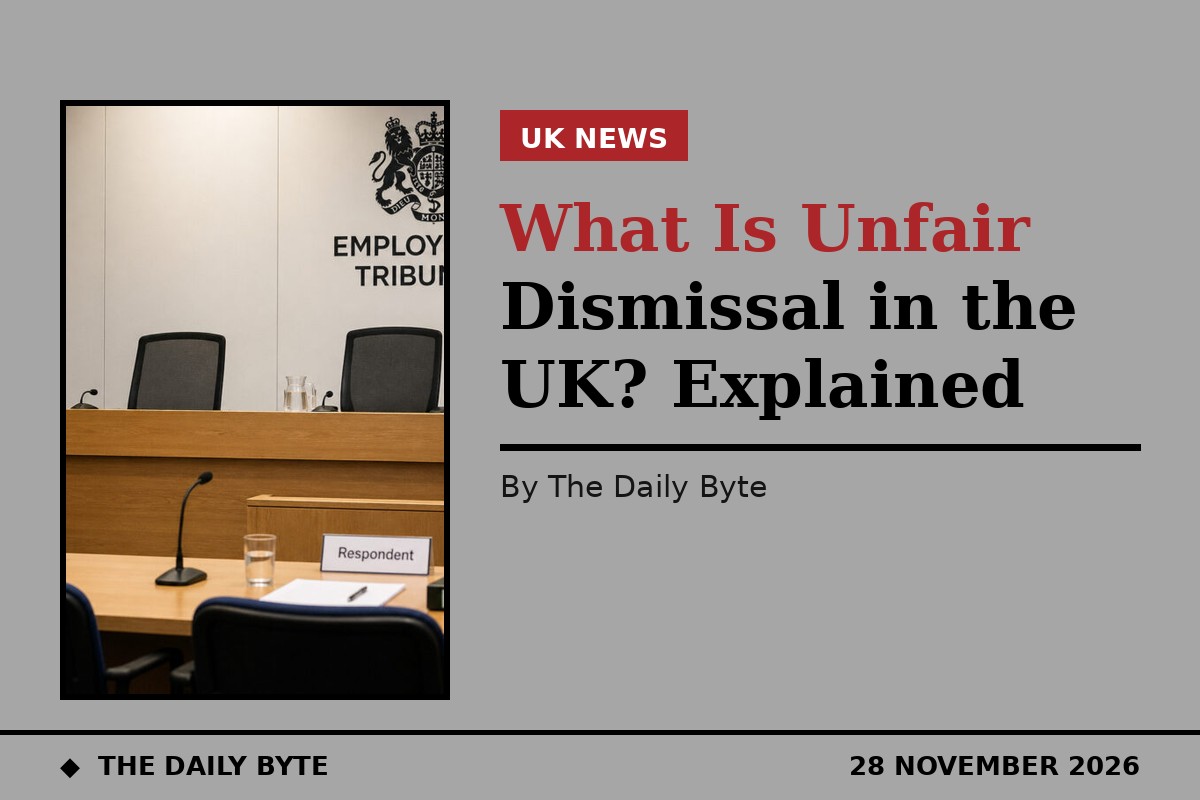
Unfair dismissal is when an employer ends an employee's employment without a fair reason, without following a fair procedure, or both. In the UK, most employees currently need two years of continuous employment with the same employer before they can claim ordinary unfair dismissal at an employment tribunal. That qualifying period falls to six months from 1 January 2027 under the Employment Rights Act 2025, and some dismissals — for example for whistleblowing or pregnancy — are automatically unfair from day one, with no qualifying period at all.
This guide explains what counts as unfair dismissal, the five reasons the law accepts as potentially fair, what a fair procedure looks like, who can claim, how much compensation is available, and the deadlines for bringing a claim. The law described here applies in England, Scotland and Wales; Northern Ireland has separate legislation.
What counts as unfair dismissal?
Unfair dismissal is a statutory right under Part 10 of the Employment Rights Act 1996. It is different from wrongful dismissal, which is about an employer breaking the contract — for example by not giving the notice the contract requires. A dismissal can be unfair even if the employer paid the right notice, if the reason was not fair or the procedure was not fair.
For a dismissal to be fair, the employer must be able to do two things. First, it must show that the reason for the dismissal falls into one of the five potentially fair reasons set out in section 98 of the Employment Rights Act 1996. Second, it must show that it acted reasonably in treating that reason as a good enough reason to dismiss, which includes following a fair procedure. If either part fails, the tribunal can find the dismissal unfair.
Unfair dismissal protection applies to employees. It does not generally cover workers, agency workers or genuinely self-employed people, who have different rights. The government's factsheet on the Employment Rights Act 2025 confirms that protection against unfair dismissal applies only to employees and that this will continue to be the case.
The five fair reasons for dismissal
The law recognises only five potentially fair reasons for dismissal. If the employer's reason does not fit one of these, the dismissal is very likely to be unfair. Having a fair reason is necessary but not enough on its own: the employer must also follow a fair procedure.
| Fair reason | What it covers | Examples |
|---|---|---|
| Capability or qualifications | The employee cannot do the job to the required standard, or lacks the skills or qualifications the role needs | Poor performance, long-term ill health, loss of a required qualification |
| Conduct | Misconduct by the employee | Repeated minor breaches of rules, or a single act of gross misconduct |
| Redundancy | The job genuinely ceases to exist, or the need for employees to do that work diminishes | A workplace closes, or a role is no longer needed |
| Statutory restriction | Continuing to employ the person would break the law | A delivery driver loses their driving licence; an employee loses the right to work in the UK |
| Some other substantial reason | A genuine business reason that does not fit the other four | A business reorganisation, or the end of a fixed-term contract such as maternity cover |
For capability dismissals, the employer will usually be expected to have set clear standards, given warnings and support, and allowed a reasonable opportunity to improve. For conduct dismissals, it will usually need to have investigated the facts properly and followed a fair disciplinary process. For redundancy, it will usually need to have warned and consulted staff, used a fair selection process and considered suitable alternative work.
What is a fair procedure?
Even with a fair reason, a dismissal can be unfair if the procedure was not fair. The Acas Code of Practice on disciplinary and grievance procedures sets the minimum standard employers are expected to follow in conduct and capability cases, and a tribunal can increase an award by up to 25% where an employer has unreasonably failed to follow the Code.
A fair procedure will normally include a proper investigation into the facts, telling the employee what the problem is, giving them a chance to respond at a hearing, allowing them to be accompanied by a colleague or trade union representative, making a decision based on the evidence, and offering a right of appeal. For performance cases, that usually means warnings and a chance to improve first. The exact steps depend on the circumstances, but an employer that dismisses on the spot without any investigation or hearing is taking a serious risk.
Employees are also entitled to statutory minimum notice under section 86 of the Employment Rights Act 1996: one week's notice after one month of employment, one week for each complete year of service between two and twelve years, and twelve weeks after twelve years or more. A contract can give more notice than this, but not less.
Who can claim? The two-year rule — and the 2027 change
Most employees currently need at least two years of continuous employment with the same employer, ending on the effective date of termination, to bring an ordinary unfair dismissal claim. If you have worked for your employer for less than two years, you can still be dismissed, and you can still challenge the dismissal on other grounds — for example discrimination or an automatically unfair reason — but you cannot usually bring an ordinary unfair dismissal claim.
That is about to change. Section 25 of the Employment Rights Act 2025 reduces the qualifying period for ordinary unfair dismissal from two years to six months. The government intends to bring that change into force on 1 January 2027, and from that date it will protect employees who already have six months' service immediately, with others gaining protection as soon as they reach six months. The Act also removes the government's power to change the qualifying period again without primary legislation.
| Now (until 31 December 2026) | From 1 January 2027 | |
|---|---|---|
| Qualifying period for ordinary unfair dismissal | Two years' continuous employment | Six months' continuous employment |
| Right to request written reasons for dismissal | Two years (except in pregnancy, maternity or adoption leave) | Six months |
| Dismissal for a spent conviction | Qualifying period applies | No qualifying period |
| Cap on compensatory awards | Lower of £123,543 or 52 weeks' gross pay (from 6 April 2026) | Cap removed entirely |
About 6.3 million employees — 22% of all employed people aged 16 and over — have been working for their current employer for between six months and two years, so they currently have only very limited protection against unfair dismissal. Those are the people the change will affect most directly. The government has said the six-month period, rather than day-one protection, was agreed with business groups and trade unions as a workable deal, and that it keeps employers able to assess whether a new recruit is a good fit during their first months.
What is automatically unfair dismissal?
Some dismissals are treated as automatically unfair. That means the reason itself makes the dismissal unlawful, whatever the procedure was, and there is no minimum length of service — the protection applies from day one. The Employment Rights Act 2025 does not change these existing day-one protections.
A dismissal is automatically unfair if the main reason is connected to one of the following:
- Pregnancy, maternity, paternity, adoption or shared parental leave, or time off for dependants.
- Whistleblowing — making a protected disclosure about wrongdoing, such as fraud, a legal breach or a danger to health and safety.
- Trade union membership or non-membership, or taking part in lawful industrial action.
- Raising a genuine health and safety concern, or refusing to work in serious and imminent danger.
- Asserting a statutory right, such as asking for the national minimum wage, paid holiday or written terms of employment.
- Jury service.
- A business transfer protected under TUPE.
- A spent conviction, once the qualifying period for that protection is removed under the Employment Rights Act 2025.
Dismissal because of a protected characteristic — age, disability, sex, race, religion or belief, sexual orientation and others — can also amount to unlawful discrimination under the Equality Act 2010, which is a separate day-one right with no cap on compensation. Employees dismissed for whistleblowing, trade union activity, health and safety representative duties, or acting as an employee representative or pension trustee can also apply for interim relief within seven days of dismissal, which can mean the employer must keep paying them until the tribunal decides the case.
How much compensation can you get?
If an unfair dismissal claim succeeds, the tribunal can order reinstatement or re-engagement, although in practice most successful claims end in compensation. Compensation is made up of two parts: a basic award, calculated by a set formula based on age, length of service and a week's pay, and a compensatory award for the financial loss caused by the dismissal, such as lost earnings.
For dismissals taking effect between 6 April and 31 December 2026, the compensatory award is capped at the lower of £123,543 or 52 weeks' gross pay. From 1 January 2027, that cap is removed entirely, so compensation for ordinary unfair dismissal will no longer have a statutory ceiling. The basic award is not affected by the cap.
In practice, few awards reach the cap. In 2023 to 2024, there were 646 compensatory awards for unfair dismissal in employment tribunals, and the median award was £6,746. A tribunal can also reduce an award if it finds the employee contributed to their own dismissal, and it can increase an award by up to 25% if the employer unreasonably failed to follow the Acas Code.
How do you make a claim?
Before you can bring an unfair dismissal claim to an employment tribunal, you must notify Acas and go through early conciliation. Acas will try to help you and your employer reach an agreement without a hearing. You cannot start a tribunal claim until you have done this, and the early conciliation process pauses the time limit for claiming.
The time limit matters, and it changed recently. If your effective date of termination is on or after 1 October 2026, you generally have six months less one day from that date to start your claim. If your employment ended before 1 October 2026, the old limit of three months less one day applies. Missing the deadline usually means losing the right to claim, so anyone who thinks they have been unfairly dismissed should contact Acas promptly rather than waiting.
When the tribunal receives your claim, your employer must respond, normally within 28 days. Many claims are settled before a hearing, either through Acas conciliation or a settlement agreement. If the case does go to a hearing, it is heard by an employment judge, sometimes with two lay members, and both sides can give evidence and be questioned.
Does it apply in Northern Ireland?
No — not in the same way. Northern Ireland has separate employment legislation, and the Employment Rights Act 2025 reforms described above do not apply there. According to GOV.UK guidance, the qualifying period for ordinary unfair dismissal in Northern Ireland is normally one year. Anyone working in Northern Ireland should check the rules that apply there rather than relying on the England, Scotland and Wales position.
Frequently asked questions
Can I be sacked in my first two years for no reason?
Your employer can end your employment in the first two years, but not for an automatically unfair reason or for a discriminatory reason, which are unlawful from day one. From 1 January 2027, employees with six months' service will be able to claim ordinary unfair dismissal. Even before that, you can still challenge a dismissal if it was discriminatory or automatically unfair.
What if I resigned because my employer treated me badly?
If you resigned because your employer's conduct left you with no real choice — for example a serious breach of your contract — you may be able to claim constructive dismissal. The same qualifying periods and time limits apply, and the claim must be brought through Acas early conciliation first. Take advice quickly, because the deadline runs from your last day of employment.
Do I need a solicitor to claim unfair dismissal?
No. You can bring a claim yourself, and many people do. Acas early conciliation is free, and you can get free advice from Acas, Citizens Advice or a trade union if you are a member. A solicitor or employment adviser can help if the case is complex or the amount at stake is large.
What is the difference between unfair dismissal and redundancy?
Redundancy is one of the five potentially fair reasons for dismissal, but a redundancy dismissal can still be unfair if the employer chose the wrong selection criteria, failed to consult, or did not consider suitable alternative work. Being made redundant is not automatically unfair; being made redundant unfairly is.
How long does an unfair dismissal claim take?
It varies. Early conciliation with Acas usually takes up to six weeks. If the case goes to a tribunal hearing, it can take many months, and employment tribunal waiting times have grown as new claims have risen. Many claims settle before a hearing.
Will the 2027 changes help me if I was dismissed in 2026?
The six-month qualifying period applies where the effective date of termination falls on or after 1 January 2027. If you were dismissed before that date, the two-year rule applies to your claim, although the longer six-month time limit applies if your dismissal took effect on or after 1 October 2026.
Sources: GOV.UK — Unfair dismissal factsheet, Employment Rights Act 2025 and AD Solicitors — How employers can dismiss an employee fairly. This guide is general information about the law in England, Scotland and Wales, not legal advice.


