What Is UNICEF? Children's Fund Explained
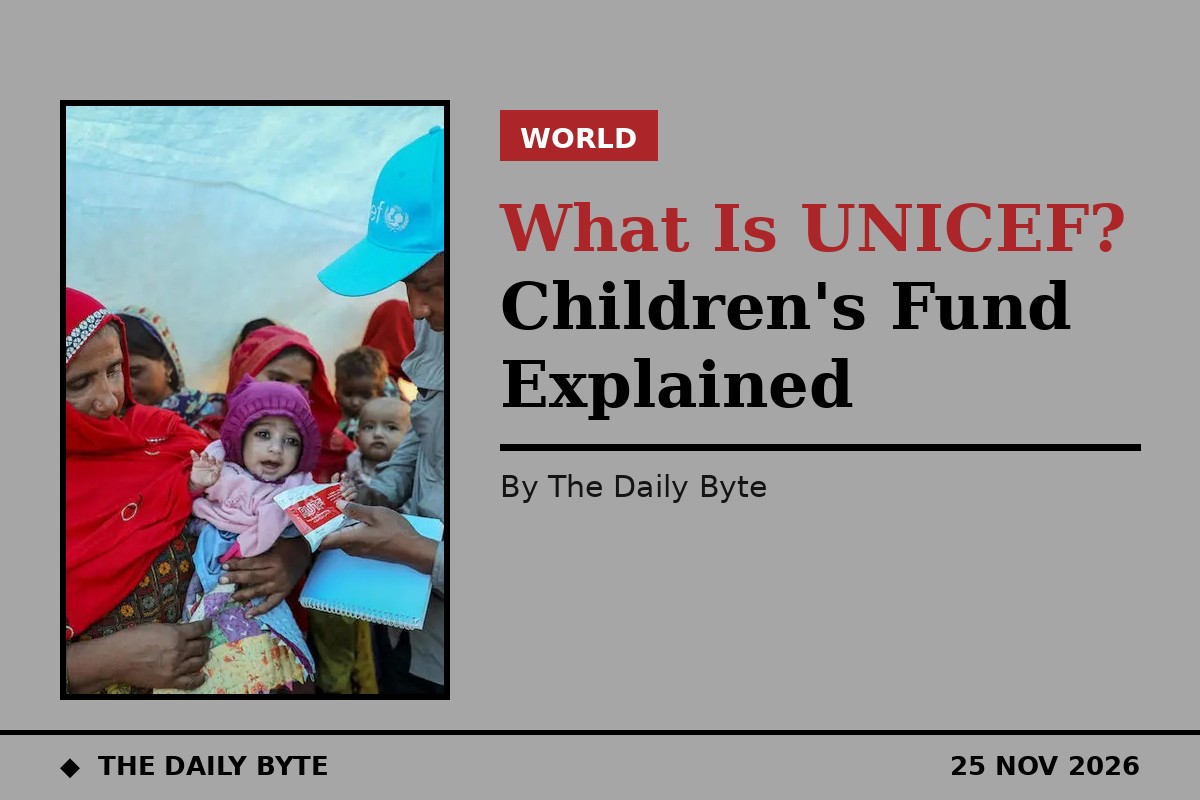
UNICEF is the United Nations Children's Fund, the United Nations agency responsible for providing humanitarian and developmental aid to children around the world. It was created on 11 December 1946, in the aftermath of the Second World War, to provide emergency food and healthcare to children and mothers in countries devastated by the war. Today it works in more than 190 countries and territories, and it is guided by the Convention on the Rights of the Child, the most widely ratified human rights treaty in history.
UNICEF is one of the best-known names in the United Nations system, and its blue logo is familiar from vaccination drives, emergency appeals and school programmes across the world. It is also often misunderstood: it is not a charity in the ordinary sense, it is not funded by the United Nations' regular budget, and it does not run countries' health or education systems. This explainer sets out what UNICEF is, how it began, what it does, how it is run and how it is paid for.
What does UNICEF stand for?
UNICEF originally stood for the United Nations International Children's Emergency Fund. The name was given when the organisation was created by the United Nations General Assembly on 11 December 1946, by resolution 57(I). Its first task was emergency relief: food, medicine and clothing for children and mothers affected by the Second World War, at first mainly in Europe, where an estimated 20 million children were in jeopardy in 14 countries.
In 1950 the General Assembly extended UNICEF's mandate beyond emergency relief to address the long-term needs of children and women, particularly in developing countries. In 1953 UNICEF became a permanent part of the United Nations system, and its name was shortened to the United Nations Children's Fund, although it kept the familiar UNICEF acronym. The organisation is now usually referred to simply as UNICEF, and its full name is the United Nations Children's Fund.
| Date | What happened |
|---|---|
| 11 December 1946 | UN General Assembly creates the United Nations International Children's Emergency Fund |
| 1950 | Mandate extended from emergency relief to long-term needs of children and women in developing countries |
| 1953 | UNICEF becomes a permanent part of the UN system; renamed the United Nations Children's Fund |
| 20 November 1959 | UN adopts the Declaration of the Rights of the Child |
| 1965 | UNICEF receives the Nobel Peace Prize for the promotion of brotherhood among nations |
| 20 November 1989 | UN General Assembly adopts the Convention on the Rights of the Child |
| 2 September 1990 | The Convention on the Rights of the Child enters into force |
| 1 February 2022 | Catherine Russell appointed as UNICEF's eighth Executive Director |
What does UNICEF do?
UNICEF's mandate, set by the UN General Assembly, is to advocate for the protection of children's rights, to help meet their basic needs and to expand their opportunities to reach their full potential. In practice that covers a wide range of work: immunisation and disease prevention, treatment for children and mothers with HIV, childhood and maternal nutrition, improving sanitation, promoting education, and providing emergency relief in response to disasters.
A large part of the work is done through country programmes agreed with host governments. These programmes typically last five years and are designed to develop practical strategies for fulfilling and protecting the rights of children and women in that country. UNICEF also responds to humanitarian emergencies, and in 2018, for example, it responded to 285 humanitarian emergencies in 90 countries. Its work is carried out by country offices around the world, coordinated from its headquarters in New York.
UNICEF is also a major source of data about children. The UN Statistics Division describes it as the world's leading source of statistical data on children, used by more than one million people a year, and the sole or joint custodian for 19 Sustainable Development Goal indicators. That data role is one reason UNICEF's figures on child deaths, vaccination coverage and school attendance are quoted so widely.
What is the Convention on the Rights of the Child?
The Convention on the Rights of the Child is the treaty that guides all of UNICEF's work. It was adopted by the United Nations General Assembly on 20 November 1989, after a decade of negotiations, and entered into force on 2 September 1990. It sets out the civil, political, economic, social and cultural rights of children in 54 articles, covering survival, development, protection from violence and exploitation, and participation in decisions that affect them.
The Convention is the most widely ratified human rights treaty in history. It followed the Declaration of the Rights of the Child, adopted by the General Assembly on 20 November 1959, which first set out children's rights to protection, education, healthcare, shelter and good nutrition. UNICEF's own history page describes the Convention as the basis for all of its work, and the organisation presses governments to ratify it and to pass laws that match it.
Who runs UNICEF, and how is it funded?
UNICEF is governed by a 36-member Executive Board made up of government representatives, which establishes policies, approves programmes and oversees administrative and financial plans. Day-to-day management is led by the Executive Director, who is appointed by the UN Secretary-General. The current Executive Director is Catherine Russell, UNICEF's eighth, who was appointed on 1 February 2022. Before taking the role she served in the White House and as the United States Ambassador-at-Large for Global Women's Issues.
UNICEF relies entirely on voluntary contributions from governments and private donors. It does not receive funding from the United Nations' regular assessed budget. Contributions come from governments, from private donors, and from UNICEF's National Committees, which raise funds and promote children's rights in their own countries. That funding model is why UNICEF runs regular public appeals and why its income rises and falls with donor governments' aid budgets and public giving.
Why is UNICEF in the news in November 2026?
UNICEF remains active in the world's largest children's emergencies, including Gaza and Sudan, where it has warned about children being killed and children at risk of famine. DailyByte reported on 8 November 2026 that UNICEF figures showed 67 children had been killed in Gaza since the ceasefire, and on 10 November that UNICEF had warned about children in Sudan facing drones, drought and hunger. The organisation also works in Pakistan, one of the more than 190 countries and territories where it operates.
In 2026 UNICEF is marking 80 years since its founding, under the banner "For Every Child, Hope". Its own anniversary material notes that the story of UNICEF is the story of how much good can be done when the world unites to protect its youngest and most vulnerable citizens, and that the organisation now brings 80 years of field experience to that work.
Frequently asked questions
Is UNICEF part of the United Nations? Yes. UNICEF is a fund of the United Nations, created by the General Assembly in 1946 and a permanent part of the UN system since 1953. It has its own Executive Board and is headed by an Executive Director appointed by the UN Secretary-General.
What does UNICEF stand for? It originally stood for the United Nations International Children's Emergency Fund. Since 1953 its full name has been the United Nations Children's Fund, but it has kept the UNICEF acronym.
Who is in charge of UNICEF? Catherine Russell, UNICEF's eighth Executive Director, appointed by the UN Secretary-General on 1 February 2022. She oversees the organisation's work for children in more than 190 countries and territories.
Where does UNICEF's money come from? Entirely from voluntary contributions from governments and private donors, including through UNICEF's National Committees. It does not receive money from the United Nations' regular assessed budget.
What is the Convention on the Rights of the Child? A United Nations treaty adopted on 20 November 1989 and in force since 2 September 1990. It sets out children's rights in 54 articles and is the most widely ratified human rights treaty in history. It guides all of UNICEF's work.
Sources: UNICEF, "UNICEF history" and "80 Years of UNICEF. For Every Child, Hope."; United Nations, "UNICEF - United Nations Children's Fund"; UN Statistics Division, UNICEF card.


