What Is UNIFIL? Lebanon Peacekeepers Explained
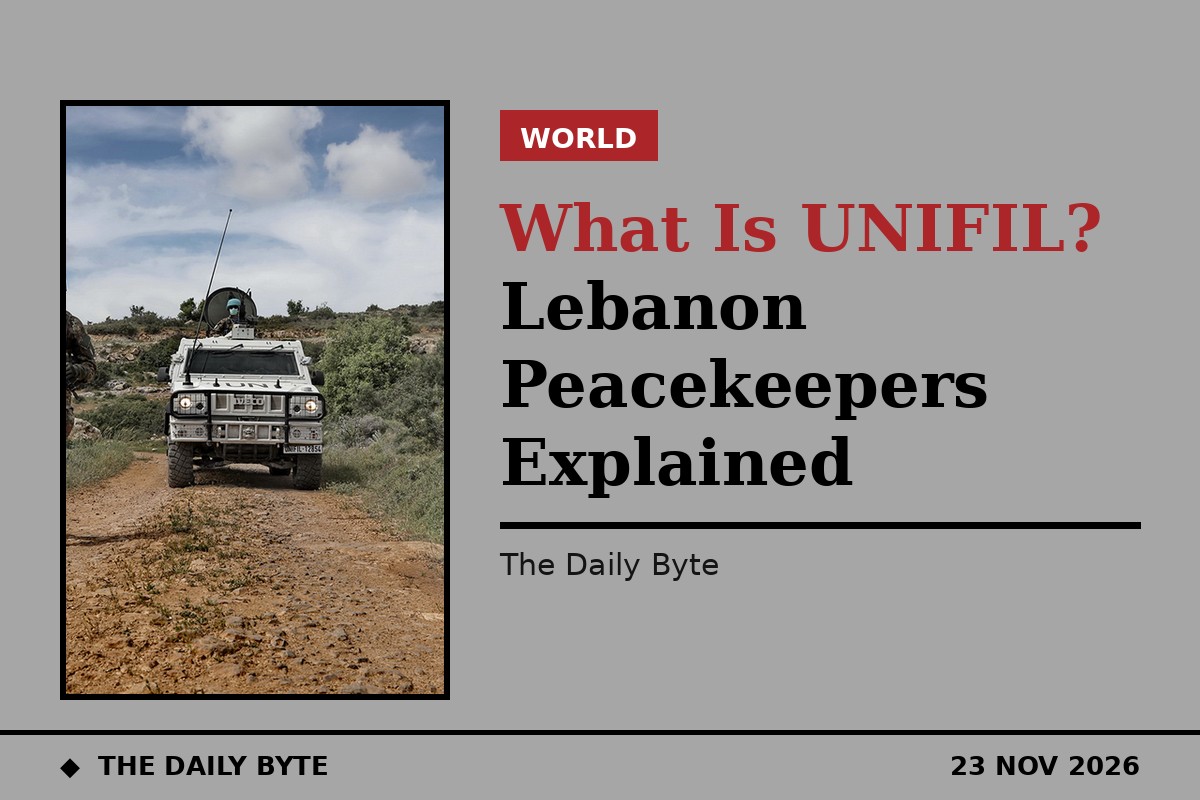
UNIFIL is the United Nations Interim Force in Lebanon, a UN peacekeeping mission that has operated in southern Lebanon since 1978. About 7,500 peacekeepers from 46 countries patrol the Blue Line, the demarcation line between Lebanon and Israel, monitoring the ceasefire and supporting the Lebanese army. Its mandate ends on 31 December 2026, after nearly five decades in the country.
The force is in the news on 23 November 2026 because it has begun handing over its positions in southern Lebanon to the Lebanese army, the first step in a withdrawal that will run through 2027. This explainer sets out what UNIFIL is, why it was created, what it does, and what happens when it leaves.
Why was UNIFIL created?
UNIFIL was established on 19 March 1978 by United Nations Security Council Resolutions 425 and 426, after Israel invaded southern Lebanon during the Lebanese Civil War and at a time of Palestinian insurgency in the south. The first troops deployed on 23 March 1978, drawn from other UN peacekeeping operations in the region. Its original mandate had three tasks: confirm the withdrawal of Israeli forces from southern Lebanon, restore international peace and security, and assist the Government of Lebanon in ensuring the return of its effective authority in the area. It built its headquarters at Naqoura, close to the Lebanese-Israeli border.
The mission's mandate had to be adjusted more than once. Israel invaded Lebanon again in 1982 and maintained a security zone in the south until it withdrew in 2000. UNIFIL then resumed its military tasks along the Blue Line, maintaining the ceasefire through patrols, observation from fixed positions and close contact with the Lebanese Armed Forces, as well as providing humanitarian assistance to local people.
What does UNIFIL actually do?
The force's mandate was greatly expanded after the 2006 Lebanon War by Security Council Resolution 1701, adopted on 11 August 2006. Under that resolution, UNIFIL monitors the cessation of hostilities, accompanies and supports the Lebanese Armed Forces as they deploy through the south, including along the Blue Line, as Israeli forces withdraw, and helps ensure humanitarian access to civilians and the voluntary and safe return of displaced people. It also helps the Lebanese army take steps towards establishing an area between the Blue Line and the Litani River free of armed personnel, weapons and other assets other than those of the Lebanese government and UNIFIL.
Day to day, that means patrols along the Blue Line, manning observation posts and checkpoints, reporting violations to the Security Council, liaising with both sides, and supporting the Lebanese army. UNIFIL also has a naval component, the Maritime Task Force, which assists the Lebanese Navy.
The 2006 expansion transformed the force's size. By July 2006 its strength had dropped to just 1,980 personnel, its lowest point. After the UN-brokered ceasefire it received large reinforcements, up to 15,000 personnel, with heavy equipment. France raised its complement from 400 to 2,000 troops and sent Leclerc main battle tanks, and Italy committed to deploying 3,000 troops. The force has shrunk since then as the security situation changed, to about 7,500 today.
The force was also authorised to make sure its area of operations is not used for hostile activities, to resist attempts by force to stop it carrying out its duties, and to protect civilians under imminent threat of physical violence. As of 2026, UNIFIL is composed of 7,565 personnel from 46 nations, and its budget is $553 million for the 2025–26 financial year.What is the Blue Line?
The Blue Line is the 120-kilometre demarcation line dividing Lebanon from Israel. It is a withdrawal line drawn up by the UN in 2000 to confirm Israel's withdrawal from southern Lebanon, rather than an agreed international border, and parts of it remain disputed. UNIFIL patrols it, monitors it and reports violations of it to the Security Council, and its tripartite meetings bring Lebanese and Israeli officers together with UNIFIL to deal with disputes along the line.
Why is UNIFIL leaving?
On 28 August 2025 the Security Council adopted Resolution 2790, which extended UNIFIL's mandate for a final time, until 31 December 2026, and ordered an orderly and safe drawdown and withdrawal from that date, within one year. The resolution calls for the full implementation of Resolution 1701, including full respect for the Blue Line and a full cessation of hostilities, and for the Lebanese government to become the sole provider of security in southern Lebanon.
The decision to end the mission followed pressure from the United States and Israel, which have accused UNIFIL of failing to contain the militant group Hezbollah. The US and Israel pushed for the mission to be shut down, while France led a diplomatic effort on Lebanon's behalf to extend it. The Lebanese government has warned of a security vacuum as the peacekeepers leave, and has appealed for a new international force. The future of the UN presence in southern Lebanon will depend on decisions by the Security Council.
What happens next?
UNIFIL has begun transferring some of its positions in southern Lebanon to the Lebanese army. Its head of mission, Major General Diodato Abagnara, announced the move during a visit to the southern city of Tyre on Saturday, 21 November, according to Lebanon's National News Agency. He stressed the need to prevent a security vacuum after the mission ends, saying its core work should continue — monitoring and reporting violations, providing humanitarian assistance, protecting civilians and supporting local communities.
Abagnara also described Israel's continued occupation of parts of southern Lebanon as a clear violation of Resolution 1701, and said peacekeepers would carry out their duties until the final day of the mandate. Resolution 2790 calls on Israel to withdraw its forces north of the Blue Line, including from five positions it holds in Lebanese territory. The handover is complicated by the fact that Israeli forces remain in parts of the south while Lebanese forces are absent from some of the same areas. UNIFIL says its personnel will draw down gradually during 2027 rather than leaving all at once, with the aim of avoiding whole areas being left without an international presence.
Frequently asked questions
How many peacekeepers are in UNIFIL?
About 7,500, from 46 countries. As of 2026 the force is composed of 7,565 personnel, including a Maritime Task Force at sea. Indonesia, Italy, India, Ghana, France, Ireland and Nepal are among the troop contributors.
Who commands UNIFIL?
The Head of Mission and Force Commander is Major General Diodato Abagnara of Italy. The mission's headquarters is at Naqoura in southern Lebanon.
When does UNIFIL's mandate end?
On 31 December 2026. Security Council Resolution 2790, adopted on 28 August 2025, was the final extension. UNIFIL is to cease operations on that date and then draw down and withdraw its personnel within one year, during 2027.
Can UNIFIL use force?
UNIFIL is authorised to resist attempts by forceful means to prevent it from discharging its duties, and to protect UN personnel, facilities and equipment, ensure the security and freedom of movement of UN and humanitarian personnel, and protect civilians under imminent threat of physical violence. It is a peacekeeping force, not an army: it monitors, reports and supports the Lebanese army rather than fighting a war.
Sources: UNIFIL: UNIFIL Mandate; United Nations: Security Council Resolution 2790 (2025); AhlulBayt News Agency, citing Lebanon's National News Agency: UNIFIL begins handing over positions.


