What Is UNRWA? Palestine Refugee Agency Explained
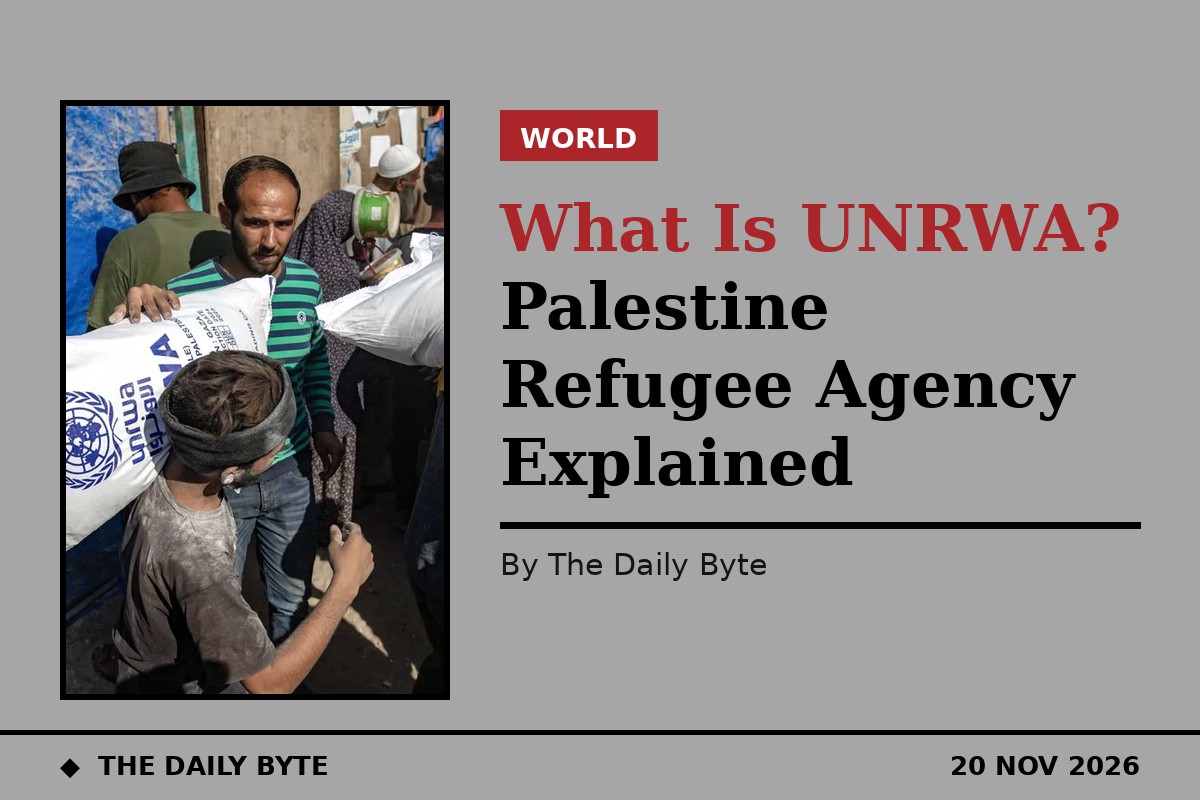
UNRWA is the United Nations agency that provides education, health care and emergency aid to Palestine refugees across the Middle East. Its full name is the United Nations Relief and Works Agency for Palestine Refugees in the Near East, and it is one of the oldest agencies in the United Nations system, created in 1949. It is in the news again after a United Nations General Assembly committee voted on 19 November 2026 to back its operations, with 143 countries in favour, nine against and 20 abstentions. This guide explains what UNRWA is, who it serves, how it is paid for, and why it is so often at the centre of political argument.
The short answer is that UNRWA is a relief and development agency, not a political body. It runs schools and clinics, distributes food and cash assistance, and provides emergency help to registered Palestine refugees and their descendants in five areas: the Gaza Strip, the West Bank including East Jerusalem, Jordan, Lebanon and Syria. It does not decide who is a refugee in the general sense, and it does not negotiate peace settlements. Its job, as set out by the General Assembly, is to provide services until a lasting solution to the refugees' situation is found.
When and why was UNRWA created?
UNRWA was established on 8 December 1949, when the UN General Assembly adopted Resolution 302 (IV). It began operations in May 1950, responding to the needs of about 700,000 Palestinians who had fled or been expelled during the 1948 Palestine war and its aftermath. The agency was set up as a temporary measure. The thinking at the time was that the refugee problem would be resolved quickly, so UNRWA was given a short mandate and told to provide relief and work programmes in the meantime.
That temporary arrangement has now lasted for more than 75 years. Because no lasting political settlement has been reached, the General Assembly has renewed UNRWA's mandate again and again, most recently on a three-year cycle. Each renewal is a vote in the General Assembly, and each one is contested: supporters argue the agency is indispensable to millions of people, while critics, led by Israel and the United States, argue that its existence prolongs the refugee problem rather than solving it.
Who does UNRWA serve?
UNRWA serves registered Palestine refugees, a category that covers Palestinians who fled or were expelled during the 1948 war and subsequent conflicts, together with their descendants. As of 2026, more than 5.9 million people are registered with the agency. That figure has grown from the original 700,000 because refugee status under UNRWA's rules passes down through the generations, including to legally adopted children.
The agency works in 59 recognised refugee camps across its five fields of operation, as well as in towns and cities where large numbers of registered refugees live outside the camps. About a third of registered refugees live in the camps; the rest live in the surrounding communities. The largest refugee populations are in Jordan and Gaza, with substantial numbers also in the West Bank, Lebanon and Syria. UNRWA says its services are available to all registered refugees in its area of operation who need them, regardless of where exactly they live.
What services does UNRWA provide?
Education is UNRWA's biggest programme. The agency runs more than 700 schools, and it is the only UN agency in the world that operates a school system of its own. Hundreds of thousands of children attend UNRWA schools, which follow the curricula of the host authorities and add the agency's own teaching on human rights, tolerance and non-violence. For many refugee families, an UNRWA school is the only route to a formal education.
Health care is the second pillar. UNRWA operates 144 health-care facilities across its five fields, providing primary health care, maternal and child health services, vaccinations and treatment for chronic diseases. In Gaza, where the agency is the largest humanitarian organisation, its clinics and shelters have become a lifeline during the war that began in October 2023. In a letter to the General Assembly in October 2024, the UN Secretary-General noted that UNRWA was providing health services to 1.1 million people and food assistance to 1.9 million people in Gaza, and warned that there was no realistic alternative to the agency that could adequately provide the services required if its operations were halted.
Beyond schools and clinics, UNRWA provides relief and social services, including food parcels and cash assistance for the poorest families, microfinance loans to help refugees start small businesses, vocational training, and emergency assistance during conflicts and natural disasters. It employs more than 30,000 people, most of them Palestinian refugees themselves, which makes it one of the largest employers in the areas where it works.
How is UNRWA funded?
UNRWA is funded almost entirely by voluntary contributions from UN member states. Only a small share of its budget comes from the UN's regular budget, mainly to cover international staffing costs. The United States has historically been its largest single donor, contributing more than 7.3 billion dollars since 1950, and accounting for nearly 30 per cent of donor contributions in 2023. The agency's regular programme budget for 2024 was 880.2 million dollars, with emergency appeals, mainly for Gaza, adding a further 1.6 billion dollars.
That funding model makes UNRWA unusually vulnerable. Governments choose each year whether and how much to give, so a political decision in one capital can remove a large share of the agency's income overnight. In 2025 the agency mobilised about 887 million dollars in confirmed pledges and received 829 million dollars in contributions, but its total requirements reached 3.3 billion dollars, so available income covered only about 27 per cent of what it needed. Two major donors terminated their contributions during 2025, leaving a significant budget deficit.
How is UNRWA different from UNHCR?
People often confuse UNRWA with UNHCR, the UN High Commissioner for Refugees, but they are separate agencies with separate mandates. UNHCR, established in 1950, is the main agency for refugees worldwide, and it covers everyone except the Palestine refugees in UNRWA's five fields of operation. UNRWA was created a year earlier specifically for Palestine refugees, and it is the only UN agency dedicated to one refugee population in one region.
The distinction matters in practice. UNHCR's mandate includes finding durable solutions for refugees, including resettlement in third countries, and it can grant refugee status under international law. UNRWA does not resettle refugees and does not have that protection mandate. It provides services and assistance, and it advocates for refugees' rights, but the question of a permanent solution for Palestine refugees is left to political negotiations between the parties.
Why is UNRWA controversial?
UNRWA has been controversial for most of its history, and the arguments have intensified sharply since October 2023. Israel has long objected to the agency's approach to refugee status, arguing that passing refugee status down through the generations keeps the refugee population growing and sustains claims to a right of return that Israel rejects. Israeli officials have also raised concerns about the content of UNRWA school textbooks and about the neutrality of some of its staff.
The sharpest crisis came in January 2024, when Israel alleged that 12 UNRWA employees had taken part in the 7 October 2023 attacks. The agency's Commissioner-General at the time, Philippe Lazzarini, dismissed the implicated employees and ordered an investigation, while the United States suspended further funding pending a review. Sixteen UN member states paused their funding in the weeks that followed. The UN's Office of Internal Oversight Services examined 19 employees in total and concluded in August 2024 that evidence indicated nine of them may have been involved, and their employment was terminated. In the other ten cases, the evidence was absent or insufficient to support the allegations.
Most donors that had paused funding resumed it during 2024, but the United States did not. Congress enacted a prohibition on US funding for UNRWA in March 2024, and as of November 2025 the American pause remained in place. Then, on 28 October 2024, Israel's parliament, the Knesset, adopted two laws: one ended the 1967 exchange of letters between Israel and UNRWA and barred Israeli state authorities from having any contact with the agency, and the second prohibited UNRWA from conducting any activity within Israel's sovereign territory. Both laws took effect on 30 January 2025, and a further amendment followed in December 2025.
What did the International Court of Justice say?
The dispute reached the International Court of Justice, the UN's highest court. In December 2024 the General Assembly asked the court for an advisory opinion on Israel's obligations towards the UN and other international organisations in the occupied Palestinian territory. The court delivered its opinion on 22 October 2025, ruling by 10 votes to 1 that Israel is obliged to facilitate humanitarian relief by UNRWA and other organisations, and must refrain from impeding that relief. The court also found that Israel must co-operate in good faith with the United Nations, including UNRWA, and respect the privileges and immunities of UN agencies.
Israel's foreign ministry said it categorically rejected the opinion, arguing that the court had ignored evidence it presented about UNRWA's alleged infiltration. The General Assembly, for its part, adopted a resolution on 12 December 2025 welcoming the advisory opinion and affirming its findings. Advisory opinions are not binding in the way a court judgment is, but they carry significant legal and political weight, and the dispute over how the opinion applies to the Israeli legislation remains unresolved.
What happened on 19 November 2026?
The latest chapter came in the General Assembly's Fourth Committee, which handles special political and decolonisation matters. On Wednesday 19 November 2026, the committee adopted four resolutions on Palestine and the occupied Syrian Golan. The resolution on UNRWA's operations was adopted by 143 votes in favour, nine against and 20 abstentions. The countries voting against were Argentina, Fiji, Israel, Micronesia, North Macedonia, Palau, Paraguay, Tonga and the United States.
A second UNRWA-related resolution, on Palestine refugee properties and their revenues, passed with 155 votes in favour, nine against and nine abstentions, the highest level of support in the set. The committee also adopted a resolution on Israeli practices and settlement activities by 143 votes in favour, 11 against and 17 abstentions, and a fourth resolution on the occupied Syrian Golan. The measures now go to the full General Assembly for final consideration in December.
What happens next for UNRWA?
The committee vote keeps UNRWA's mandate on track for renewal, but it does not solve the agency's funding crisis. With requirements of 3.3 billion dollars in 2025 and only about a quarter of that covered, UNRWA has warned repeatedly that it may have to cut services, including schooling and health care, unless donors step in. The loss of American funding, which once supplied nearly a third of its income, has left a hole that other donors have only partly filled.
For the refugees themselves, the practical question is simpler than the politics: whether the schools open, the clinics stay stocked and the food distributions continue. UNRWA has survived for 76 years on the argument that it is the only body capable of delivering those services at scale in Gaza, the West Bank, Jordan, Lebanon and Syria. Its critics argue that the agency itself is part of the problem. That argument, unresolved since 1949, is why a vote about a relief agency still draws 143 countries to one side and nine to the other.


